On 28 April 2026, the United Arab Emirates announced it will leave OPEC and OPEC+ effective 1 May. The move ends nearly six decades of membership and removes the production quotas that have constrained UAE oil output for years. While the headlines have focused on the geopolitical drama, the more important question for Dubai property investors is narrower and far more actionable: what does the UAE’s OPEC exit mean for Dubai real estate?
This analysis sets out the cause-and-effect chain in detail – from the Fujairah pipeline that lets the UAE bypass the Strait of Hormuz, through the sovereign revenue uplift, to the direct impact on Dubai property prices, infrastructure spend, and the investor entry window through 2026 and 2027.
1. What Just Happened: The UAE Walks Away From OPEC
The UAE’s exit from OPEC and OPEC+ takes effect on 1 May 2026. The decision was unilateral. According to reporting from Bloomberg and The National, Saudi Arabia – OPEC’s de facto leader was not consulted. The exit is the culmination of years of friction between Abu Dhabi and Riyadh over production quotas, regional strategy, and economic competition.
Three drivers converged to make the move possible now:
- The Iran war and the Strait of Hormuz crisis. Iran’s blockade of the strait – through which roughly 20% of global oil normally flows – made it untenable for the UAE to honour OPEC commitments while its export routes were under fire from a fellow OPEC member.
- Production ambition. The UAE has set a target of 5 million barrels per day (bpd) of capacity by 2027. OPEC quotas had restricted output to roughly 3.2 million bpd. The cartel was blocking the UAE from approximately 1.8 million bpd of its own potential.
- Strategic divergence from Saudi Arabia. A quiet but deepening rivalry over Yemen, the Red Sea, and broader Gulf leadership has been building for years. The OPEC exit formalises UAE strategic independence.
| “The time has come to focus our efforts on what our national interest dictates.”— UAE ENERGY MINISTRY, 28 APRIL 2026 |
2. The Fujairah Pipeline: Why the UAE Doesn’t Need OPEC Anymore
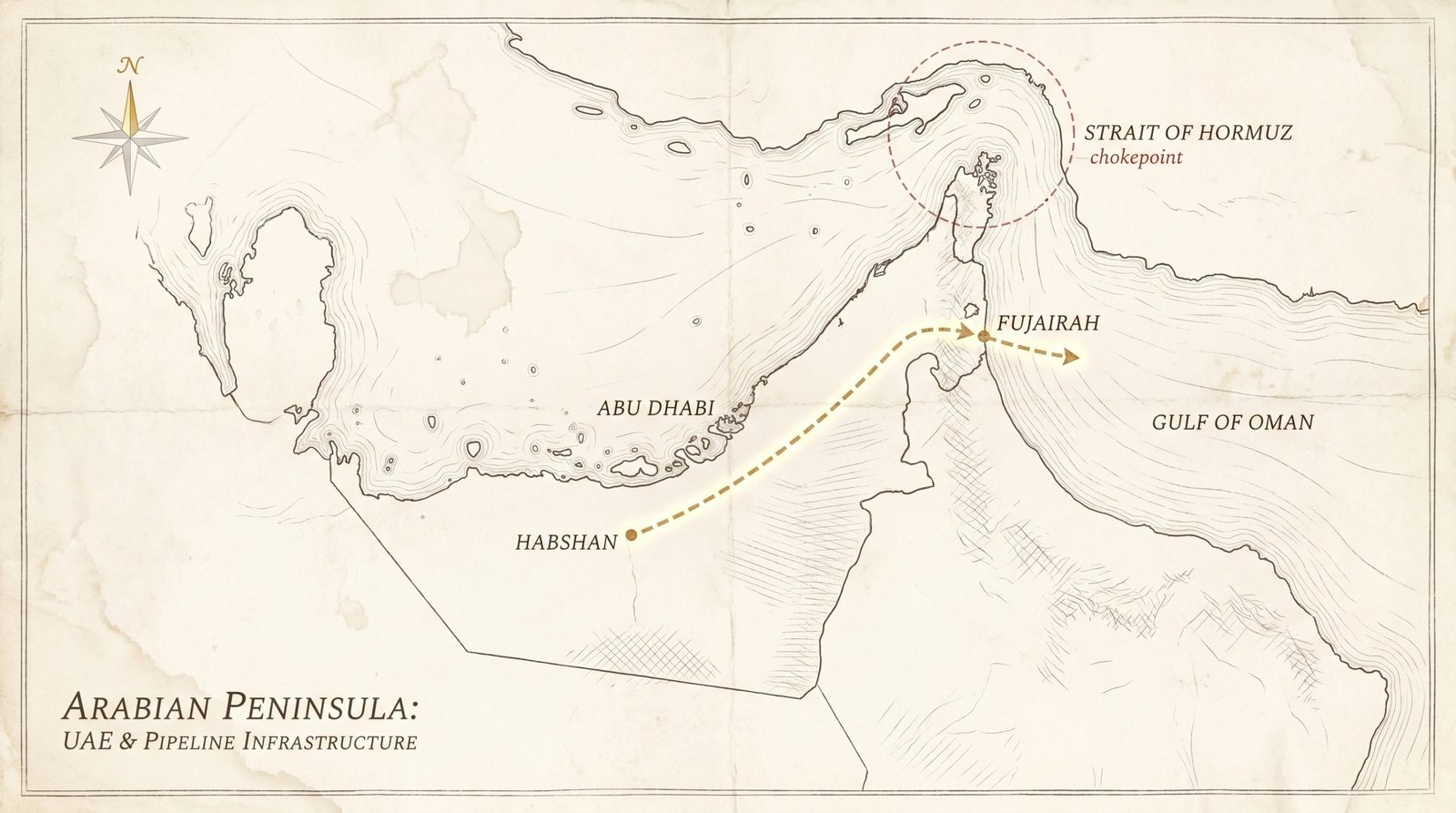
The single most under-discussed piece of infrastructure in this story is the Habshan–Fujairah pipeline. It runs roughly 248 miles from onshore oil facilities at Habshan, in Abu Dhabi, east across the country to the Fujairah export terminal on the Gulf of Oman. Crude exported via Fujairah never enters the Strait of Hormuz.
This matters for two reasons. First, it gives the UAE genuine strategic independence – Iran’s leverage over the Strait of Hormuz cannot fully strangle UAE oil exports. Second, it makes the OPEC exit operationally credible. The UAE can now ramp production toward its 5 million bpd target and physically deliver the additional barrels to global markets, even with the strait under pressure.
Pipeline capacity in numbers
| METRIC | CURRENT | NOTES |
|---|---|---|
| Habshan–Fujairah capacity | 1.5–1.8M bpd | Hormuz-free export capacity |
| UAE production (under quota) | 3.2M bpd | OPEC ceiling pre-exit |
| UAE current capacity | 4.85M bpd | ADNOC reported, 2025 |
| UAE 2027 capacity target | 5.0M bpd | Backed by $150B ADNOC capex |
John Spencer of West Point’s Modern War Institute argued in an April 2026 Washington Post op-ed that the long-term answer to Iran’s chokepoint leverage is to build enough infrastructure to make the Strait of Hormuz strategically irrelevant. The UAE’s exit from OPEC, paired with the Fujairah pipeline, is the most concrete step any Gulf state has taken consistent with that doctrine.
3. How UAE Oil Capacity Translates Directly Into Dubai Real Estate
The link between UAE oil capacity and Dubai property is not abstract. It moves through three concrete channels.
Channel 1 — Sovereign revenue and infrastructure spend
ADNOC’s revenue base is in the order of $100 billion per year at current prices. Adding 1.5–1.8 million bpd of unconstrained production at sustained Brent levels translates into tens of billions of dollars of additional annual revenue. ADNOC has committed $150 billion in capex through 2027. That capex flows into UAE infrastructure, services, jobs, and population growth – all of which structurally support Dubai property demand.
Channel 2 — Population growth and rental demand
Sustained oil revenue funds the immigration-driven growth model Dubai has run for the past two decades. Every percentage point of population growth feeds directly into rental yields and end-user property demand. Knight Frank’s 2026 outlook for Dubai assumes continued net inward migration as the central support for the residential market.
Channel 3 — Sovereign confidence signal to international investors
Leaving OPEC is read by international capital allocators as a confidence move, not a retreat. It signals that the UAE believes its production economics work without cartel support. That signal materially reduces the perceived sovereign risk premium on UAE real estate – which is a meaningful component of how non-resident buyers price entry into the Dubai market.

4. Dubai Property Market in 2026: What the Data Shows
Even before the OPEC announcement, the Dubai property market was running hot. Q1 2026 transactions reached Dh252 billion, up 31% year-on-year by value, with foreign investment up 26%. The market has absorbed the regional war without breaking – a pattern consistent with every prior Gulf crisis since 2003.
Q1 2026 — Dubai market snapshot
| METRIC | VALUE | YOY |
|---|---|---|
| Total transaction value | Dh252 billion | +31% |
| Total transactions | 60,303 | +6% |
| Foreign investment value | Dh148.35 billion | +26% |
| Foreign investments (count) | 48,445 | +11% |
| Knight Frank 2026 price forecast | +8–12% | Moderating from +12–22% |
Knight Frank’s full-year 2026 forecast for Dubai residential is +8–12% — a deliberate moderation from the +12–22% recorded in 2024 and 2025, reflecting roughly 120,000–150,000 new units expected to come online, not weakness in demand. Moody’s flags this supply wave as the principal downside risk to prices in 2026, not geopolitics.
5. What This Means for International Property Investors
For non-resident investors, the OPEC exit changes the framing of the Dubai opportunity in three ways.
The fundamental case is stronger, not weaker
The dominant narrative around the UAE this week is risk. The data argues the opposite. Uncapped production, Hormuz-free export infrastructure, $150 billion in committed sovereign capex, and a property market that grew 31% during a regional war – those are not risk indicators. They are confidence indicators.
The entry window is narrower than it looks
Sentiment is currently cautious. International buyers are waiting for clarity on the Iran war, the Strait of Hormuz, and the practical implications of the UAE’s OPEC exit. That hesitation creates a temporary gap between the underlying fundamentals and current pricing. Historically, those gaps close quickly once headline risk fades. The window is real but short.
Asset selection matters more in 2026 than in 2025
With 120,000+ new units coming and prices already elevated, this is not a market for indiscriminate buying. Prime areas (Palm Jumeirah, Downtown, Dubai Hills, Emirates Hills) and tier-one developers (Emaar, DAMAC, Aldar, Sobha) are the structural beneficiaries. Mid-market and far-out master communities are most exposed to the supply wave. Selectivity is the difference between average and outsized returns through 2027.
6. The Risks Every Investor Should Watch
An honest analysis requires naming the downside scenarios. Three matter most.
- Prolonged Hormuz closure. If the strait remains effectively closed past Q3 2026, distress in UAE real estate bonds — already documented by Bloomberg in March 2026 — could spread into developer balance sheets and off-plan deposits. The Pakistan-mediated peace proposal is the catalyst to watch.
- Supply absorption. 120,000–150,000 new Dubai units in 2026 is a real test. If absorption underperforms, the +8–12% Knight Frank forecast slides toward flat or negative for mid-market segments.
- Oil price reversal. If Brent moves materially lower as additional UAE supply hits the market post-2027, the sovereign revenue uplift narrows. The base case still works at $70 Brent; the bull case requires $80+.
7. Frequently Asked Questions
Why did the UAE leave OPEC?
The UAE left OPEC and OPEC+ effective 1 May 2026 to remove production quotas that had capped its output at roughly 3.2 million barrels per day, well below its 5 million bpd 2027 target. The decision was also a response to the strategic vulnerability exposed by the Iran war and Strait of Hormuz crisis.
How does the UAE OPEC exit affect Dubai real estate?
The exit is structurally positive for Dubai real estate. Uncapped UAE production translates into higher sovereign revenue, which funds infrastructure and services, supports population growth, and reinforces investor confidence — all of which underpin property demand and pricing.
What is the Fujairah pipeline?
The Habshan–Fujairah pipeline is a 248-mile crude oil pipeline that moves UAE oil from inland production fields to the Fujairah terminal on the Gulf of Oman, bypassing the Strait of Hormuz entirely. Its capacity is 1.5–1.8 million barrels per day.
Will Dubai property prices rise in 2026?
Knight Frank forecasts +8–12% Dubai residential price growth in 2026, moderating from +12–22% in 2024–2025. The moderation is driven by new supply, not weakening demand. Prime segments are expected to outperform.
Is now a good time to invest in Dubai property?
Asset-by-asset selection matters more in 2026 than in prior years because of incoming supply. Prime areas and tier-one developers remain the strongest structural plays. The current sentiment caution creates a narrow but real entry window before headline risk normalises.
Final Take
The UAE’s OPEC exit is not an isolated geopolitical event. It is the formal start of a new chapter in which the UAE produces and sells more oil on its own terms, exports through routes that reduce Hormuz dependence, and channels the resulting revenue into Dubai’s economy and infrastructure. For international property investors, the practical implication is straightforward: the fundamentals supporting Dubai real estate just got stronger overnight, and the market hasn’t fully priced it in yet.