Dubai doesn’t build infrastructure for the city it is. It builds infrastructure for the city it plans to become.
When the Burj Al Arab opened in 1999, it served a Dubai of roughly 862,000 people. The Red Line opened in 2009 for a Dubai of 1.8 million. The Expo 2020 site was designed for a Dubai of around 3.3 million. And today, as Sheikh Mohammed bin Rashid announces the Dubai Metro Gold Line, the city sits at roughly 3.8 million residents and the Gold Line is being built for a Dubai of 5.8 million.
That single fact reframes everything about the announcement. The Gold Line isn’t a commuter line. It’s a blueprint for where and how Dubai grows between now and 2040.
This guide walks through that blueprint in full: the hard facts of the project, the 2040 plan sitting behind it, the 15 strategic areas it serves, the three most consequential stations (Business Bay, Meydan, Jumeirah Golf Estates), the 55-plus developments already pinned to the corridor, and the moves the next decade almost certainly brings with it.
How to read this guide
The Gold Line is a layered story. To avoid the trap of treating it as a single headline, it helps to keep five frames in mind as you read:
- Scale frame: the line is sized for the Dubai of 2040, not today. Capacity, station depth and development allocation all assume roughly 5.8 million residents.
- Corridor frame: each of the 18 stations sits inside a distinct neighbourhood archetype, heritage, financial, middle-corridor, emerging, creative, or premium western.
- Hub frame: Business Bay becomes Dubai’s first true triple-mode super-hub, combining Red Line, Gold Line and Dubai Canal access.
- GCC frame: Meydan and Jumeirah Golf Estates plug the Gold Line directly into Etihad Rail, effectively integrating Dubai and Abu Dhabi into a single rail market.
- Sequence frame: the Gold Line is phase one. The Blue Line, already drawn on the 2032 rail plan, is phase two. This is a decade of announcements, not a one-off event.
The Gold Line, in five lines
Before zooming out, the essential facts of the project in one place:
| Metric | Detail |
|---|---|
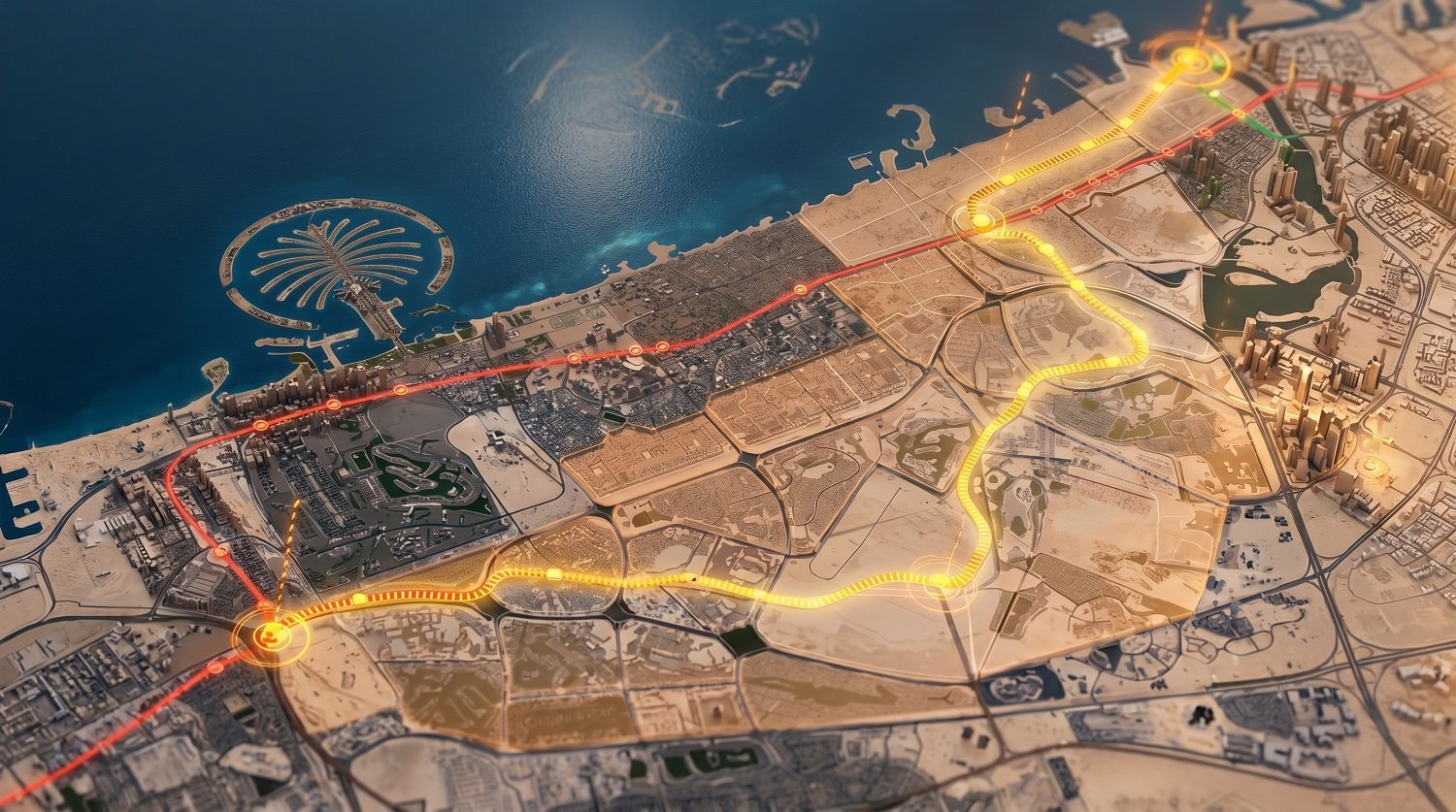
| Route | Al Ghubaiba (Bur Dubai) to Jumeirah Golf Estates |
| Length | 42 kilometres, fully underground |
| Stations | 18 subterranean stations, averaging ~40 metres depth |
| Investment | AED 34 billion |
| Opening date | 09 September 2032 |
| Interchanges | Red Line (Business Bay), Green Line (Al Ghubaiba), Etihad Rail (Meydan and Jumeirah Golf Estates) |
| Developments served | 55+ active or planned real estate projects along the corridor |
| Strategic areas | 15 zones spanning heritage, business, residential, creative and premium districts |
Those numbers are the headline. The story underneath them is more interesting, because every one of those data points was reverse-engineered from Dubai’s own population, economic and urban-planning targets for 2040.
The 2040 Urban Master Plan is the real story
The Gold Line is a single chapter in Dubai’s 2040 Urban Master Plan — a city-level blueprint that forecasts a population of 5.8 million by 2040, up from roughly 3.8 million today. That’s an additional 2 million residents in about 15 years, an increase roughly equivalent to the current population of Paris.
You cannot physically fit 5.8 million residents into Dubai on today’s transit infrastructure. Road congestion becomes untenable, air-quality targets slip, and the D33 economic agenda(Sheikh Mohammed’s programme to double Dubai’s GDP by 2033) becomes harder to hit. The Gold Line exists because Dubai’s growth model requires it to exist.
The 2040 plan also sets specific urban targets the Gold Line directly supports: raising the share of public beaches by 400%, adding 60% more natural parks and reserves, and moving 55% of the population within 800 metres of mass-transit hubs. That last target is the one that quietly drives metro planning. Every new station is effectively a zoning decision, a signal to developers, municipalities and infrastructure agencies about where the next decade of density gets allocated.
In infrastructure terms, the Gold Line is a spine. The 18 stations are vertebrae. The 55+ developments it serves are the body of work around it. And the 2040 Urban Master Plan is the skeleton underneath.
The Gold Line is not a commuter line. It is a zoning instrument for the Dubai that will exist in 2040.
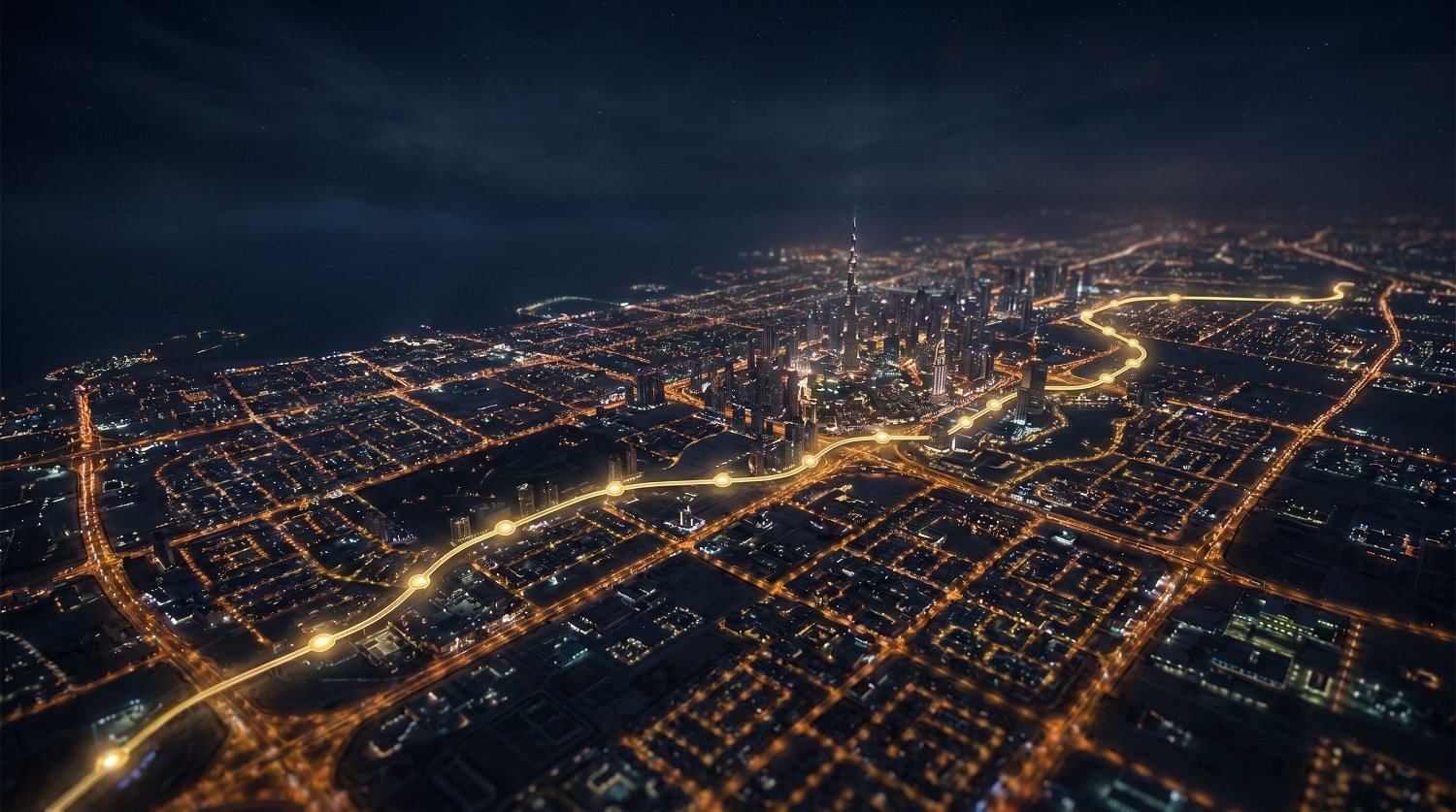
The 15 strategic areas, decoded
The official announcement references 15 strategic areas. Translated into neighbourhood terms, those areas fall into six clear zones — each sitting at a different point on Dubai’s growth curve.
| Zone | Key stations | What changes in 2032 |
|---|---|---|
| Heritage & historic core | Al Ghubaiba, Bur Dubai, Al Satwa, Zabeel | Two-line interchange at Al Ghubaiba. Heritage investment, adaptive reuse, boutique hospitality. |
| Business & Downtown belt | Business Bay, Al Merkadh, Meydan | Business Bay becomes a triple-mode super-hub. Meydan becomes a Dubai–Abu Dhabi commuting base. |
| Middle corridor | Al Quoz, Al Barsha South, Dubai Hills | Dubai’s creative and mid-market heartland gets its first full metro access. |
| Emerging residential clusters | JVC, Dubai Sports City | Category-changing relief for two of the fastest-growing, previously transit-poor communities. |
| Media & tech belt | Dubai Studio City, Dubai Production City | Specialist clusters get a direct spine into Downtown and Business Bay. |
| Western premium | Tilal Al Ghaf-adjacent, Jumeirah Golf Estates | JGE becomes the western Etihad Rail anchor – a luxury district with GCC reach. |
Walk the line from east to west and the pattern becomes obvious: the Gold Line stitches together Dubai’s heritage core, its financial heart, its middle corridor, its emerging belt, its creative / tech cluster and its premium western frontier. Each of those Dubais currently operates semi-independently. By 2032, they operate as a single city, with one spine running through them.
1. Al Ghubaiba — heritage meets modernity
Today, Al Ghubaiba is Dubai’s oldest commercial district: dense, lived-in, and already a Green Line terminus. In 2032 it becomes the eastern Gold Line terminus and a rare two-line interchange in Old Dubai. Expect renewed investment across the heritage zone – adaptive reuse of historic buildings, boutique hotels, and the first serious push to reconnect Bur Dubai’s waterfront to the rest of the city.
2–4. Bur Dubai, Al Satwa, Zabeel — the connective tissue
Historic, fragmented, and under-invested relative to their neighbours today. The Gold Line rewires this belt into an easy connector between Deira, Downtown and the coast. Watch for mid-rise redevelopment, especially around Al Satwa, which currently sits in an infrastructure gap right next to some of Dubai’s most desirable real estate.
5. Business Bay — Dubai’s first triple-mode super-hub
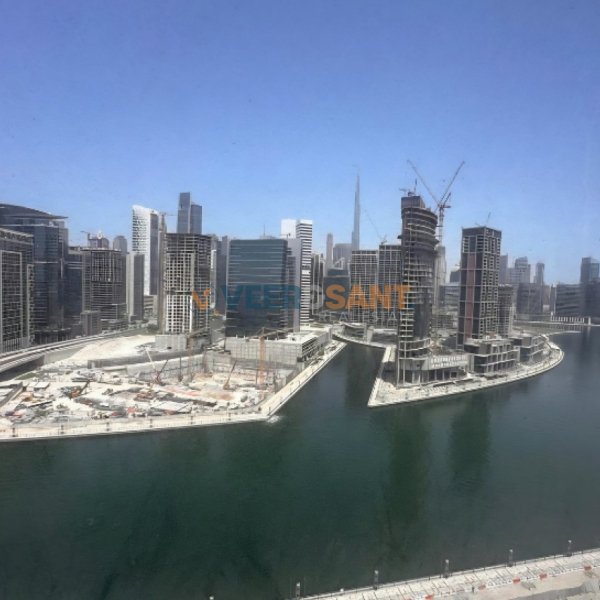
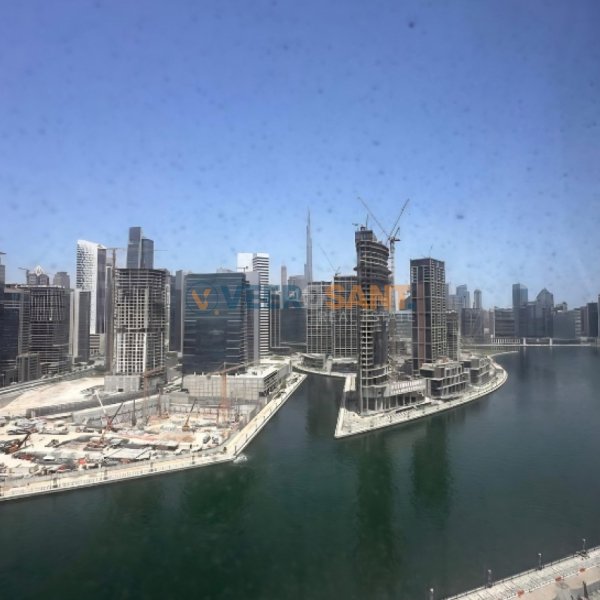
Business Bay is already one of Dubai’s most liquid commercial and residential districts and is served by the Red Line today. On opening day in 2032, it becomes the single most connected station on the entire network.
6–7. Al Merkadh and Meydan — the Etihad Rail turning point
Today, both are lifestyle-led: Meydan known for the racecourse, Al Merkadh quietly becoming a premium residential cluster in its shadow. In 2032, Meydan becomes Dubai’s first Gold Line + Etihad Rail interchange. Abu Dhabi is a direct ~60-minute ride, no above-ground transfer. This is arguably the single biggest neighbourhood upgrade in the entire announcement — going from “premium suburb” to “GCC-integrated transit node.”
8–9. Al Quoz and Al Barsha South — the middle corridor wakes up
Al Quoz is Dubai’s creative and light-industrial district; Al Barsha South is a mid-market residential cluster. Both currently function without direct metro access. In 2032, Al Quoz’s gallery, workshop and studio ecosystem gains the commuting infrastructure needed to scale, while Al Barsha South (one of the largest metro-less residential zones in Dubai) jumps an entire tier in liveability and price ceiling.
10. Dubai Hills — the established wins again
Dubai Hills is already one of Emaar’s flagship communities and did not, strictly speaking, need the boost. It gets one anyway. The premium density of the area increases, pulling additional retail, F&B and healthcare anchor tenants into the zone.
11–12. JVC and Dubai Sports City — the emerging belt
Two of Dubai’s fastest-growing mid-market residential zones, both currently underserved by transit. This is the corridor where the proportional shift is largest – dense populations, young demographics, and chronic traffic into Sheikh Zayed Road. Metro access here isn’t incremental; it’s category-changing.
13–14. Dubai Studio City and Dubai Production City — the creative / tech belt
Specialist clusters (media, production, tech-adjacent) that currently function as semi-isolated pockets. In 2032, they plug directly into the Downtown / Business Bay core. Expect talent attraction and retention for these clusters to improve meaningfully once the commute math works, a 25-minute ride to Business Bay is a different proposition from a 50-minute drive.
15–17. Tilal Al Ghaf-adjacent to the Jumeirah Golf Estates approach
Premium master-planned communities at Dubai’s western edge. Today, they are effectively “drive-only” zones. In 2032 they are pulled back into the transit grid. High-end residents gain a metro option; short-term rental operators gain a new pitch to international visitors arriving via the Red Line from the airport.
18. Jumeirah Golf Estates — the western Etihad Rail anchor
A luxury golf community today; the Gold Line’s western terminus and an Etihad Rail interchange tomorrow. Jumeirah Golf Estates residents wake up in 2032 with seamless access to Business Bay in roughly 35 minutes and to central Abu Dhabi in around 90 minutes — all on a single underground journey with one transfer at the same station.
Business Bay: Dubai’s first triple-mode super-hub
Among the 18 stations, one quietly becomes the most important point on Dubai’s entire transit map: Business Bay.
On opening day, Business Bay will be the only Dubai station with access to:
- The Red Line, already operating and serving DXB airport and the Marina corridor
- The Gold Line, new as of 2032
- The Dubai Canal and its marine transit network
- Direct walking access to Downtown Dubai, Burj Khalifa and Dubai Mall
No other node in the 2032 network plan offers that combination. It is Dubai’s first true triple-mode super-hub. Historically, the arrival of interchange density of this kind has reshaped surrounding real estate for a generation, King’s Cross in London, Shinjuku in Tokyo, and Fulton Center in New York are all useful reference points.
In each of those cases, office vacancy compressed, residential rents re-rated, and new mixed-use towers clustered within a 400-metre radius of the interchange. Business Bay, which is already one of the most liquid commercial markets in the region, enters the 2030s with that same structural tailwind.
By 2032, Business Bay is no longer just a Dubai neighbourhood. It is the most connected square kilometre in the Gulf.
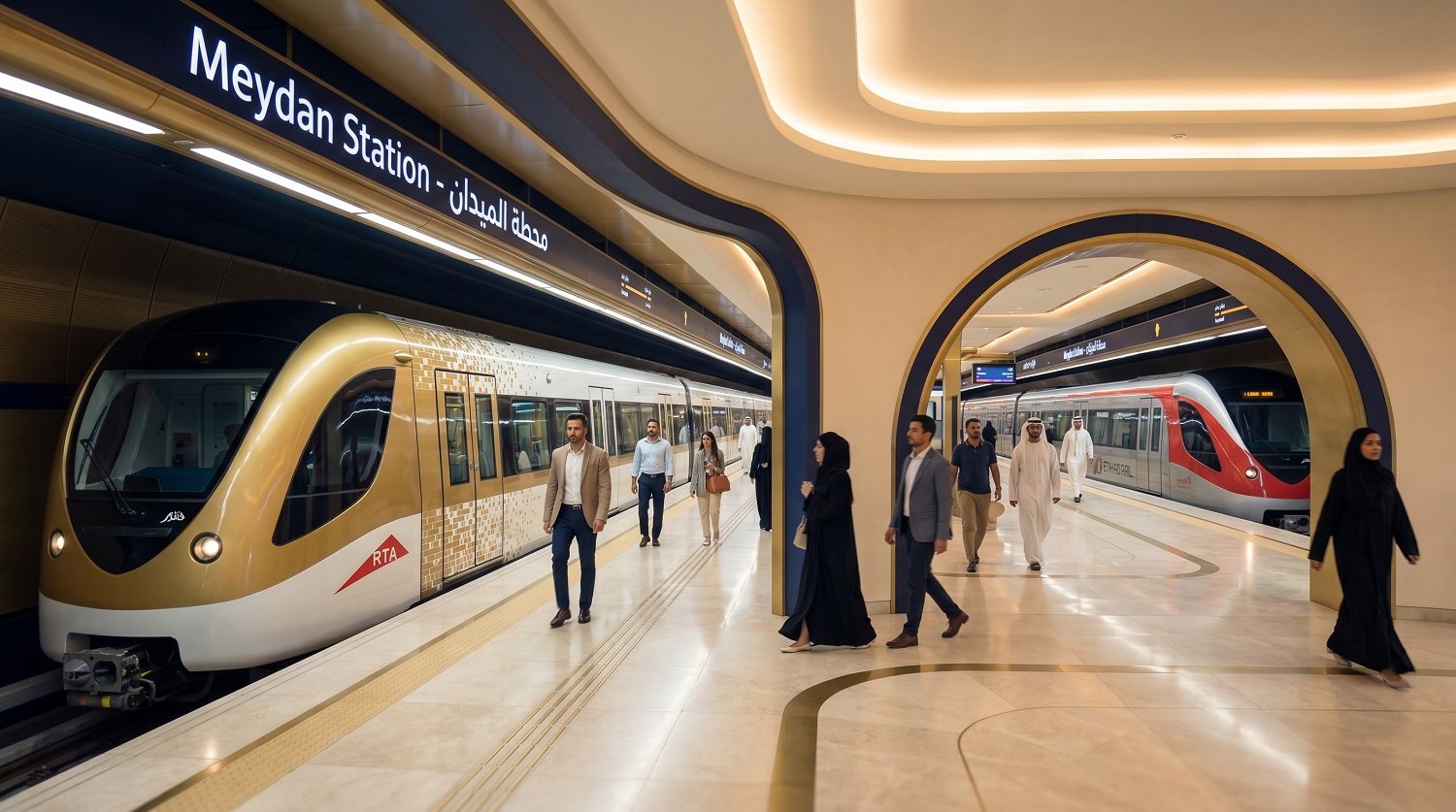
Meydan and Jumeirah Golf Estates: from lifestyle to GCC-connected
Another detail almost nobody is covering loudly enough: Meydan and Jumeirah Golf Estates will both have Etihad Rail interchange stations.
Etihad Rail is the UAE’s federal rail network, designed to connect Abu Dhabi, Sharjah, Fujairah and the Northern Emirates on a single system with design speeds of up to 200 km/h. Its passenger service is engineered to move between Abu Dhabi and Dubai in roughly 60 minutes.
When the Gold Line opens in 2032, a resident of Meydan or Jumeirah Golf Estates will be able to board a Gold Line train, transfer to Etihad Rail at the same station without surfacing, and arrive in central Abu Dhabi in around 60 minutes. Door-to-door, that is a Business Bay to central Abu Dhabi trip in roughly 90 minutes by rail only. Today, the same journey at peak hours can easily take 2–2.5 hours by road.
That single change has a cascade of effects:
- Workers gain a new commute option. Abu Dhabi-based professionals with family or a second home in Dubai suddenly have a viable daily commute. The same is true in reverse.
- Employers gain a wider talent pool. A Business Bay tech employer can hire from Abu Dhabi without relocation friction. An Abu Dhabi government entity can recruit from Dubai without losing candidates to the drive.
- Tourism flows re-route. International visitors flying into Dubai can day-trip Abu Dhabi’s cultural district (Louvre Abu Dhabi, Saadiyat) with a fraction of the logistics friction they face today.
- Real estate demand profiles shift. Meydan and Jumeirah Golf Estates reprice from Dubai-premium lifestyle districts to inter-emirate transit hubs. Their addressable demand pool widens from the Dubai workforce to the entire UAE workforce.
- The GCC logic improves. Beyond the UAE, Etihad Rail has public ambitions to connect into the Saudi rail network. Combined with the wider GCC Railway programme, this opens a potential direct rail spine between Dubai and Riyadh on a longer horizon.
In global terms, this is the UAE’s Shinkansen moment — the equivalent of what Tokyo–Osaka did when the bullet train cut that journey to two hours in 1964 and quietly reshaped Japan’s economic geography for the next 60 years.
The corridor already has 55+ developments planned
The RTA’s own materials confirm the Gold Line serves more than 55 development projects, most already under construction or in late-stage planning. You do not put 55 major developments along a corridor by coincidence. The route is the result of reverse-engineering Dubai’s growth plan: where are the largest 2025–2035 developments, and how do we connect them efficiently?
On announcement day, every one of those 55 developments gained a structural tailwind. Not a speculative one – a structural one. They now sit on a transit spine that the city has committed AED 34 billion to deliver.
From a practical standpoint, that also tells you where early-mover developer activity is most likely:
- Emerging clusters with the largest proportional uplift — JVC, Al Barsha South, Dubai Sports City, Dubai Studio City.
- Premium districts gaining GCC-scale connectivity — Meydan, Al Merkadh, Jumeirah Golf Estates, Tilal Al Ghaf-adjacent.
- Established hubs adding interchange density — Business Bay above all, followed by Al Ghubaiba and Dubai Hills.
Construction, engineering and why the line is fully underground
Every one of the 18 Gold Line stations will be subterranean, averaging roughly 40 metres depth. That is a deliberate engineering and planning choice, not a quirk of the route.
Running the line underground preserves Dubai’s above-ground streetscape, avoids permanent loss of developable land, and keeps construction disruption concentrated at station boxes rather than along the full 42 km. It also future-proofs the corridor: overground rail is constrained by surrounding development, while underground alignment is independent of what gets built above it. On a 15-year horizon, that flexibility matters.
The depth itself is a clue to where Dubai expects density to go. A 40-metre station box assumes heavy vertical development directly above it – towers, podium retail, basement parking and district cooling all integrated into the station envelope. Do not be surprised, between now and 2032, to see master-plan updates for zones around Gold Line stations that increase permitted height, density and mixed-use allocation.
What comes after the Gold Line
The 2032 Dubai Rail Network Plan already shows four coloured lines on the map: Red, Green, Blue and Gold. The Blue Line (serving the International City / Dubai Academic City / Silicon Oasis corridor) is not yet under construction, but it is already drawn and publicly referenced.
Read the announcement sequence correctly and the pattern becomes clear: Gold Line this decade, Blue Line next. Dubai’s metro expansion isn’t a one-off. It’s a 15-year programme, of which the Gold Line is phase one.
By 2035, Dubai’s rail network is planned to exceed 160 kilometres with around 85 stations. By 2040, the emirate will have grown to 5.8 million residents. By 2033, the D33 agenda targets a doubled GDP. These dates are not isolated, they describe a single integrated plan, and the Gold Line is the piece of it you can see most clearly today.
Key dates and what to watch
| Year | Milestone |
|---|---|
| 2026 | Gold Line publicly announced. Expect early tender activity for tunnelling contracts and station packages. |
| 2026–2027 | Early-mover off-plan launches along JVC, Al Barsha South, Al Quoz, Dubai Studio City. |
| 2027–2029 | Peak construction. Station-level land-use plans and retail concessions begin to firm up. |
| 2028–2030 | Etihad Rail passenger service comes online in stages. Meydan and JGE interchanges finalise. |
| 2032 | Gold Line opens on 09 September. Dubai’s rail network exceeds 130 km across four lines. |
| 2033 | D33 agenda milestone: Dubai targets a doubled GDP vs 2022 baseline. |
| 2035 | Planned network exceeds 160 km, ~85 stations, including Blue Line expansion. |
| 2040 | Target population of ~5.8 million residents — the city the Gold Line was sized for. |
Three signals are worth monitoring closely over the next 18 months:
- Tender announcements for tunnelling and station contracts. These set the real construction start date and the first wave of supply-chain commitments.
- New off-plan launches along the emerging corridor. JVC, Al Barsha South, Dubai Studio City and Dubai Production City are where developers will move first to price in the metro catalyst.
- The Blue Line announcement. Likely within 24 months based on the 2032 rail plan. Expect it to serve the International City / Academic City corridor and to extend the same playbook into east Dubai.
What this means for residents, businesses and investors
If you are a Dubai resident
The Gold Line is not a project you will live with from 2032. It is a project that shapes your city from today – through rezoning, construction, new off-plan launches and shifting neighbourhood prestige. If you are renewing a lease, buying a home or considering a move, the single most useful thing you can do is overlay the Gold Line route onto your shortlist. A neighbourhood with a Gold Line station, or within a short connector of one — has a structurally different outlook from a neighbourhood without one.
If you run or lead a business in Dubai
Start modelling what a 60-minute Abu Dhabi commute does to three things: your hiring pool, your customer base and your travel budget. The business case for a Dubai-only footprint changes by 2032. So does the business case for choosing a Business Bay, Meydan or Jumeirah Golf Estates office over a more conventionally central one. If your workforce is distributed across the UAE, the Gold Line + Etihad Rail stack is a meaningful incentive.
If you invest in Dubai real estate
The productive question today is not “should I buy into the hype?” There is no meaningful hype cycle yet, the line opens in 2032. The productive question is:
Where in this 2040 map do I want to be located for the next decade?
For some, the answer is Business Bay — already liquid, about to become maximally connected. For others, it is Meydan or Jumeirah Golf Estates, about to become GCC-connected. For others still, it is the emerging clusters at Dubai Studio City, Dubai Production City, JVC or Al Barsha South, where the infrastructure catalyst is largest relative to where the area is today.
There is no single right answer. There is only the right answer for your horizon, your risk tolerance and your use case. Which is why, for the next twelve to eighteen months, the most useful thing to do with this announcement is not to react to it, but to study it.
The bottom line
Dubai is telling you, in black and gold, where it plans to grow for the next 15 years. It is rarely that explicit. A transit line is a commitment device: once the tunnels are dug and the stations are poured, the city cannot easily choose to grow somewhere else. The Gold Line is, at one level, 42 kilometres of track between Al Ghubaiba and Jumeirah Golf Estates. At another level, it is the first public, physical, on-the-ground version of Dubai 2040 — readable as a map, walkable as a commute, and investable as a corridor.
If you live, work or invest in the emirate, the Gold Line is not a news item. It is a planning document you can actually use.
Next steps
Browse available properties along the Gold Line corridor, or book a consultation to map your 2032 strategy.