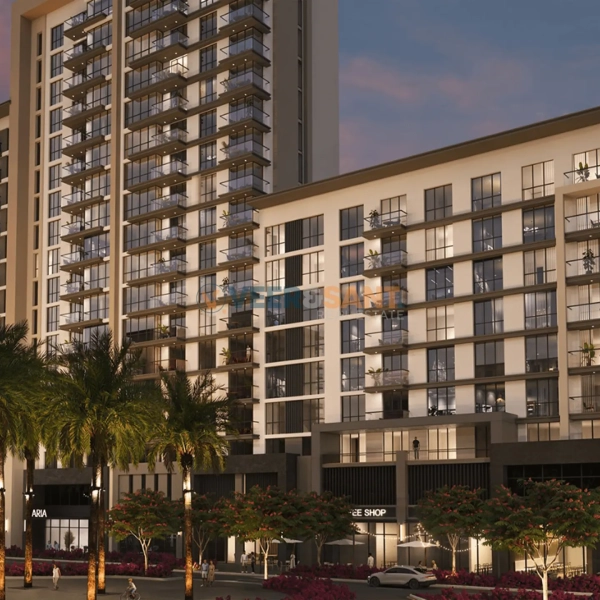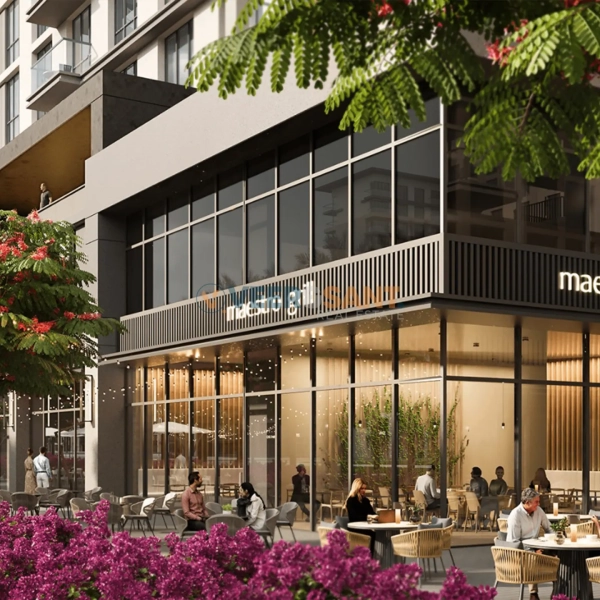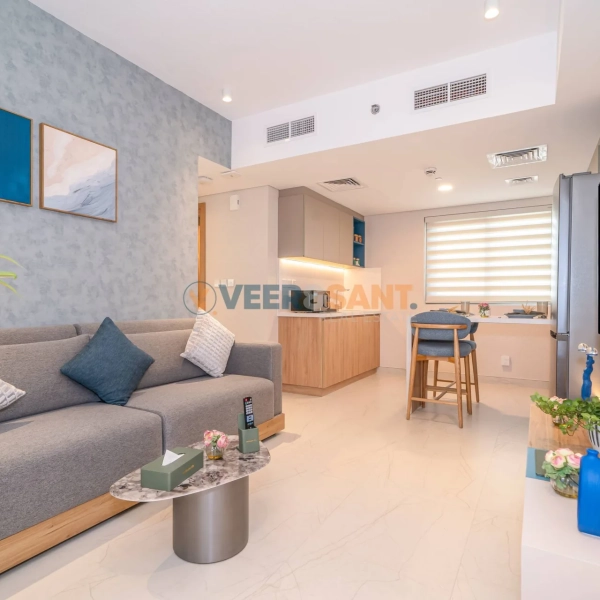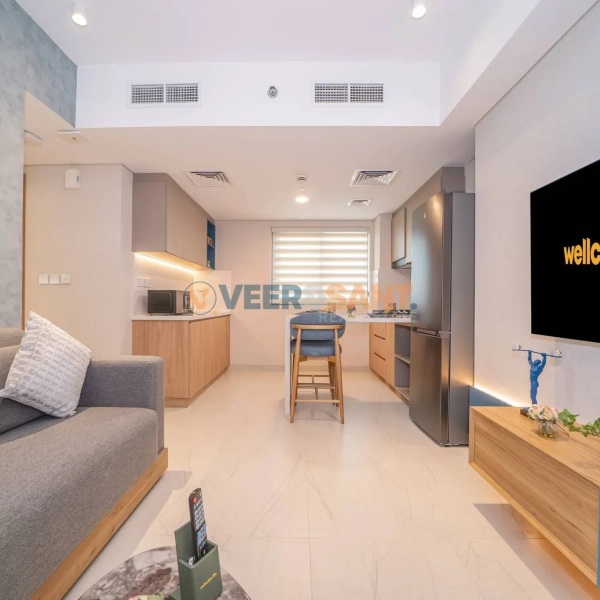
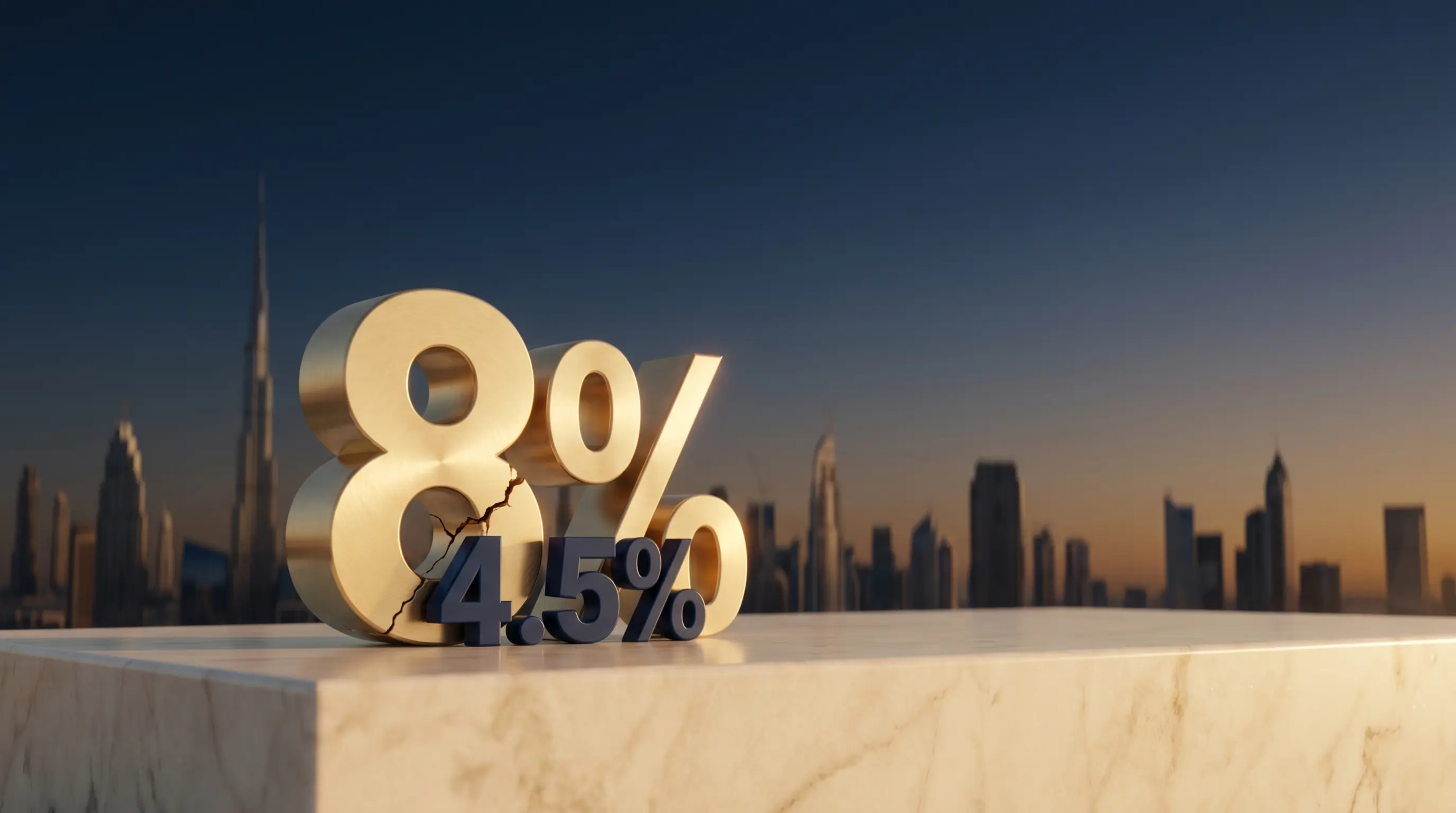
Every Dubai brochure leads with the same number: 7%, 8%, sometimes 9%. Then the rent lands in your home account and it does not feel like 8%. This article shows you, in May 2026 numbers and with three real-world examples, exactly where the missing percentage points go — and what you can do to recover them.
The 8% promise and the 4.6% receipt
Speak to any Dubai broker, watch any property influencer on YouTube, open any off-plan brochure, and you will be greeted by a single figure: a rental yield somewhere between 7% and 9%. It is the most marketed number in the emirate.
It is also, for the typical overseas owner, not what arrives in their bank account.
Engel & Völkers and several local data providers now place Dubai’s weighted-average net residential yield at around 4.6% as of early 2026 — already 150 to 250 basis points below the headline gross figures that dominate marketing. And that 4.6% is itself measured before two further drags that almost no broker mentions: foreign exchange and home-country tax. By the time an investor in London, Frankfurt or Mumbai sees the money on their statement, the realised yield is frequently in the 3.5% to 4.5% band — and on prime trophy assets it can dip below 3%.
This is not a Dubai problem. It is a Dubai-marketing problem. The asset class can still be a perfectly sound investment. But the number on the brochure and the number on your bank statement are rarely the same number, and pretending otherwise is the single most expensive habit in this market.
Three definitions of yield, and only one of them matters
Before we run the waterfalls, a brief but critical distinction. The word “yield” is used to describe three very different numbers:
- Gross yield: annual rent divided by purchase price. This is what brochures quote. It assumes 100% occupancy and ignores every cost.
- Net yield (local currency): gross rent minus all operating costs — service charges, agent and management fees, voids, maintenance reserves, DEWA owner-borne items, insurance. Still in AED, still pre-tax.
- Net-in-pocket yield (home currency, after tax): net yield converted into your home currency at the rate you actually transact at, then taxed by your home jurisdiction.
Brokers quote yield number one. The honest investor cares only about yield number three. The gap between the two is what we are going to map.
Example 1: A JVC studio — the entry-level workhorse
Jumeirah Village Circle is where most first-time overseas investors land. The math is clean, the entry price is low, and on paper the yields look exceptional. Bayut’s last-six-month listing data places the average JVC studio at AED 710,000 and the average studio gross yield at 7.87%. For our example, take a freehold studio bought at AED 750,000, around 400 square feet, achieving AED 60,000 in annual rent. That is a gross yield of 8.0% — squarely in the territory the brochures promise.
Now run the waterfall:
| Line item | AED | % of gross rent |
|---|---|---|
| Gross annual rent | 60,000 | 100.0% |
| Service charges (AED 12 / sqft × 400) | (4,800) | (8.0%) |
| DEWA owner-borne items + chiller deposit amortisation | (1,500) | (2.5%) |
| Property management (6% of gross) | (3,600) | (6.0%) |
| Reletting & Ejari renewal (annualised) | (1,500) | (2.5%) |
| Maintenance reserve (1.5% of rent) | (900) | (1.5%) |
| Void allowance (~30 days / 8% of rent) | (4,800) | (8.0%) |
| Sinking-fund top-ups (typical reassessment) | (600) | (1.0%) |
| Net rent (AED, pre-tax) | 42,300 | 70.5% |
| Net yield in AED | 5.64% | — |
| Less UK income tax @ 40% (higher-rate) | (16,920) | (28.2%) |
| Net-in-pocket (AED equivalent) | 25,380 | 42.3% |
| Net-in-pocket yield | 3.38% | — |
Sources: Bayut listing data (JVC studio averages); FAM Properties / Driven Properties service-charge index 2026; UK HMRC foreign rental income rules post-April-2025 reforms.
The 8.0% headline does not lie. It simply describes a number that was never going to land in your account. For a higher-rate UK taxpayer, the realised yield is 3.4%. For a basic-rate taxpayer with no other UK income, around 4.5%. Either way, the gap is somewhere between 350 and 460 basis points.
Example 2: A Downtown 1-bedroom — the prestige squeeze
Move up the food chain to Downtown Dubai and the dynamics invert. The asset is more liquid, more aspirational, more leverageable — and dramatically less yield-efficient. Sands of Wealth’s 2026 dataset places typical Downtown 1-bed asking rents in the AED 110,000 to AED 180,000 band. Take a 1-bedroom of around 750 square feet, purchased for AED 2.5 million, achieving AED 140,000 in annual rent. That is a gross yield of 5.6%, though many brokers will still talk about “6 to 7% in Downtown” by quoting peak rents against off-plan launch prices.
| Line item | AED | % of gross rent |
|---|---|---|
| Gross annual rent | 140,000 | 100.0% |
| Service charges (AED 21 / sqft × 750) | (15,750) | (11.3%) |
| DEWA owner-borne + central chiller exposure | (2,000) | (1.4%) |
| Property management (6% of gross) | (8,400) | (6.0%) |
| Reletting & marketing (annualised) | (2,500) | (1.8%) |
| Maintenance reserve (2% of rent) | (2,800) | (2.0%) |
| Void allowance (~30 days / 8%) | (11,200) | (8.0%) |
| Sinking-fund top-ups & insurance | (1,500) | (1.1%) |
| Net rent (AED, pre-tax) | 95,850 | 68.5% |
| Net yield in AED | 3.83% | — |
| Less UK income tax @ 40% (higher-rate) | (38,340) | (27.4%) |
| Net-in-pocket (AED equivalent) | 57,510 | 41.1% |
| Net-in-pocket yield | 2.30% | — |
Sources: Sands of Wealth Dubai rent dataset 2026; Luxhabitat & FAM Properties service-charge index for Downtown Dubai (AED 17–40 per sqft, average AED 21); Engel & Völkers 2026 Dubai rental yield analysis.
Downtown is where the yield illusion bites hardest. Brokers will pitch this as a 6–7% asset on the way in. The honest pre-tax number is closer to 3.8%, and a higher-rate UK taxpayer will see roughly 2.3% net-in-pocket. This is not a reason to avoid Downtown — many Downtown buyers are explicit capital-appreciation investors, and the asset is excellent for that — but it is a reason to stop telling rental-income buyers that it pays them what it does not.
Example 3: A Palm Jumeirah villa — where the math stops working as rental
At the trophy end of the market, the rental yield arithmetic is openly unforgiving. Property Finder and Bayut transaction data put the 12-month average rental price for a 4-bedroom Palm Jumeirah villa at approximately AED 1.4 million, while the average asking sale price for the same configuration sits around AED 31 million on the open listing market, with entry-level renovated stock available from around AED 18 to 25 million.
Take a 4-bedroom villa of around 5,500 square feet, purchased for AED 22 million, achieving AED 1.25 million in annual rent. That is a gross yield of 5.7% — already well below the 7–9% the broader Dubai market markets itself on. Then run the costs:
| Line item | AED | % of gross rent |
|---|---|---|
| Gross annual rent | 1,250,000 | 100.0% |
| Service charges (AED 12 / sqft × 5,500) | (66,000) | (5.3%) |
| DEWA owner-borne, pool & garden | (8,000) | (0.6%) |
| Property management (6% of gross) | (75,000) | (6.0%) |
| Reletting & broker fees (annualised) | (18,000) | (1.4%) |
| Major maintenance reserve (3% of rent) | (37,500) | (3.0%) |
| Void allowance (~30 days / 8%) | (100,000) | (8.0%) |
| Sinking fund, community fees, insurance | (20,000) | (1.6%) |
| Net rent (AED, pre-tax) | 925,500 | 74.0% |
| Net yield in AED | 4.21% | — |
| Less UK income tax @ 45% (additional-rate) | (416,475) | (33.3%) |
| Net-in-pocket (AED equivalent) | 509,025 | 40.7% |
| Net-in-pocket yield | 2.31% | — |
Sources: Property Finder & Bayut 4-bed Palm Jumeirah transaction data (12-month average AED 1.4M rent, AED 31M average asking sale price); FAM Properties villa service-charge index (AED 8–15 per sqft); UK HMRC additional-rate band (45% above £125,140 in 2026/27).
On Palm, the gross-to-net spread is not the story. The story is that anyone buying a Palm villa for the yield is using the wrong tool for the job. Palm is, and has long been, a capital-preservation and prestige asset. Treat it as that, and it is excellent. Treat it as a yield play, and you will quietly underwrite a 2.3% net-in-pocket return on AED 22 million of capital — money that would compound faster in many less interesting places.
| Already own a Dubai property? Or thinking of selling one? Veer & Sant manages and sells Dubai properties for overseas owners — the same owners who, three years in, are quietly wondering where their yield went. Send us the building name and unit on WhatsApp and we will reply with two numbers: what your property should be earning under proper management, and what it would realistically sell for in today’s market. Both in your home currency. Message us on WhatsApp → https://wa.me/971558522157 |
Where the missing percentage points actually go
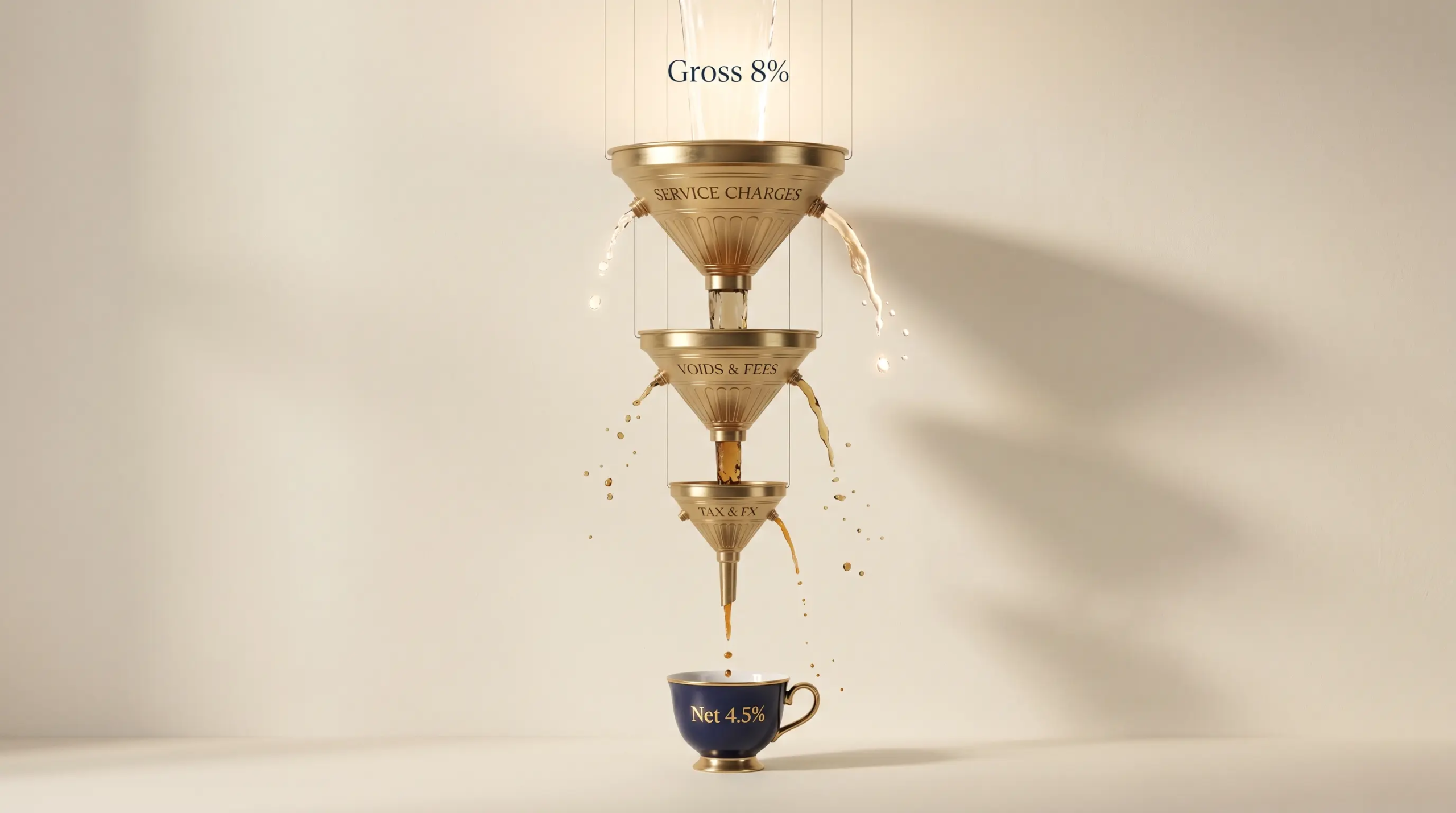
Pattern across all three waterfalls: roughly 28–30% of gross rent is consumed by operating costs in AED, and a further 28–33% is consumed by home-country tax. That second leak is the one almost no Dubai broker discusses, because it is genuinely outside their remit — and yet it is the single biggest determinant of what you actually earn.
The AED leakage (28–30% of gross)
- Service charges are the single largest controllable cost. They range from AED 6 per sqft in International City to AED 40-plus per sqft in prime Downtown towers, and over AED 60 per sqft in branded residences. Service-charge differentials of AED 8 per sqft on a 1-bed apartment translate to roughly 100 basis points of yield. This is where due diligence pays.
- Property management at 5–8% of gross rent is industry-standard, but it is also negotiable, and is the cost most overseas owners over-pay on. Long-term tenants in stable buildings rarely need full-service management.
- Voids are real. The citywide vacancy figure for early 2026 sits between 7% and 12% depending on whose dataset you trust. A 30- to 45-day gap between tenants is normal — and removes roughly 100 basis points from yield on its own.
- Reletting friction (Ejari, photography, broker re-listing fees, minor refurbishment) recurs every 12–18 months under typical Dubai tenancy patterns, and is rarely budgeted by first-time owners.
The home-currency layer (28–33% of net)
The AED is pegged to the US dollar, which means owners earning in dollars face minimal FX drag. Owners earning in GBP or EUR face a different problem. The GBP–AED rate has averaged around 4.97 in 2026 with a peak-to-trough swing of roughly 3.3%. A handful of repatriation events done at retail FX spreads of 1–2% can quietly remove another 30 to 50 basis points of yield over a holding period.
Tax is the heavier weight. Since April 2025, all UK residents are taxed on the arising basis on their worldwide income, including UAE rental profits. There is no UK–UAE double-taxation issue to fall back on, because the UAE does not levy personal income tax — meaning the UK simply taxes the full net profit. Marginal rates of 20%, 40% or 45% apply, and a single Dubai 1-bed is sufficient to push many middle-income owners into the 40% band on the rental income alone. Other EU jurisdictions vary, but the principle holds: there is no tax-free Dubai rental income for a non-UAE-tax-resident owner. The dirham is tax-free; the owner is not.
A corrected expectations framework
If you take only one thing from this article, take this table:
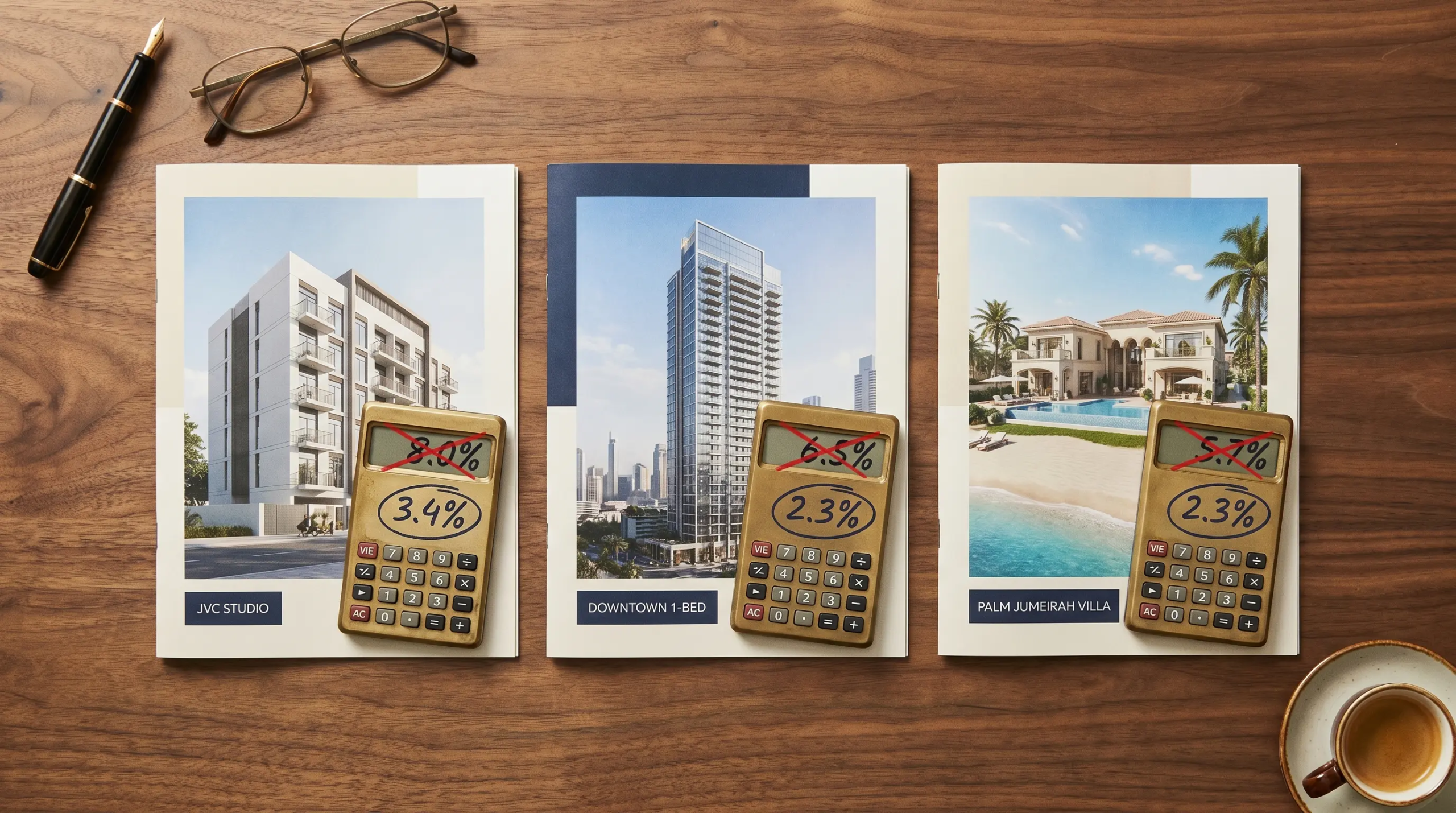
| Asset | Brochure gross | Net (AED) | Net-in-pocket (GBP higher-rate) |
|---|---|---|---|
| JVC studio | 8.0% | 5.6% | 3.4% |
| Downtown 1-bedroom | 6.5% | 3.8% | 2.3% |
| Palm Jumeirah 4-bed villa | 5.7% | 4.2% | 2.3% |
Modelled on May 2026 inputs. Net-in-pocket assumes a UK higher- or additional-rate taxpayer. Basic-rate owners and tax-resident UAE owners will see 80–150bps higher across each row. Methodology is fully reproducible from the waterfalls above.
Three structural moves that recover 100–150 basis points
Almost everything in the waterfall is fixed by the day you buy. But three decisions are genuinely in your control and, taken together, regularly add 100 to 150 basis points back onto realised yield.
1. Run the service-charge audit before you sign, not after.
Service charges are the single largest controllable leak, and they vary by a factor of three to six across otherwise similar buildings. Two seemingly identical JVC towers can carry AED 9 and AED 16 per square foot respectively. The DLD service-charge index makes this data public; almost no buyer reads it. Doing so before purchase will routinely save 60 to 100bps a year, every year you hold the asset.
2. Stop paying for full-service property management you do not need.
On a stable long-term tenancy in a well-run building, the property manager is largely a postbox. Capping management fees at 4–5% of gross (rather than the default 7–8%), tightly defining reletting and renewal fees, and using a single trusted handyman on retainer rather than the manager’s preferred contractor list will recover 50 to 80bps. The catch is that this requires a manager who tolerates being negotiated with, which is a smaller pool than the market suggests.
3. Stop accepting retail FX and confused tax positions.
FX losses on quarterly repatriation, done at 1–2% spreads, are pure leakage. A dedicated multi-currency account and a quarterly conversion plan removes 30 to 50bps annually. The tax conversation is a one-time investment with a qualified UK or EU adviser, ideally before purchase. For higher-rate UK taxpayers, the choice of personal name versus an appropriate structure can change the post-tax yield by more than every other line in the waterfall combined. We do not give tax advice ourselves, but we will tell you when you need it — and the answer is, almost always, before you buy, not after.
The bottom line
Dubai is not a low-yield market. It is, by most international comparisons, an above-average one. A realised 4–5% net-in-pocket return, in an AED-pegged-to-USD economy with no transfer tax on holding and no capital gains tax on exit, is a perfectly serviceable result — particularly when paired with the capital appreciation Dubai has delivered through the current cycle.
The problem is not the asset. The problem is the marketing of the asset. The investor who underwrites a Dubai purchase at 4.5% net-in-pocket will, in almost every case, be content with the outcome. The investor who underwrites it at 8% will spend years wondering where their money went. The difference between those two investors is not the property. It is whether anyone told them the truth before they bought.
At Veer & Sant, we would rather you bought slightly less property, with a slightly lower headline yield, with both eyes open — than buy more, faster, on numbers that were never going to arrive in your account. The market does not need another 8% promise. It needs a 4.5% one that turns out to be true.
| Sell it. Manage it properly. Or buy the next one with your eyes open. Veer & Sant works with overseas Dubai property owners in three ways. We sell — discreetly, at the right price, with overseas clients who do not want to fly in for viewings. We manage — with capped fees, full transparency on every line of the waterfall above, and a single point of contact. And we advise — when you are about to commit capital and want one honest read of the math before you sign. Book a 30-minute call and tell us which one you need. We will not push the other two. Book a 30-minute call → https://veersant.com/consultation |