When figuring out how to build a property portfolio in Dubai, most people make a common mistake: they buy one apartment, rent it out, and stop there. They treat it as a single purchase. Serious investors do something different. They treat each property as a tool to fund the next one, and they grow a portfolio of three, five, or ten units over time, often using far less of their own cash than you would expect.
The good news is that this is not a secret reserved for the ultra-wealthy. It comes down to three simple ideas working together: leverage, cash flow, and refinancing. In this guide we break down exactly how investors use all three to build a property portfolio in Dubai, with real 2026 numbers, the rules you need to know, and the mistakes that quietly sink beginners.
The three engines behind every Dubai portfolio
Before the strategy, it helps to understand the three forces doing the heavy lifting.
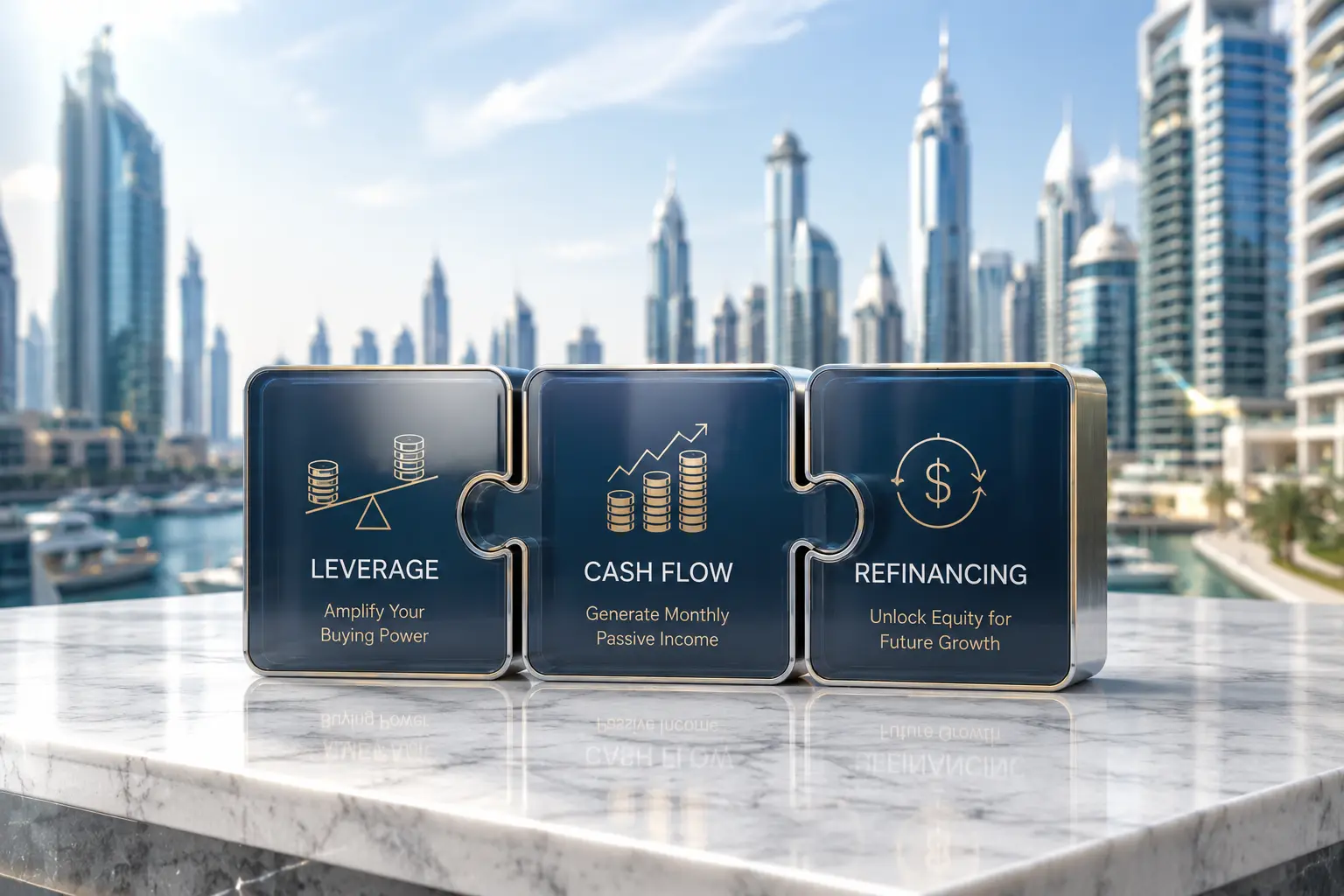
Leverage is using the bank’s money alongside your own. Instead of paying full price for one property, you put down a deposit, borrow the rest, and control a more valuable asset. When prices rise, your return is calculated on the whole property value, not just the cash you put in.
Cash flow is the rent left in your pocket after the mortgage and costs are paid. In Dubai this matters more than in most cities, because rental income is tax-free for individuals, there is no annual property tax, and no capital gains tax when you sell. What you earn is what you keep.
Refinancing is how you recycle your money. As a property rises in value and the loan is paid down, you build equity. You can release that equity to fund your next deposit, instead of waiting years to save it again.
Put together, these three engines turn one purchase into a repeatable system.
Why leverage works so well in Dubai
Dubai pairs two things that rarely appear together: strong rental yields and a tax-free environment.
Gross rental yields in Dubai commonly sit around 6–7%, and some communities push higher. Compare that with roughly 2.5–4% in London, 3–5% in New York, and 2.5–3.5% in Singapore. Even after real-world costs bring the figure down to a net 4–5% for most overseas owners, the gap is large. (We break this down honestly in our guide to the real net rental yield — it is essential reading before you buy.)
Here is the key point. When your rental yield is higher than your mortgage interest rate, leverage works for you. In 2026, fixed mortgage rates in Dubai start from around 3.99–4.2% for an initial period. If a property yields more than it costs to borrow, the tenant effectively pays down your loan while you keep the surplus and benefit from any price growth.
How much can you actually borrow?
The amount you can borrow depends on whether you are a UAE resident or an overseas buyer. These limits are set by the UAE Central Bank rules, so they apply across all regulated banks.
| Buyer type | Typical max loan (ready property) | Deposit you provide |
|---|---|---|
| UAE resident, property under AED 5M | Up to 80% | From 20% |
| UAE resident, property over AED 5M | Up to 70% | From 30% |
| Non-resident / overseas buyer | Around 50–60% | 40–50% |
| Off-plan (most buyers) | Around 50% | From 50% |
Two more rules matter. Banks apply a Debt Burden Ratio (DBR) cap of 50% — your total monthly debt payments cannot exceed half of your gross monthly income. And if the bank values a property below the price you agreed, your loan is calculated on the lower figure, so you cover the difference. Knowing these numbers before you shop keeps your plan realistic.
The “Buy, Refinance, Repeat” strategy, explained simply
This is the engine that lets investors scale without saving a fresh deposit every time. It works in four steps.
Step 1 — Buy a cash-flowing property. Choose a unit in an area with steady tenant demand where the rent comfortably covers the mortgage and costs. The goal is positive cash flow from day one, not a property you have to subsidise each month.
Step 2 — Hold while it grows. Over the next few years two things happen at once: the property rises in value, and your tenant’s rent steadily pays down your loan. Both increase your equity.
Step 3 — Refinance to release equity. Once you have built enough equity, you remortgage the property. A cash-out refinance lets you pull out a lump sum — your original deposit, effectively recycled — while you keep owning the asset and keep collecting rent.
Step 4 — Repeat. You use that released cash as the deposit for property number two. Then you do it again. This is how investors move from one unit to four or five over a decade, largely using the bank’s money and the market’s growth rather than draining their savings each time.
A simple illustration: an investor buys a Dubai Marina apartment, holds it as values rise, refinances a few years later to release the gained equity, and uses that cash to buy a second unit in another community. Now two properties are generating rent, and most of the second purchase was funded by the first.
A quick reality check: every property should be able to carry its own mortgage from its own rent. If a unit only works when you top it up from your salary, it is a liability, not an engine. Scale on properties that pay for themselves.
A realistic 10-year picture
Numbers vary by area and timing, but the shape of the journey looks like this. An investor who starts with one well-chosen, cash-flowing apartment and reinvests released equity every few years can realistically hold four to five properties within ten years, generating a meaningful tax-free rental income each year. The compounding comes not from luck, but from repeating a disciplined process: buy for cash flow, let equity build, refinance, reinvest.
This is also where residency fits in. Building a property portfolio above the AED 2 million threshold can qualify you for the Golden Visa, turning an investment strategy into a long-term residency plan for you and your family.
Talk to a Dubai investment specialist
Have a question about your numbers, your borrowing limit, or your next move? Message us directly — we usually reply within minutes.
The costs and risks beginners forget
A good playbook is honest about the downsides. Build these into your plan from the start.
Upfront buying costs. Budget around 4% for the Dubai Land Department transfer fee, plus agency, mortgage arrangement, and valuation fees. These reduce your usable capital, so never plan a deposit down to the last dirham.
Interest rate movements. Many Dubai mortgages move to a variable EIBOR-linked rate after the initial fixed period. If rates rise, your repayment rises, which squeezes cash flow. Stress-test every property against a higher rate before you buy.
Vacancy and service charges. Rent is not guaranteed every single day, and annual service charges vary a lot between buildings. The honest net yield of 4–5% already accounts for much of this — plan on the net figure, not the headline gross.
Over-leveraging. Borrowing to the maximum on every property leaves no buffer. A smart portfolio keeps some breathing room so a single vacancy or rate rise does not threaten the whole structure.
Remote management. If you live abroad, a property left unmanaged can quietly lose money through voids and maintenance issues. Here is what actually happens when you manage it from abroad without local support.
How to start the right way
You do not need ten properties on day one. You need one property bought correctly, in the right area, with the cash flow and the financing structured to let you repeat the process. Picking the best areas to invest for tenant demand, and getting the right mortgage and finance support in place, are the two decisions that shape everything that follows.
That is exactly where the right advisor saves you years.
Ready to build your Dubai portfolio? Let’s map your first move.
Building a property portfolio in Dubai is a system, not a gamble — but the first purchase has to be structured correctly, or the whole plan stalls. Our advisors will look at your budget, your borrowing power, and your goals, and build a clear, realistic plan for your first (or next) property.
👉 Book your free consultation with Veer & Sant and let’s turn one property into a portfolio.
Or message us on WhatsApp at +971 52 689 8597 — we’re happy to answer questions before you commit to anything.
Frequently Asked Questions
How do you build a property portfolio in Dubai?
You build a property portfolio in Dubai by buying a cash-flowing property, holding it while its value rises and the mortgage is paid down, then refinancing to release the built-up equity and using that cash as the deposit for the next property. Repeating this “buy, refinance, repeat” cycle lets investors grow from one unit to several over time, largely using bank financing and market growth rather than fresh savings.
Can foreigners get a mortgage to invest in Dubai property?
Yes. Non-residents can get a mortgage in Dubai, typically borrowing around 50–60% of the property value, which means a deposit of about 40–50%. UAE residents can borrow up to 80% on a ready property under AED 5 million. All limits follow UAE Central Bank rules and a 50% debt-burden ratio cap.
Is rental income taxed in Dubai?
No. The UAE charges no personal income tax, so rental income earned by individuals is tax-free. There is also no annual property tax and no capital gains tax when you sell. This is a major reason leverage works so well in Dubai — more of your rent stays in your pocket to cover the mortgage and fund growth.
What is a good rental yield in Dubai in 2026?
Gross rental yields in Dubai commonly sit around 6–7%, higher than London, New York, or Singapore. For most overseas owners, the realistic net yield after service charges, management, and other costs is closer to 4–5%. Plan your portfolio around the net figure, not the headline gross.
What is equity release or cash-out refinancing in Dubai?
Equity release, also called cash-out refinancing, means remortgaging a property that has grown in value to withdraw a lump sum of the equity you have built, while keeping ownership and rental income. Investors use the released cash as the deposit for their next property, which is how they scale a portfolio without saving a new deposit each time.
How many properties can I realistically own in 10 years?
With a disciplined buy, refinance, repeat approach and the right area selection, many investors build a portfolio of four to five cash-flowing properties within about ten years. The exact number depends on price growth, your borrowing capacity, and how consistently you reinvest released equity.
How much money do I need to start investing in Dubai property?
It depends on the property and your residency status. A non-resident usually needs 40–50% of the price as a deposit plus around 4% in Dubai Land Department fees and other costs, while a resident may need just 20% down on a ready home under AED 5 million. The best first step is a consultation to match your budget to the right property and financing.