
When comparing Dubai mortgage vs off-plan 2026 trends, most guides treat these as one decision. However, Dubai’s transaction data shows they are two almost separate markets. Knowing which path you are on changes everything about your down payment, costs, and timing. This report breaks down the differences and includes a simple step-by-step guide to getting a mortgage in Dubai for both residents and non-residents.
The one idea most Dubai buyers get wrong
Ask ten people how Dubai property works and most will blur two very different things together: taking a mortgage, and buying off-plan. In their head it’s one path. “Put down a deposit, the bank lends the rest, you buy a new apartment from a developer.”
The transaction record tells a different story. When you line up every residential deal in Dubai over the last three years and split it by how it was financed, two distinct markets appear. One is the off-plan market, which runs almost entirely on developer payment plans and cash. The other is the ready and resale market, where bank mortgages do most of the heavy lifting. They have different buyers, different price points, different rules, and, right now, different momentum.
This report uses REIDIN transaction data covering 2023 to June 2026. In 2025 alone there were 44,110 mortgage registrations worth AED 90.1 billion, and across January 2024 to June 2026 the market recorded 100,389 mortgage deals worth AED 209.7 billion. Sitting alongside that is the much larger off-plan sales engine. Read together, they explain how Dubai actually buys, and where the smart, low-risk moves are in mid-2026.
1. Understanding Dubai mortgage vs off-plan 2026: Two different markets
The single most useful thing an investor can do is stop thinking about “the Dubai market” as one block. Split residential deals four ways (off-plan paid with cash or a developer plan, off-plan with a bank mortgage, ready bought with a mortgage, and resale bought with cash) and the shape of the market becomes obvious.
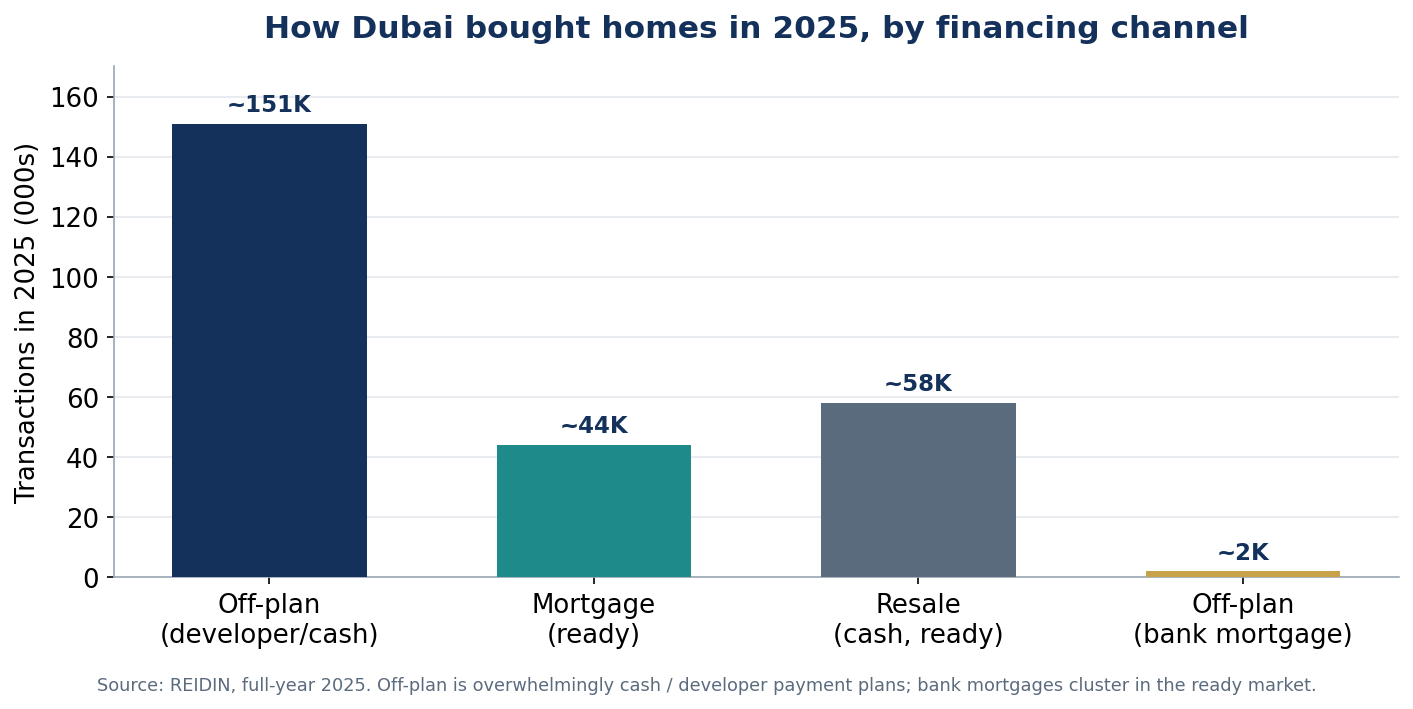
In 2025, off-plan purchases financed through developers and cash dwarfed everything else, roughly 150,000 transactions, versus about 44,000 mortgaged ready homes and 58,000 cash resales. Off-plan made up roughly 60 to 65% of all residential sales. Crucially, almost none of that off-plan volume involved a bank mortgage at the point of sale.
Why? Because off-plan isn’t financed by banks during construction. Developers offer their own payment plans: you pay a booking deposit, then instalments linked to construction milestones, with a chunk due on handover. The bank usually only enters the picture later, if you choose to mortgage the unit once it’s built. So the off-plan boom you read about is, in financing terms, a payment-plan boom.
The takeaway: “Can I get a mortgage for this?” is the wrong first question for off-plan. The right questions are about the developer’s payment plan, the escrow account, and your cash flow to handover.
2. Where Dubai mortgage vs off-plan 2026 deals actually live
If off-plan runs on payment plans, where do all those bank mortgages go? Overwhelmingly into the ready and resale market.
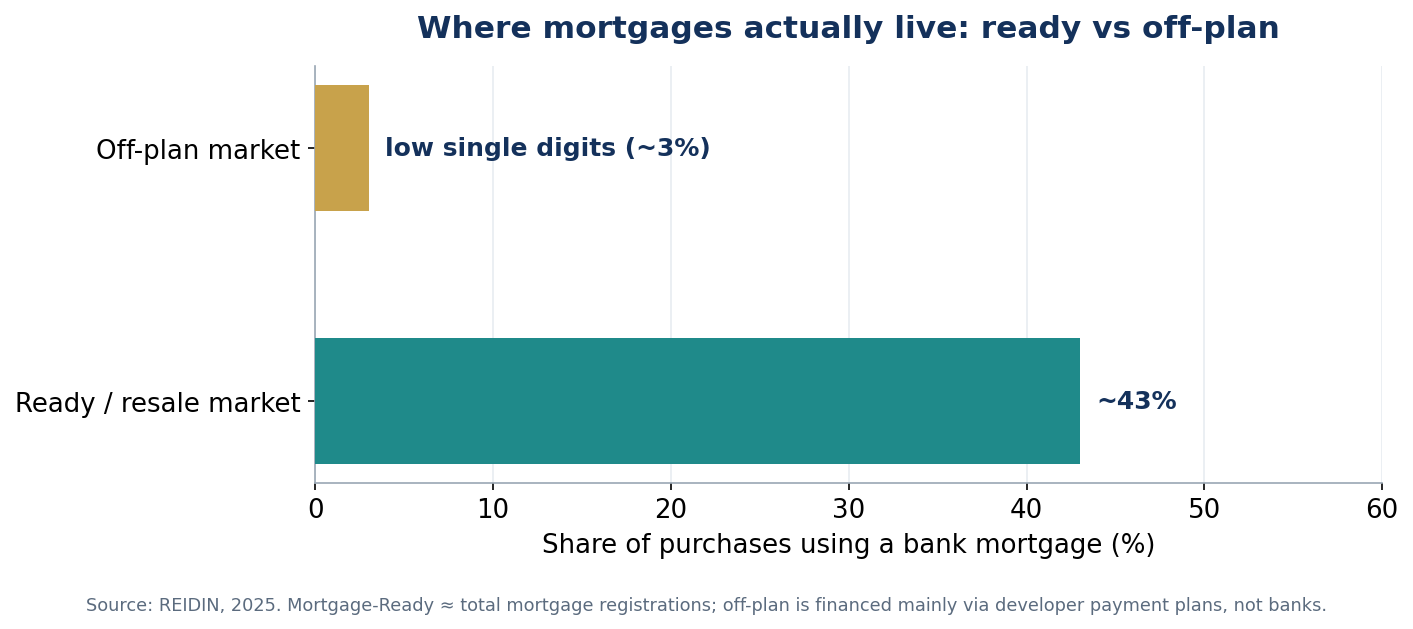
In 2025, mortgage registrations on ready homes (about 44,000) were close to the total mortgage count for the entire market. Set against roughly 102,000 ready and resale transactions, that means around 43% of ready-market buyers used a bank mortgage. In the off-plan market, mortgage use at point of sale sits in the low single digits.
There’s a regulatory reason this gap is so wide. The Central Bank caps off-plan mortgages at a 50% loan-to-value, so you would need to fund half the price yourself before the property even exists. A developer payment plan is simply easier and cheaper to carry during construction. So the rules themselves push off-plan buyers toward payment plans and mortgage buyers toward finished homes.
| Plain-English summaryOff-plan = developer payment plan now, optional mortgage later (at handover).Ready / resale = where bank mortgages do the work. About 4 in 10 buyers use one.So your financing route is mostly decided by what you buy, not the other way around. |
3. The price-per-foot “illusion”
Here’s where the data gets genuinely useful, and where most blogs go quiet. Look at the average price per square foot in each of the four channels and you’ll see numbers that look contradictory until you understand who is buying.
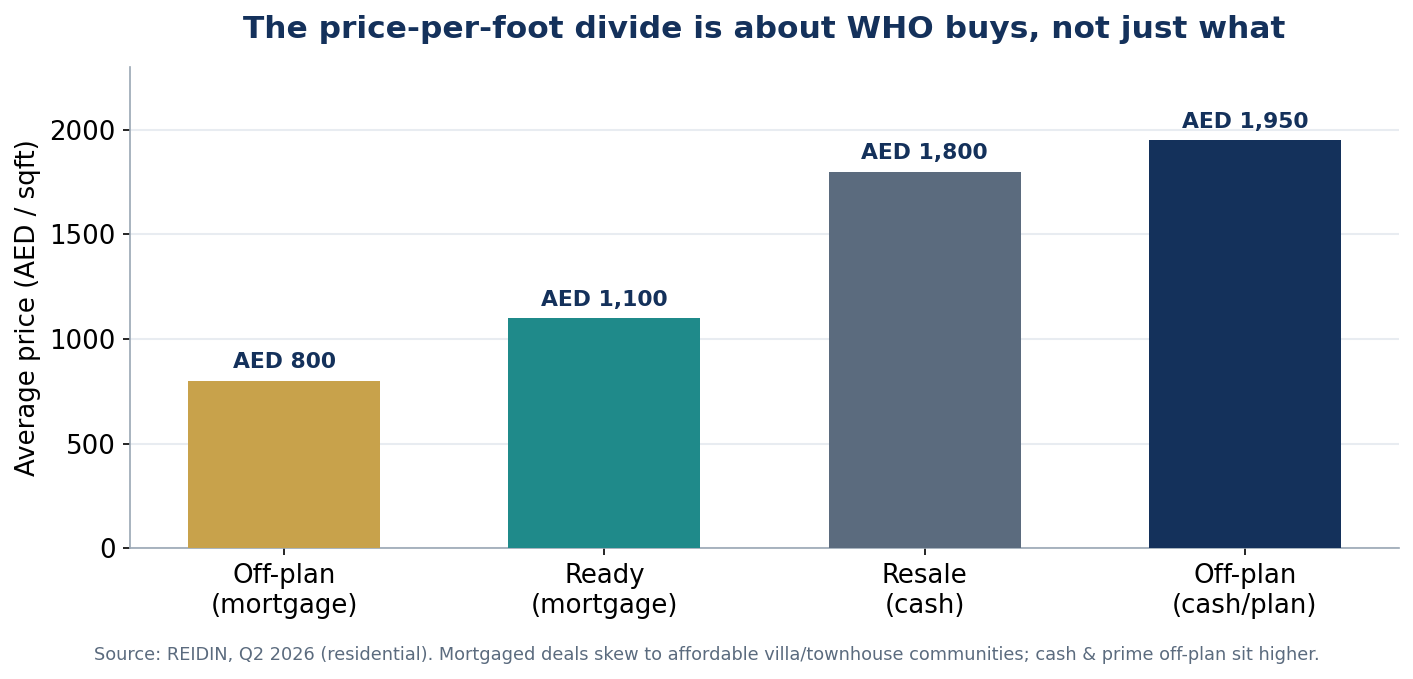
Mortgaged deals trade far cheaper per square foot (roughly AED 800 to 1,100/sqft) than cash and prime off-plan deals (roughly AED 1,800 to 1,950/sqft). That is not a discount for using a mortgage. It reflects buyer mix: mortgage buyers cluster in affordable villa and townhouse communities (think Town Square, Damac Hills 2, Mudon, Emaar South, The Springs), while cash and premium off-plan money chases new launches on the Palm, in Downtown, the Marina and Dubai Hills.
So two “ready apartments” can sit in the same statistic and mean completely different things. When you read an average price-per-foot headline, always ask which channel and which communities it’s built from.
The second pattern is about new versus resale stock:
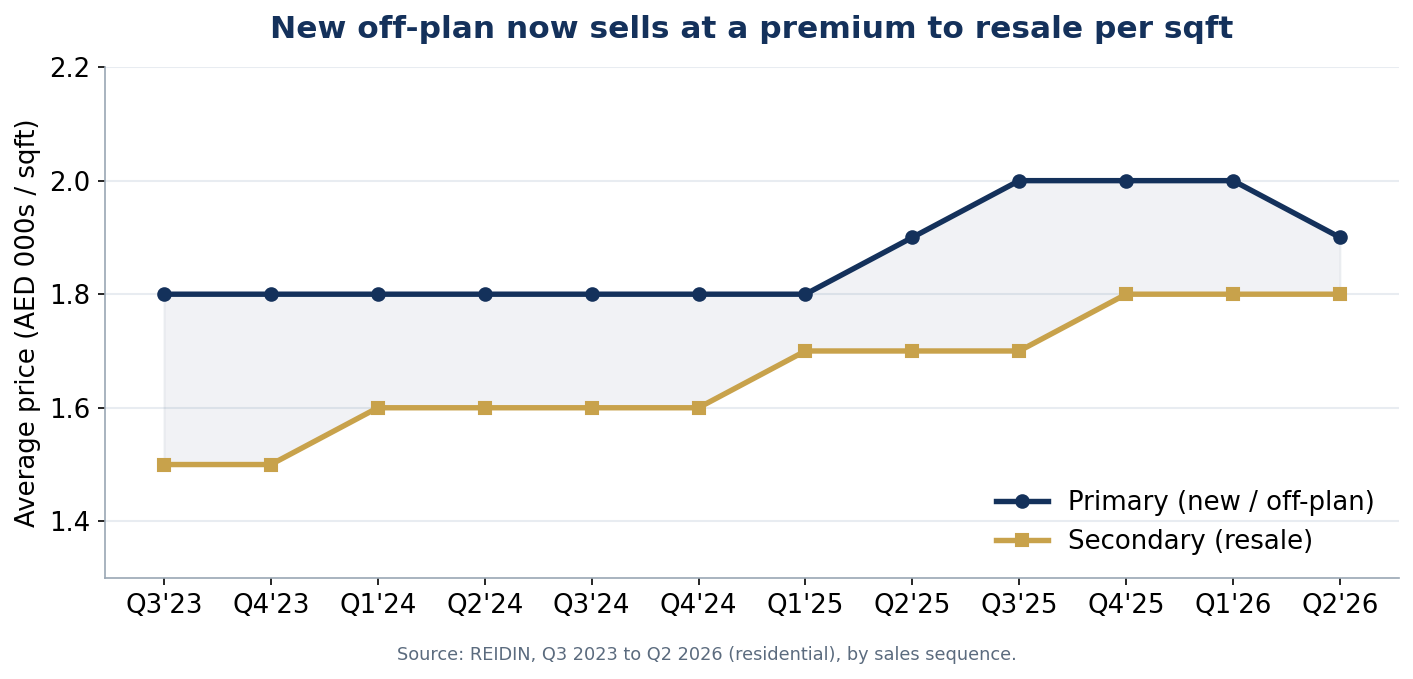
New (primary/off-plan) stock now sells at a premium to resale per square foot, around AED 2,000 versus AED 1,800, and that gap has widened since 2024. Investors are paying up for the newest product, while comparable resale homes (the ones banks happily finance) are often the better value on a price-per-foot basis. For a mortgage buyer, that’s an edge, not a consolation prize.
4. The 2026 rulebook: what actually applies today
The financing rules changed in ways that matter, and a lot of older articles are now wrong. Here is the current picture as of June 2026.
Loan-to-value and down payments
| Buyer / property type | Max LTV | Min down payment |
|---|---|---|
| Expat, first home, up to AED 5M | 80% | 20% |
| Expat, first home, above AED 5M | 70% | 30% |
| Second / additional property | 60 to 65% | 35 to 40% |
| Off-plan (any buyer) | 50% | 50% |
| Non-resident buyer | 50 to 60% | 40 to 50% |
Source: CBUAE mortgage regulations (Circular 31/2013 and amendments). Debt-burden ratio capped at 50% of income; maximum loan term 25 years.
The change that catches buyers out: upfront fees
Since 1 February 2025, banks can no longer fold the 4% Dubai Land Department transfer fee or the 2% agency commission into your mortgage. These now have to be paid in cash, upfront, on top of your down payment. This single rule meaningfully raises the cash you need on day one, and it is the most common nasty surprise for first-time buyers.

Here is what that looks like on a typical AED 2,000,000 ready home bought with an 80% mortgage:
| Cost item | Basis | Amount (AED) |
|---|---|---|
| Down payment | 20% of price | 400,000 |
| DLD transfer fee | 4% of price | 80,000 |
| Agency commission | 2% of price | 40,000 |
| Bank arrangement fee | ~1% of loan | 16,000 |
| Mortgage registration | 0.25% of loan + 290 | 4,290 |
| DLD trustee fee | fixed | ~4,200 |
| Valuation + title deed | fixed | ~3,600 |
| Total cash needed on day one | ~548,000 |
Illustrative only; exact fees vary by bank and trustee office. The point: budget for roughly 27 to 28% of the price in cash on a mortgaged purchase, not just the 20% down payment.
5. What borrowing actually costs in mid-2026
Rates have settled into a calmer band. As of June 2026 the Central Bank’s base rate sits at 3.65%, with three-month EIBOR around 4.5 to 5.0%. In practice, that puts fixed mortgage rates roughly between 3.5% and 4.75%, and EIBOR-linked variable rates around 4.5 to 5.5%. Analysts expect this corridor to stay relatively stable through 2026, which makes monthly payments easier to plan than in the volatile 2022 to 2023 period.
The borrowing story has two layers. Mortgage volume is rising only modestly, but mortgage value is climbing fast. The average mortgage size grew sharply year-on-year as buyers financed larger, higher-quality homes. In other words, the people using mortgages are increasingly serious end-users and investors buying meaningful assets, not marginal buyers stretching to get in.
| Why this matters for your decisionStable rates + the 50% off-plan LTV cap = the ready/resale market is where leverage is cheapest and easiest to access.If you want a mortgage, finished homes give you more LTV, lower per-foot prices, and immediate rental income.If you want maximum exposure to a new launch, expect to fund it largely yourself or via the developer’s plan. |
6. Off-plan financing and the 2026 Golden Visa shift
Two things make off-plan attractive despite the financing limits: low entry cost through staged payments, and a residency pathway that just got easier.
The headline change in 2026: the Dubai Land Department and GDRFA removed the old requirement to have paid at least AED 1 million (or 50% of value) before applying for a Golden Visa through a mortgaged or off-plan property. Qualification is now assessed on the total property value shown on your title deed or Oqood contract, so the full value of an off-plan purchase counts toward the AED 2 million threshold, regardless of how much you’ve actually paid so far. For investors using payment plans, that brings the 10-year visa within reach much earlier.

Protections to check before you sign: every approved off-plan project must have a RERA registration number and a project-specific escrow account. Your instalments go into that ring-fenced account and can only be used to build your project, not the developer’s other ventures. Confirm both numbers appear on your SPA and Oqood.
7. Buying from abroad: the non-resident reality
Non-residents can get a Dubai mortgage, but on tighter terms: typically 50 to 60% LTV (so a 40 to 50% down payment), rates around 4 to 6%, and most banks will finance ready properties only. Active lenders include Emirates NBD, HSBC, Mashreq, ADCB and Standard Chartered. Expect to provide overseas income proof, bank statements and ID.
This reinforces the central theme: for an overseas investor who wants leverage, a finished, mortgageable home is the path of least resistance. Off-plan from abroad is usually a cash-and-payment-plan play, with a mortgage option kept in reserve for handover.
8. A simple guide to getting a mortgage in Dubai
Whether you live in the UAE or you are buying from overseas, the mortgage process follows the same shape. The differences are mostly in how much you can borrow, how much cash you bring, and the paperwork. Here is the plain-English version.
Residents vs non-residents at a glance
| What changes | Resident buyer | Non-resident buyer |
|---|---|---|
| Maximum loan (LTV) | Up to 80% (first home up to AED 5M) | 50% to 60% |
| Minimum down payment | 20% and up | 40% to 50% |
| Typical interest rate | About 3.5% to 4.75% fixed | About 4% to 6% |
| Usual minimum income | Around AED 15,000 / month | Higher; varies by bank |
| What banks will finance | Ready homes, plus off-plan up to 50% | Mostly ready homes only |
| Loan term | Up to 25 years | Usually up to 20 to 25 years |
In both cases your total monthly debt (this loan plus any other repayments) cannot exceed 50% of your income, and the standard maximum age at the end of the loan is about 65 for salaried buyers and 70 for self-employed buyers.
The process, step by step
- Get pre-approved first. Before you fall in love with a property, get a mortgage pre-approval. The bank checks your income, your existing debts and your credit, then tells you how much it will lend. A pre-approval is usually valid for about 60 days.
- Set your real budget. Add your down payment to the cash fees you must pay upfront (roughly 6% to 7% of the price). On an AED 2M home that is about 20% plus fees, so plan for around 27% to 28% in cash.
- Find the property and sign the MoU. Once you choose a home, you and the seller sign the sale agreement (Form F, the Memorandum of Understanding) and you pay a deposit of about 10%, usually held by the agent or trustee.
- Bank valuation and final offer. Your bank sends a valuer to confirm the property is worth the price. It then issues a Final Offer Letter setting out your rate, loan amount and term.
- Get the developer NOC (for resale). For a ready resale, the developer issues a No Objection Certificate confirming there are no unpaid service charges. This clears the way to transfer.
- Sign the mortgage offer. You accept the bank offer and pay the arrangement fee (about 1% of the loan) and valuation fee. The bank prepares to release funds.
- Transfer at the DLD trustee office. Buyer, seller and bank meet at a registration trustee. You pay the 4% DLD transfer fee and register the mortgage (0.25% of the loan), the bank pays the seller, and the title deed is issued in your name. Done.
Documents to prepare
| Resident buyer | Non-resident buyer |
|---|---|
| Passport, visa and Emirates ID | Passport (and visa if you have one) |
| Salary certificate and recent payslips | Proof of income or employment letter |
| 6 months of UAE bank statements | 6 months of home-country bank statements |
| Proof of current address | Proof of address in your home country |
| Statement of existing loans / cards | Self-employed: audited accounts or trade licence |
| Two tips that save buyers the most stressGet pre-approved before you offer on anything. It makes your offer stronger and stops you chasing homes you cannot finance.Budget the cash fees from day one. Since February 2025 the 4% DLD fee and 2% agency fee cannot be added to the loan, so keep that money ready. Start to finish, a mortgage purchase typically takes about 4 to 6 weeks. |
9. What the data means for your strategy
Pulling the numbers and the rules together, here’s how to use this in practice.
- Decide your financing route first, then shop. Want a mortgage and rental income now? Lead with ready/resale, where ~43% of buyers finance and per-foot prices are lower. Want maximum upside on a new launch and can self-fund to handover? Off-plan with a developer plan.
- Budget ~27 to 28% cash on mortgaged buys. Since Feb 2025 the 4% DLD and 2% agency fees are out-of-pocket. Plan for fees on top of your down payment so the deal doesn’t stall at signing.
- Read price-per-foot by channel. A low average often just means “more affordable communities,” not a bargain. Compare like-for-like: same community, same status, same channel.
- Mind the Q2 2026 cooling in off-plan. Off-plan value fell from a Q1 2026 peak near AED 103bn to about AED 63bn in Q2 2026. Some of that is registration lag, but the trend says be selective: favour credible developers, realistic payment plans and locations with real end-user demand.
- Use the new Golden Visa math. If residency is a goal, an off-plan purchase at or above AED 2M now counts at full value toward the visa even on a payment plan, a genuine 2026 advantage.
- Always verify escrow + RERA. No registration number and project escrow account, no signature.
“For a deeper look into the long-term potential of these assets, read our Dubai Property Investment 2026 guide.”
Key takeaways
- Two markets: off-plan runs on payment plans (mortgage use in low single digits); ready/resale is where ~43% of buyers use a bank mortgage.
- Rules favour finished homes for leverage: 80% LTV on a first home up to AED 5M vs a 50% cap on off-plan.
- New upfront-fee rule (Feb 2025): 4% DLD + 2% agency must be paid in cash, so budget ~27 to 28% of price upfront.
- Rates are calm: fixed ~3.5 to 4.75% in June 2026; mortgage value is rising faster than volume.
- 2026 Golden Visa: full off-plan value counts toward the AED 2M threshold regardless of amount paid.
- Watch off-plan momentum: Q2 2026 cooled meaningfully from the 2025 peak, so be selective.
| Thinking about buying in Dubai?At Veer & Sant we help first-time buyers and overseas investors choose the right financing route (mortgage or off-plan) and find the right property at the right time.Book a free consultation → |