Dubai property investment in 2026 is doing something that surprises even seasoned investors: the market is getting more expensive at the same time it is getting more selective. Quarter one data is in, and the headline (AED 139.2 billion in residential transactions) only tells half the story. The other half is about what is shifting beneath the surface, why the government just released an AED 1 billion lifeline into the economy, and what all of it means if you are deciding whether to buy, wait, or move fast.
This is the full breakdown.
The Q1 2026 Numbers: Strong, But Read Carefully
Dubai property investment activity in Q1 2026 produced 44,480 residential transactions, a 3.7% increase year-on-year. Total sales value reached AED 139.2 billion, up 21.3% from Q1 2025. On paper, that is a market firing on all cylinders.
But zoom in and a more nuanced picture emerges. Transaction volume has pulled back from the highs of mid-2025, when quarterly apartment deals topped 48,000. March 2026 recorded 12,825 total sales transactions – respectable, but clearly softer than the 15,000–17,000 monthly run rate seen between July and September 2025. Part of this is Ramadan timing, which historically suppresses deal flow by 10–20%. Part of it is the market simply digesting a massive wave of new supply.
What has not softened is price. Apartment prices averaged AED 1,876 per square foot in Q1 2026, up 3.2% from Q4 2025. Villa and townhouse prices averaged AED 2,312 per square foot, up 7.9% in the same period. Prices are rising even as volume cools, that is the market telling you something important about underlying demand.
| Metric | Q1 2026 Value | Change |
| Total Sales Value | AED 139.2B | +21.3% YoY |
| Total Transactions | 44,480 | +3.7% YoY |
| Apt Price / Sqft | AED 1,876 | +3.2% QoQ |
| Villa Price / Sqft | AED 2,312 | +7.9% QoQ |
| March Transactions | 12,825 | vs 15K+ mid-2025 |
| Off-Plan Share (Apt) | 73% | Stable from 74.7% Q4 |
| Off-Plan Share (Villa) | 46% | +from 17% in Q2’25 |
Villas Are the Story of 2026
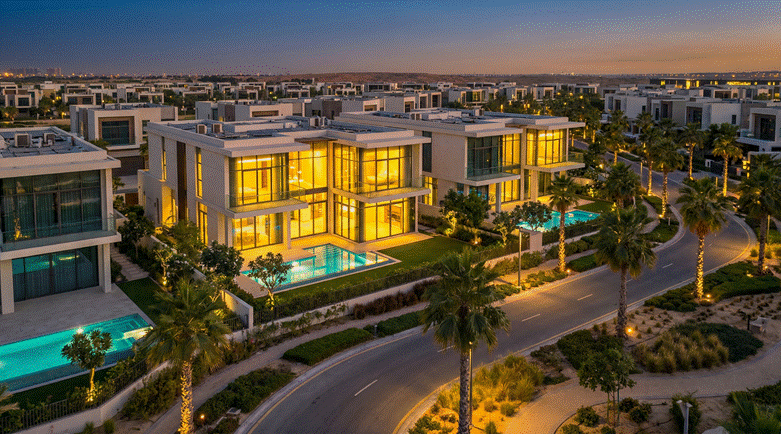
If you are evaluating Dubai property investment options in 2026, the villa segment deserves your full attention. It is outperforming apartments by more than double on price growth, and the reasons are structural, not speculative.
Emirates Hills posted a 17.6% price increase quarter-on-quarter. Sobha Hartland gained 12%. Arabian Ranches, The Valley, Mudon, and The Springs all recorded between 5% and 7% quarterly appreciation. These are not fringe communities. They are established, infrastructure-backed, family-oriented neighbourhoods with limited ready supply and strong end-user demand.
Off-plan villa registrations (Oqood) have surged to 46% of Q1 villa transactions, up sharply from just 17% in Q2 2025. Developers are responding to demand with aggressive launches. DAMAC Islands 2 alone recorded 768 transactions in March, making it the third-busiest area in the entire market for the month.
For investors: the villa cycle has room to run, and entry points in emerging communities with strong developer backing offer some of the best risk-adjusted returns in Dubai property investment in 2026.
| Community | Q4 2025 (AED/sqft) | Q1 2026 (AED/sqft) |
| Emirates Hills | AED 7,684 | AED 9,037 (+17.6%) |
| Sobha Hartland | AED 2,157 | AED 2,416 (+12.0%) |
| Victory Heights | AED 1,965 | AED 2,120 (+7.9%) |
| Mudon | AED 1,497 | AED 1,601 (+6.9%) |
| Arabian Ranches | AED 2,172 | AED 2,305 (+6.1%) |
| The Valley | AED 1,427 | AED 1,503 (+5.3%) |
The Mid-Market Opportunity Nobody Is Talking About
While headlines focus on Palm Jumeirah and Emirates Hills, the strongest price momentum for Dubai property investment in 2026 is coming from a completely different tier.
Al Jaddaf apartments gained 22.7% quarter-on-quarter. Barsha Heights (Tecom) jumped 18.1%. Al Khail Heights rose 10.3%. Discovery Gardens climbed 9.9%. These are communities where prices are still in the AED 800–1,400 per square foot range, accessible entry points with yields that premium locations can no longer match.
The concentration of market activity supports this. Dubai South led all areas in March with 1,001 transactions. Jumeirah Village Circle recorded 873. Majan logged 573. These are high-volume, mid-market communities where tenant demand is deep, occupancy is strong, and capital appreciation is just beginning to accelerate.
Studio apartments generated the highest rental yield per square foot in March 2026 at AED 99/sqft. For yield-focused investors, the compact unit play in high-demand areas remains the most efficient entry point.
Sheikh Hamdan’s AED 1 Billion Package: What It Means for Property
On March 30, 2026 (right at the close of Q1) Sheikh Hamdan bin Mohammed bin Rashid Al Maktoum approved a sweeping AED 1 billion economic support package for Dubai businesses. The key measures:
- Government fees deferred for three months across all Dubai businesses
- Hotels received a 100% break on sales fees
- Customs grace periods extended from 30 to 90 days
- Fast-track residency permits introduced for talent retention
- Relief applied starting April 1, 2026 to tourism operators, importers, and service businesses
This matters for real estate investors for a direct reason: business continuity support sustains occupier demand. When companies are not scrambling to cover operational costs, they retain staff, maintain headcount, and keep leasing residential space. The package is a signal that Dubai’s leadership understands the mechanics of confidence and is willing to deploy capital to protect it.
It also comes against a backdrop of genuine economic strength. Dubai’s GDP reached AED 937 billion with 5.4% growth in Q4 2025. The emirate is not operating from a position of distress. The support package is not a rescue, it is momentum management.
The Elephant in the Room: Geopolitical Risk
Any honest guide to Dubai property investment in 2026 has to acknowledge the broader regional context. The ongoing conflict across the Middle East has created uncertainty that extends well beyond the immediate theatre. Global investors are recalibrating risk, capital flows are shifting, and some markets in the region are experiencing genuine disruption.
Dubai, characteristically, has responded by leaning into its structural advantages. The city’s neutrality, its status as a global logistics and financial hub, and its diversified economy have historically attracted capital from conflict zones rather than losing it. During periods of regional instability, Dubai has consistently served as the safe harbour, for families, for businesses, and for investment portfolios.
The Q1 2026 data reflects this. Despite a global environment full of uncertainty, 44,480 buyers and sellers transacted residential property in Dubai. AED 139.2 billion changed hands. Prices rose. That is not the behaviour of a market losing confidence, it is the behaviour of a market being repriced as a global flight-to-quality destination.
Where other governments have been reactive, Dubai has been proactive. Using its fiscal firepower to smooth volatility, retain talent, and signal to global capital that this is where resilience lives.
The Risks Investors Must Not Ignore
This is not a market without risk. The 73% off-plan share in apartments means a substantial supply pipeline is being created today that will enter the secondary market in 2027 and 2028. In high-volume communities like Dubai South, JVC, and Dubai Production City, the cumulative effect of new supply hitting simultaneously could compress prices and extend time-to-let.
Rental yields are also compressing in premium areas. Apartment rents declined an average of 11.4% quarter-on-quarter, with only three of 57 tracked communities posting increases. Investors buying at today’s prices in Palm Jumeirah or Downtown Dubai should underwrite yields of 4–5%, not the 6–7% that was achievable 18 months ago.
The volume softening, if it continues beyond Ramadan into Q2 2026, will also be worth watching. Sustained declines in transaction activity have historically preceded price corrections by two to three quarters. The data is not there yet, but it is a trend to monitor closely.
What This Means If You Are Investing Right Now
Dubai property investment in 2026 rewards clarity of purpose more than ever before.
| Your Goal | Best Strategy |
| Capital Growth | Villas in Arabian Ranches, Sobha Hartland, The Valley, Mudon. Mid-market apartments in Al Jaddaf, Barsha Heights, Al Khail Heights. |
| Rental Income | Studios & 1-bed units in Dubai South, JVC, Motor City, Arjan. Target AED 99/sqft rental yields. |
| Capital Preservation | Dubai’s macro fundamentals — AED 937B GDP, 5.4% growth, government surplus, flight-to-quality positioning. |
| Off-Plan Entry | Early-stage developer projects in well-located communities. Focus on established developers with delivery track records. |
Talk to Veer & Sant
We work with the data every month so you do not have to guess. Whether you are entering the Dubai market for the first time or rebalancing an existing portfolio, our team can identify the right asset, the right community, and the right timing for your specific objectives.