Let’s start with honesty. The last two weeks have been frightening. Iranian missiles and drones struck the UAE. Landmarks were hit. The airport was evacuated. People were injured. Six people died. Families panicked. Some packed their bags and left. That fear is real, valid, and understandable.
This article is not here to dismiss any of that. If you’re in the UAE and you don’t feel safe, leaving is a legitimate decision that nobody should criticise.
But if your decision is about where to put your money, your career, or your family’s long-term future, then fear alone is a terrible guide. Data is a better one. And when you put Dubai and the UK side by side the two most common choices for the English-speaking investor, the numbers tell a story that the headlines don’t.
The UK, the “safe” alternative many are considering, is quietly experiencing a structural economic decline that no air defence system can protect you from: stagnant GDP, the highest tax burden in modern history, collapsing disposable income, crumbling infrastructure, and a property market that has made homeownership a fantasy for an entire generation.
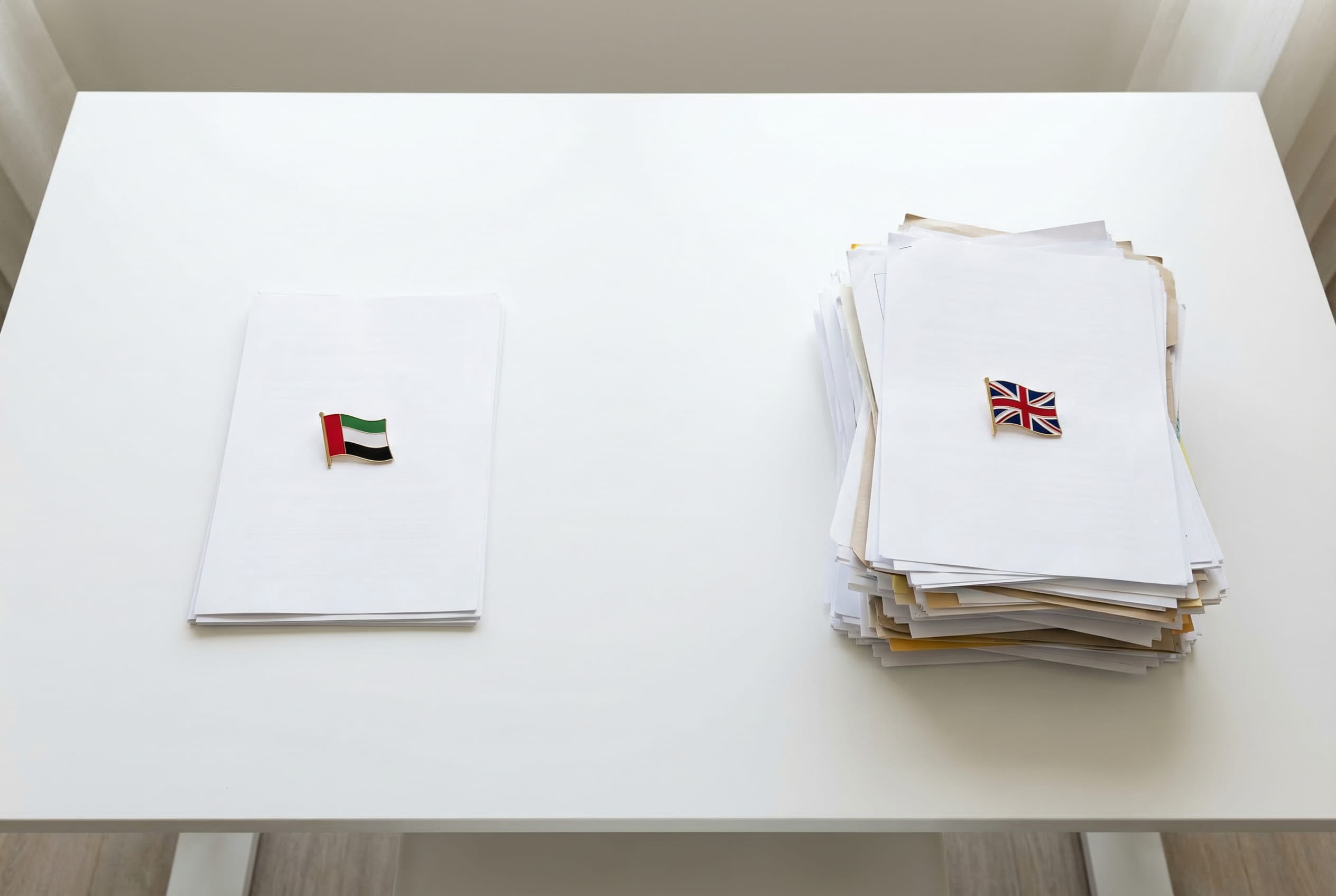
Here are 20 data points, all sourced from official institutions, that put both countries side by side as of March 2026.
The Comparison: Dubai vs UK by the Numbers
| METRIC | 🇦🇪 DUBAI / UAE | 🇬🇧 UNITED KINGDOM |
| GDP Growth (2026 Forecast) | 5.0% (IMF) | 0.9% (EY ITEM Club) |
| GDP Growth Trend | Accelerating (4.0% → 4.8% → 5.0%) | Decelerating (1.4% → 0.9%) |
| Population Growth (2025) | 5.2% (+208,000 in Dubai alone) | 0.5% (ONS estimate) |
| Unemployment Rate | ~2.8% (UAE, IMF) | 5.1–5.2% (ONS, highest since 2020) |
| Personal Income Tax | 0% | 20–45% (plus NI contributions) |
| Capital Gains Tax | 0% | 18–24% (residential property) |
| Corporate Tax | 9% (above AED 375K profit) | 25% (main rate) |
| Tax Burden (% of GDP) | ~15% (estimated) | 37–38% → rising to all-time high of 38%+ by 2029 (OBR) |
| Inheritance Tax | 0% | 40% above £325K threshold |
| Avg Gross Rental Yield | 5–7% (citywide), up to 8–9% in JVC/Arjan | 3–4% (London), 5–6% (regional UK) |
| Property Transaction Volume (2025) | 270,000+ transactions (AED 917 billion) | ~1 million (approx, HMRC data, declining) |
| Property Price Trend | 13% growth YoY (Cushman & Wakefield) | ~1–2% (Nationwide, sluggish) |
| Property Purchase Tax | 4% DLD fee (one-time) | 0–12% Stamp Duty + ongoing Council Tax |
| Annual Property Tax | None | Council Tax: £1,200–£5,000+/year |
| Cost of Living (Numbeo Index) | Lower in housing, transport, dining | Higher across food, energy, rent, tax |
| Disposable Income Growth | Strong (driven by zero income tax) | 0.25%/year forecast (OBR) — near zero |
| Energy Bills | Low (subsidised, stable) | Among highest in Europe (OFGEM) |
| Inflation (2026) | ~2–3% (projected) | 2.5–3.5% (OBR, slow to reach target) |
| Long-Term Residency | 10-year Golden Visa (AED 2M property) | No property-linked visa exists |
| Business Setup Time | 24–48 hours (free zone) | 1–4 weeks (Companies House + HMRC) |
Sources: IMF World Economic Outlook (Jan 2026), UAE Ministry of Economy, OBR Economic & Fiscal Outlook (March 2026), EY ITEM Club Winter Forecast, ONS Labour Market Statistics, Dubai Land Department (DXB Interact), Cushman & Wakefield Core, Knight Frank, Nationwide House Price Index, HMRC Property Transaction Stats, Numbeo Cost of Living Index, OFGEM.
Unpacking the Numbers: What the Table Actually Means
The GDP Story: 5% vs 0.9%
The UAE economy is forecast to grow at 5.0% in 2026, the fastest rate among all GCC countries and well above the global average. This is driven by economic diversification, population growth, sustained foreign investment, and infrastructure spending under the D33 agenda. By contrast, the UK is forecast to grow at just 0.9%, with EY’s ITEM Club describing it as “another dismally anaemic year.” UK productivity growth has been essentially flat for 16 years — the worst performance of any major developed economy.
GDP growth matters because it drives job creation, wage growth, business opportunities, and property demand. A 5% growth economy absorbs new housing supply, supports rental demand, and creates upward pressure on property values. A 0.9% growth economy does the opposite.
The Tax Gap: 0% vs 45%
This is the structural advantage that no crisis changes. In Dubai, you keep 100% of your income. No income tax, no capital gains tax, no inheritance tax, no annual property tax. The UAE’s overall tax burden sits at approximately 15% of GDP.
In the UK, the tax burden is at 37–38% of GDP and heading toward an all-time record of 38%+ by 2029 according to the OBR’s own March 2026 forecast. Income tax rates range from 20% to 45%, capital gains tax on property is 18–24%, inheritance tax is 40% above a £325,000 threshold, and frozen income tax thresholds mean millions of people are being dragged into higher tax bands every year through fiscal drag.
For a professional earning £100,000 in the UK, the effective combined tax rate (income tax + NI + student loan) is approximately 42–47%. That same professional in Dubai keeps 100% of their gross income. Over a 10-year career, the tax savings alone can fund a property portfolio.
The Property Numbers: Yields, Growth, and Costs
Dubai’s property market recorded 270,000+ transactions worth AED 917 billion in 2025, a record year with 20% growth. Prices appreciated 13% year-on-year, and gross rental yields range from 5–7% citywide, with some areas achieving 8–9%. There is no annual property tax, and the only purchase levy is the one-time 4% DLD fee.
The UK property market is a different picture. Price growth has been anaemic at 1–2% annually. London yields sit at 3–4%, barely covering mortgage interest at current rates. Stamp Duty ranges from 0% to 12% depending on value, and on top of that, every property owner pays Council Tax annually (£1,200–£5,000+ per year depending on band and location). Capital gains tax on sale is 18–24%. And the government has signalled that property taxation may increase further to meet fiscal targets.
A UK investor who buys a £500,000 property, earns 4% yield, and sells after 5 years for £550,000 will pay approximately £15,000 in Stamp Duty, £15,000+ in Council Tax over 5 years, and up to £12,000 in Capital Gains Tax. A Dubai investor in an equivalent AED 2M property pays AED 80,000 DLD fee (one-time), zero annual tax, and zero capital gains tax on exit. The net difference is tens of thousands of pounds.
The Disposable Income Crisis
The OBR’s March 2026 forecast projects that real household disposable income per person will grow by just 0.25% per year essentially flat. In fact, UK disposable income per person is forecast to remain below pre-pandemic levels for years. Meanwhile, wages are stagnating, the tax burden is rising, energy bills remain among the highest in Europe, and housing costs continue to absorb a growing share of household income.
In Dubai, with zero income tax, subsidised energy, competitive housing costs relative to income, and strong wage growth in key sectors, disposable income is structurally protected. This isn’t just a lifestyle argument, it’s a financial one.
Addressing the Elephant in the Room: The Security Situation
None of the data above changes the fact that missiles hit Dubai in late February and early March 2026. That is real. So let’s put the security context in data terms as well:
- Over 90% of incoming missiles and drones were intercepted by UAE air defences. The interception rate has been among the highest of any country under missile attack in modern history.
- Six people were killed — all from falling debris, not direct strikes. Every death is a tragedy. For context, the UK records approximately 700 knife crime homicides per year.
- Daily life in Dubai has continued. Shops opened, businesses operated, schools functioned. The government avoided alarmist messaging and maintained public services throughout.
- The conflict is between Iran and the US/Israel, not between Iran and the UAE. The UAE recalled its ambassador to Israel, signalling clearly that this is not a war the Gulf states chose or want. Diplomatic resolution is actively being pursued.
- Dubai has survived crises before. The 2008 financial crash, the 2020 pandemic, the 2020 oil price collapse each time, the city rebuilt faster than analysts predicted. The question isn’t whether Dubai recovers, but how quickly.
The UK, by contrast, faces risks that are slower but arguably more corrosive: a National Health Service in chronic crisis, a housing affordability emergency, rising youth unemployment, crumbling water and transport infrastructure, and a political class that has presided over 16 years of flat productivity growth. These problems have no interception system.
The honest framing: Dubai faces a temporary geopolitical shock with strong fundamentals. The UK faces a structural economic decline with no clear recovery timeline. Which risk would you rather take with your money?
Who Should Read This (And What to Do Next)
If You’re a UK Investor Watching Dubai from Afar
The headlines are designed to scare you. That’s what headlines do. But property markets don’t move on headlines they move on fundamentals. Dubai’s population is growing at 5.2% per year. Over 270,000 property transactions happened in 2025. GDP is growing at 5%. And you pay zero tax on your rental income. Every crisis in Dubai’s history has been followed by a buying window that the people who stayed or arrived capitalised on massively.
If You’re a Dubai Resident Getting Pressure from Family Back Home
Send them this article. Not to dismiss their concerns, but to show them the data. The conversation shouldn’t be “are you safe?” (that’s a personal, emotional decision you’re entitled to make). The conversation should be: “compared to what?” The UK they’re suggesting you return to has 5.1% unemployment, the highest tax burden in modern history, and disposable income growth of essentially zero. The “safe” option isn’t free of cost.
If You’re Thinking of Selling Your Dubai Property
Panic selling during a crisis is historically one of the worst financial decisions you can make. Dubai’s property market absorbed the 2008 crash, the 2014 oil rout, and the 2020 pandemic and reached all-time highs by 2025. If your property is in a structurally strong segment (villa, waterfront, established community), the fundamentals haven’t changed. The crisis is temporary. Your asset is long-term.
Frequently Asked Questions
Is Dubai safe to invest in right now (March 2026)?
The security situation is evolving and requires monitoring. However, Dubai’s economic fundamentals population growth, GDP growth, zero income tax, strong property demand remain intact. Crisis periods have historically created buying opportunities in Dubai’s property market for investors with a medium to long-term horizon.
Are property prices falling in Dubai because of the conflict?
As of mid-March 2026, there has been no reported broad-based price correction in Dubai’s property market. Transaction data for January 2026 showed AED 111 billion in deals — a record. While some short-term uncertainty may affect sentiment, structural supply constraints in villas and prime areas continue to support values.
Is the UK a safer investment than Dubai?
Safer from a geopolitical standpoint in the short term, but not from a financial standpoint. UK GDP growth is projected at 0.9%, the tax burden is approaching a historic high (38%+ of GDP by 2029), disposable income is stagnant, and property yields are significantly lower than Dubai. “Safety” has multiple dimensions financial security matters too.
Will expats return to Dubai after the crisis?
History suggests yes. Dubai’s population recovered rapidly after every previous crisis. The structural pull factors zero income tax, world-class infrastructure, safety (outside geopolitical events), business environment, and quality of life remain compelling relative to alternatives. The question is timing, not direction.
Should I buy property in Dubai during the crisis?
This is not financial advice, and every individual’s circumstances differ. What data shows is that previous Dubai crises (2008, 2020) created significant buying opportunities for those who entered the market during uncertainty and held for 3–5 years. If your financial position is strong and your investment horizon is medium to long term, the data suggests fundamentals remain favourable.
How does Dubai’s tax saving compare to UK over 10 years?
A professional earning AED 500,000/year (approximately £100,000) saves roughly £35,000–40,000 per year in income tax alone compared to a UK equivalent. Over 10 years, that’s £350,000–£400,000 in tax savings enough to purchase an additional investment property outright.
The Bottom Line
No data table can tell you whether to stay or go. That’s a personal decision involving family, emotions, risk tolerance, and circumstances that no spreadsheet captures.
But if the question is “where do the fundamentals point?”, the answer hasn’t changed. Dubai’s economy is growing 5x faster than the UK’s. Its tax regime saves the average professional hundreds of thousands of pounds over a decade. Its property market delivers 2–3x the yields. Its population is growing 10x faster. And its track record of rebuilding after crises is among the strongest of any city on earth.
The UK offers political stability and distance from the current conflict. It also offers stagnant growth, rising taxes, collapsing disposable income, and a property market that has locked an entire generation out of ownership.
Missiles make headlines. Structural decline doesn’t. But over 10 years, it’s the structural decline that costs you more.