
Since late February 2026, the UAE has found itself in the crosshairs of a regional conflict it never asked for. Following coordinated Israeli and US strikes on Iran, the Islamic Republic launched a sustained campaign of missile and drone attacks targeting multiple Gulf states, with the UAE absorbing a disproportionate share of the fire.
Social media erupted. Videos of expats crying at the airport went viral. Private jet evacuation prices reportedly surged to $250,000 on a single day in early March. Influencers who had spent years selling the “Dubai dream” suddenly went silent or packed their bags.
But what does the actual data say? Is Dubai genuinely unsafe, or are we witnessing a panic driven more by algorithm-fed fear than by ground-level reality? In this article, we separate emotion from evidence and let the numbers speak for themselves.
The UAE’s Air Defense: A 90%+ Interception Rate
According to the UAE’s Ministry of Defense and official WAM news agency reports, as of early April 2026 the country’s multi-layered air defense network, built on the US-supplied THAAD (Terminal High Altitude Area Defense) and Patriot missile systems, has intercepted over 520 ballistic missiles, more than 2,200 drone attacks, and 26 cruise missiles.
The interception rate has consistently remained above 90 percent. In practical terms, out of roughly 2,400 incoming threats directed at the UAE, only a handful of drone fragments reached ground level. The total civilian death toll stands at 13 people, with 221 injuries reported across all emirates. Every loss of life is tragic, but for context, the annual road traffic fatality rate in the UAE has historically averaged around 500 to 600 deaths per year.
To put it bluntly: as of April 2026, you are statistically far more likely to be involved in a car accident on Sheikh Zayed Road than to be harmed by an incoming missile in Dubai.
The US government has also approved a $4.5 billion THAAD radar and command restoration package for the UAE, signaling long-term confidence in the country’s defense architecture. This is not a temporary patch. It is a multi-billion dollar strategic investment in keeping the UAE protected for decades to come.
Business Continuity: Dubai Never Stopped
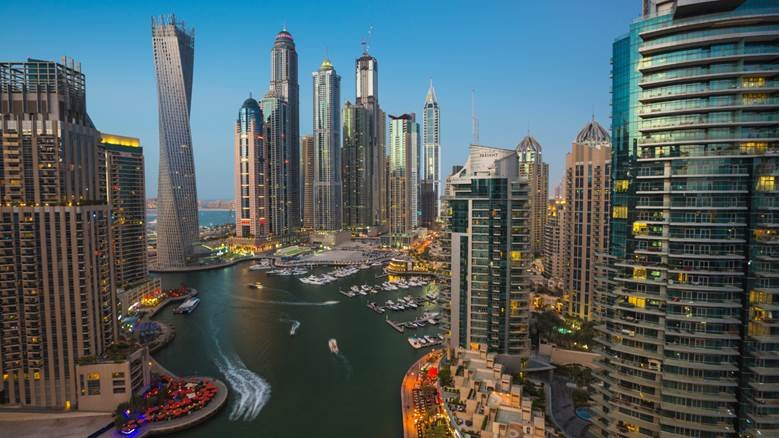
One of the most telling indicators of stability is whether the economic machinery keeps running. In Dubai, it has not missed a beat.
Between March 2 and March 9, 2026, the first full week after hostilities began, the emirate recorded 3,570 real estate sales transactions worth a total of AED 11.93 billion (approximately $3.24 billion). Average home prices dipped by a modest 4 to 5 percent, a fraction of the 40 percent crash that social media doomers predicted.
Banks continued to operate. The Dubai Land Department processed transfers without interruption. Schools remained open. Dubai International Airport maintained flight schedules, with some understandable adjustments for airspace safety. Malls, restaurants, and entertainment venues stayed open for business throughout.
Emaar Properties, the developer behind the Burj Khalifa and Dubai Mall, publicly confirmed that all communities, malls, hotels, and development projects were operating normally. The company reported AED 17.2 billion in UAE property sales in just the first two months of 2026, representing a 118 percent increase compared to the same period in 2025.
Developer Cash Reserves: Why Your Investment Is Protected
For property investors, the question is not just whether Dubai is safe to live in, but whether their capital is protected. The answer lies in developer balance sheets.
Emaar holds approximately AED 7.5 billion in cash and nearly AED 12 billion in escrow accounts. Their revenue backlog stands at AED 155 billion, providing clear visibility over future earnings and cash flows. For perspective, their cash reserves alone exceed the entire GDP of Iceland.
Even mid-tier developers like Sobha are carrying over half a billion dollars in cash reserves, with roughly AED 6 billion in escrow. Major developers have already paid for two to three years of upcoming construction work in advance.
What does this mean for buyers? It means your off-plan investment is not sitting in a developer’s operating account waiting for the next sales cycle to fund construction. It is ring-fenced in escrow, protected by regulation, and backed by companies with years of runway already secured.
The Stock Market Dip vs. Actual Property Prices
One of the most misunderstood data points during this conflict has been the Dubai Financial Market (DFM) real estate index, which dropped more than 15 percent in a single week after the conflict began.
Social media seized on this graph as proof that “Dubai is over.” But this interpretation reflects a fundamental misunderstanding of how markets work. The DFM index tracks developer stock prices, not property values. When regional tensions spike, institutional investors sell equities across the board. It happened to US tech stocks after COVID. It happened to European banks during the Ukraine war. It happened to Dubai’s listed developers in March 2026.
But here is what the doom merchants never mention: actual property prices have declined by just 4 to 7 percent. Transaction volumes remain healthy. As one market insider put it on the J2Hub podcast: if Apple stock drops 30 percent tomorrow, you do not suddenly see iPhones selling at half price. The logic applies here. Stock volatility and asset value are two very different things.

Who Left, Who Stayed, and Why It Matters
Approximately 88 percent of the UAE’s population of over 10 million people are expatriates. Some left during the first days of the conflict. Social media amplified their departures to make it seem like a mass exodus. But the reality on the ground tells a different story.
As CNBC reported in mid-March 2026, life in Dubai is “functioning but tense.” Day-to-day routines continue. Social events happen. Businesses transact. The expats who remain, which is the overwhelming majority, describe a city that is vigilant but far from paralyzed.
More than 240,000 British nationals call Dubai home, a number that has more than doubled since 2010. UK-to-UAE migration inquiries surged by 420 percent over the past five years, driven by tax policy, lifestyle, and opportunity, none of which have changed because of this conflict.
Here is what the J2hub podcast hosts observed on the ground: the people who left at the first sign of trouble are, by and large, not the investors, entrepreneurs, or long-term residents who built their lives here. They are the ones who came for a trend. The serious money, the family offices, the multi-property investors, they are still here, and many are actively looking for deals in a temporarily soft market.
The Recovery Timeline: Why August 2026 Is the Key Date
Even without a conflict, March through August is historically Dubai’s softest real estate period. Ramadan, spring school breaks, and summer holidays create a natural slowdown every year. The conflict has amplified this seasonal dip, but it has not fundamentally altered the market structure.
Industry insiders expect that if the conflict stabilizes or concludes by mid-2026, Dubai’s property market will rebound sharply by August or September. This is consistent with every previous external shock Dubai has weathered, from the 2008 financial crisis to the 2020 pandemic. In each case, the market overcorrected downward, then snapped back stronger.
The government’s Dubai 2040 Urban Master Plan and the Dubai Economic Agenda D33 remain firmly on track. Infrastructure spending has not been paused. Visa reforms continue to attract global talent. The structural tailwinds that made Dubai the world’s top destination for incoming millionaires have not changed.
Should You Leave? A Data-Driven Decision Framework
If you are considering leaving Dubai, or if you already left and are wondering whether to return, here is a framework based on what the data actually shows.
The UAE’s air defense system has a 90 percent-plus interception rate and is being reinforced with billions of dollars in new hardware. Total civilian casualties across the entire country remain lower than a single month of traffic fatalities. Property prices have dipped modestly, not collapsed. Developer balance sheets are the strongest they have ever been. The city’s economic infrastructure has not stopped operating for a single day. Long-term fundamentals including tax policy, quality of life, geographic position, and government vision remain unchanged.
Leaving Dubai is a personal decision that no article can make for you. But if you are making that decision based on viral TikTok videos and fear-driven headlines, you owe it to yourself and your family to look at the data first.
Final Thought
Dubai was not built on a five-minute dream. It was engineered by a leadership with a generational vision and it has weathered every storm that has come its way. This conflict is serious, and it deserves to be taken seriously. But the numbers do not support a narrative of collapse or mass exodus. They support a narrative of resilience, preparedness, and a city that keeps moving forward.
For a deeper discussion on this topic, including firsthand perspectives from residents, investors, and industry professionals, watch the full J2hub podcast episode:
👉 Watch the FullReal Estate Podcast Episode on YouTube