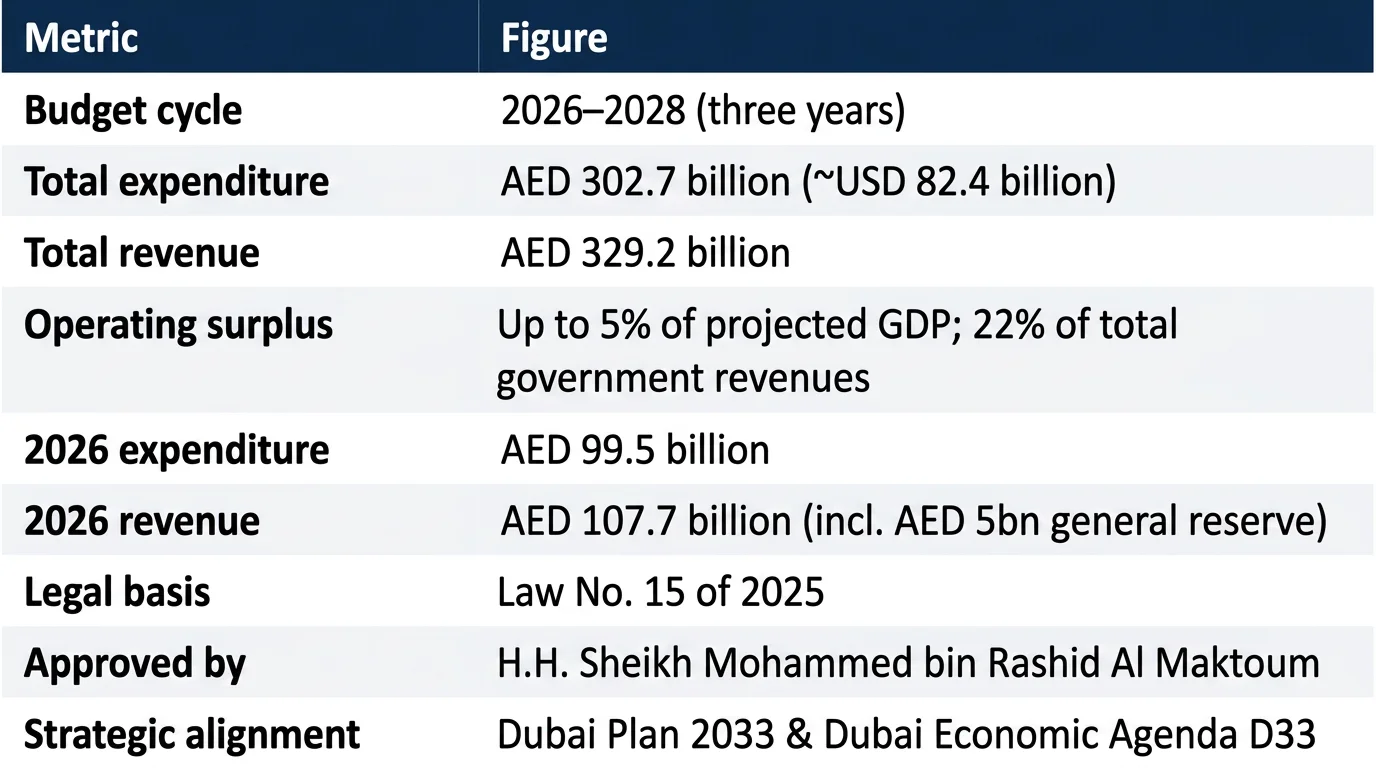
On 23 November 2025, Dubai’s Ruler, His Highness Sheikh Mohammed bin Rashid Al Maktoum, approved Law No. 15 of 2025, establishing the Government of Dubai’s general budget cycle for the 2026–2028 financial years. The headline figure is the largest in the emirate’s history: AED 302.7 billion in total expenditure against AED 329.2 billion in projected revenue. Crucially, this is a surplus budget) planned income exceeds planned spending by more than AED 26 billion over the three years.
Dubai’s Department of Finance (DOF) was clear that the plan is built for delivery, not headlines: contracts are being signed, construction is under way, and services are already funded. For anyone who lives in Dubai or is weighing an investment here, the budget is one of the clearest, most concrete signals of where the city is heading between now and the end of the decade. This guide unpacks the real figures, how the money is allocated sector by sector, the flagship projects it supports, the fiscal thinking behind it, and (most importantly) what it practically means for investors and residents.
Dubai Budget 2026–2028 at a Glance
The dirham is pegged to the US dollar (USD 1 ≈ AED 3.67), so these totals hold steady in dollar terms, useful context for foreign investors comparing Dubai against other global markets.
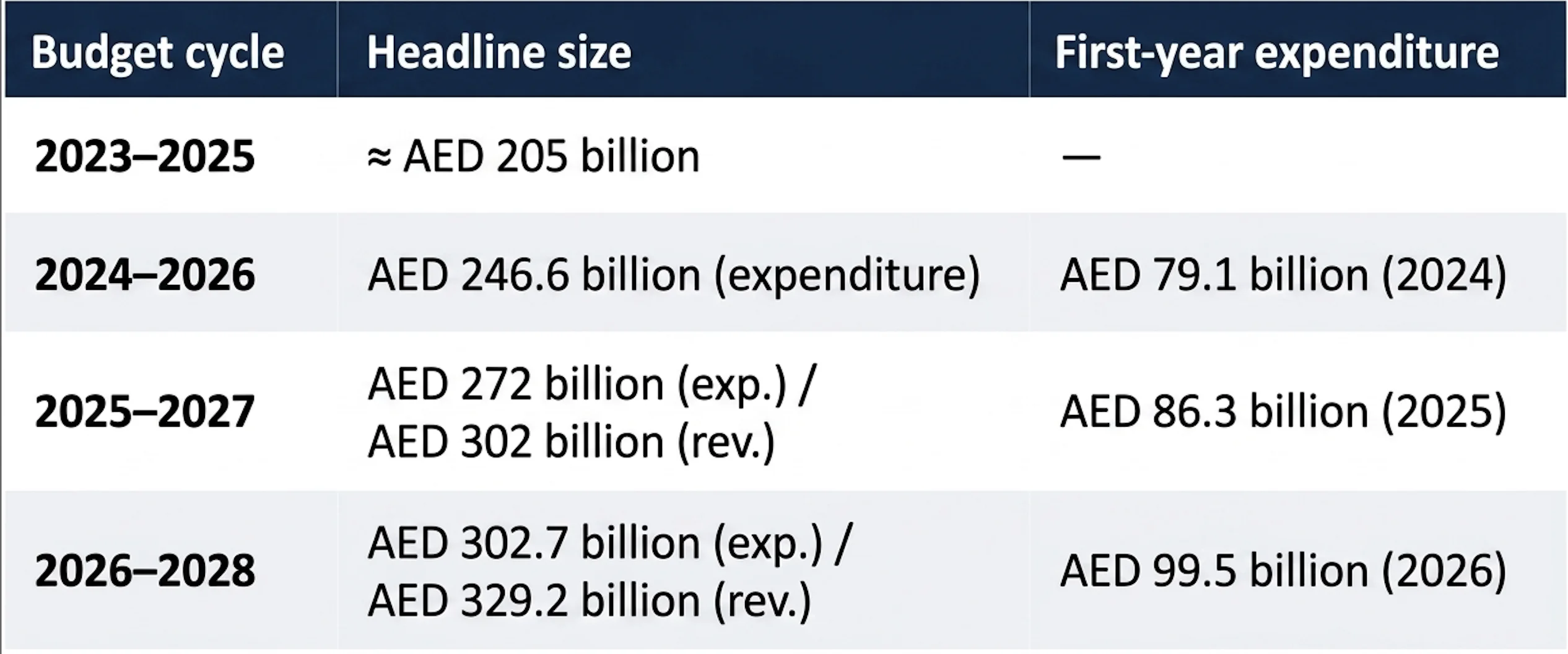
A Record Budget — But Part of a Longer Trajectory
Dubai has expanded its rolling three-year budget every cycle, and the jump in single-year spending tells the story most clearly. The 2026 expenditure of AED 99.5 billion is roughly 15% higher than the AED 86.3 billion spent in 2025, and it is the first time the annual figure has approached the AED 100 billion mark.
What makes the number notable is not just its size but its structure. Dubai is spending at record levels while still planning for a surplus, funding an annual reserve, and keeping debt on a managed path. For a government, that combination (ambition plus discipline) is exactly what supports strong credit ratings and long-term investor confidence.
Where the Money Goes: 2026 Sector Allocation
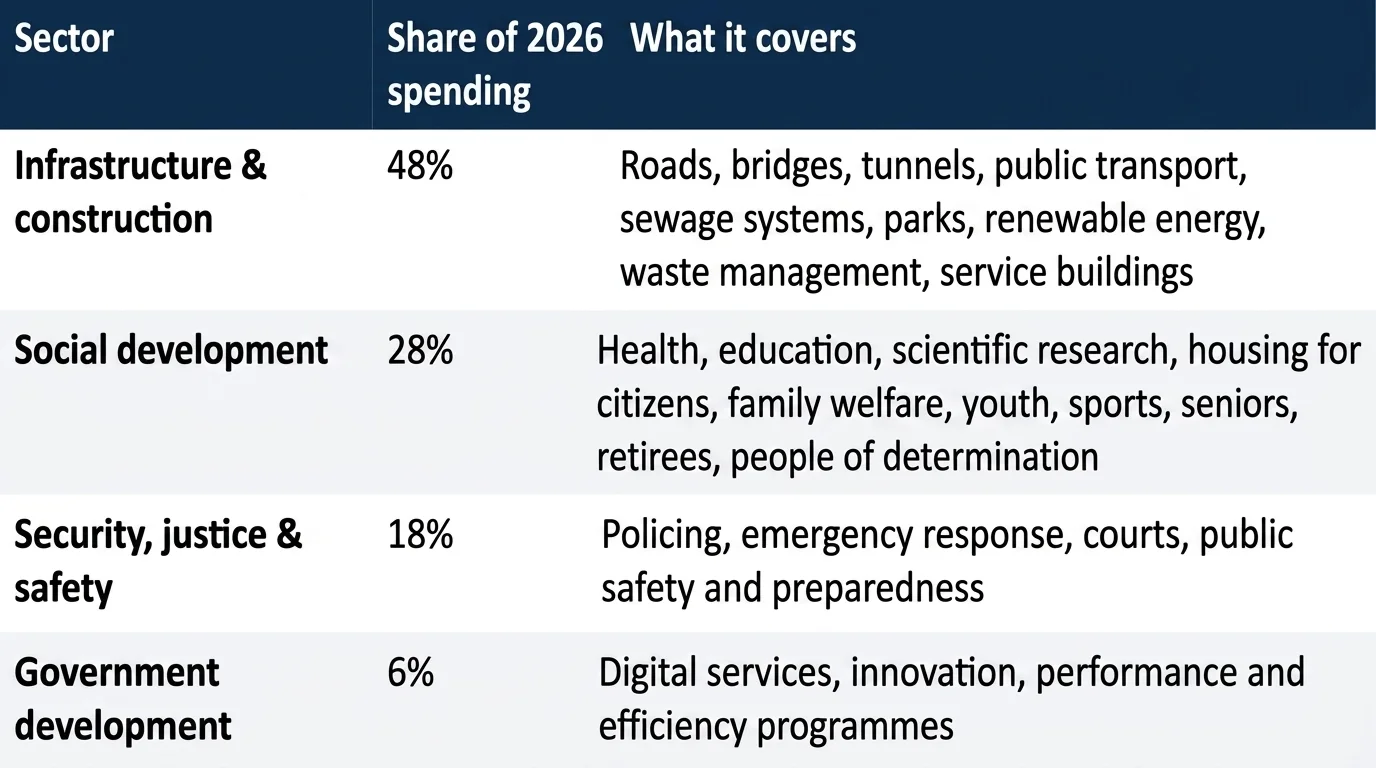
The Department of Finance divides the 2026 budget into four sectors. Almost half of all spending is directed at physical infrastructure, and more than a quarter goes to social services, a split that reflects a city building capacity ahead of a fast-growing population.
Infrastructure & construction (48%)
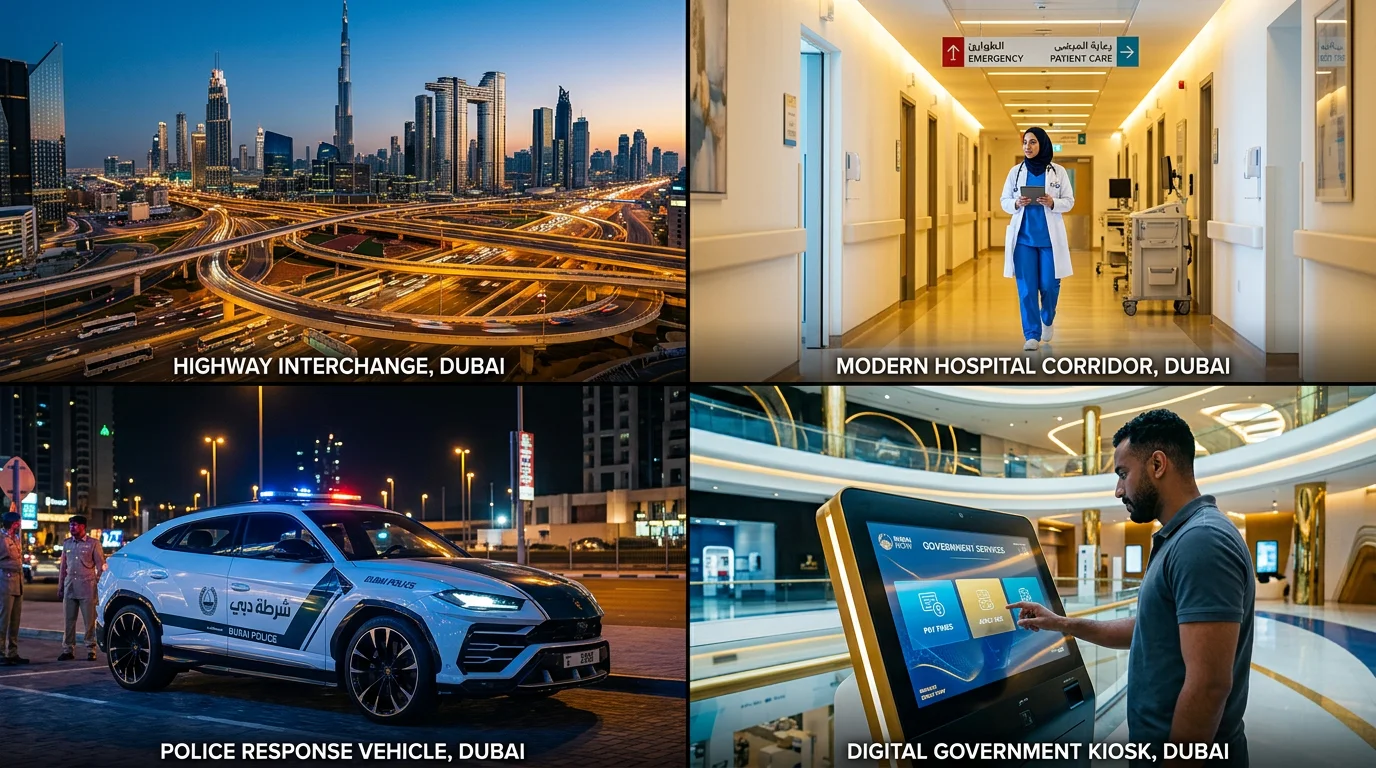
The largest slice funds the physical backbone of the city: new road networks and interchanges, bridges and tunnels, expanded public transport, sewage and drainage upgrades, renewable energy facilities, parks, and waste-management systems. This is the category that most directly shapes property values and business logistics — connectivity and utilities are the groundwork on which everything else is built.
Social development (28%)
More than a quarter of the budget goes to people-centred services. This covers the healthcare network (hospitals, clinics, and research), education and scientific research, housing for Emirati citizens, and welfare programmes spanning families, youth, sport, seniors, retirees, and people of determination. It is the part of the budget residents feel most directly in day-to-day life.
Security, justice & safety (18%)
Dubai consistently ranks among the safest major cities in the world, and this allocation is designed to keep it there, funding policing, faster emergency response, the courts, and broader public-safety preparedness. Safety is also an underrated economic asset: it supports tourism, talent attraction, and family relocation.
Government development (6%)
The smallest but strategically important slice funds the modernisation of government itself: digital services, innovation programmes, and efficiency initiatives. It underwrites the shift toward faster, paperless, citizen-friendly administration, including the newly launched Dubai Government Unified Contact Centre (UCC), a single point of contact across all departments.
The Flagship Projects Behind the Numbers
A budget this size is easier to understand through the concrete projects it helps fund. Two stand out.
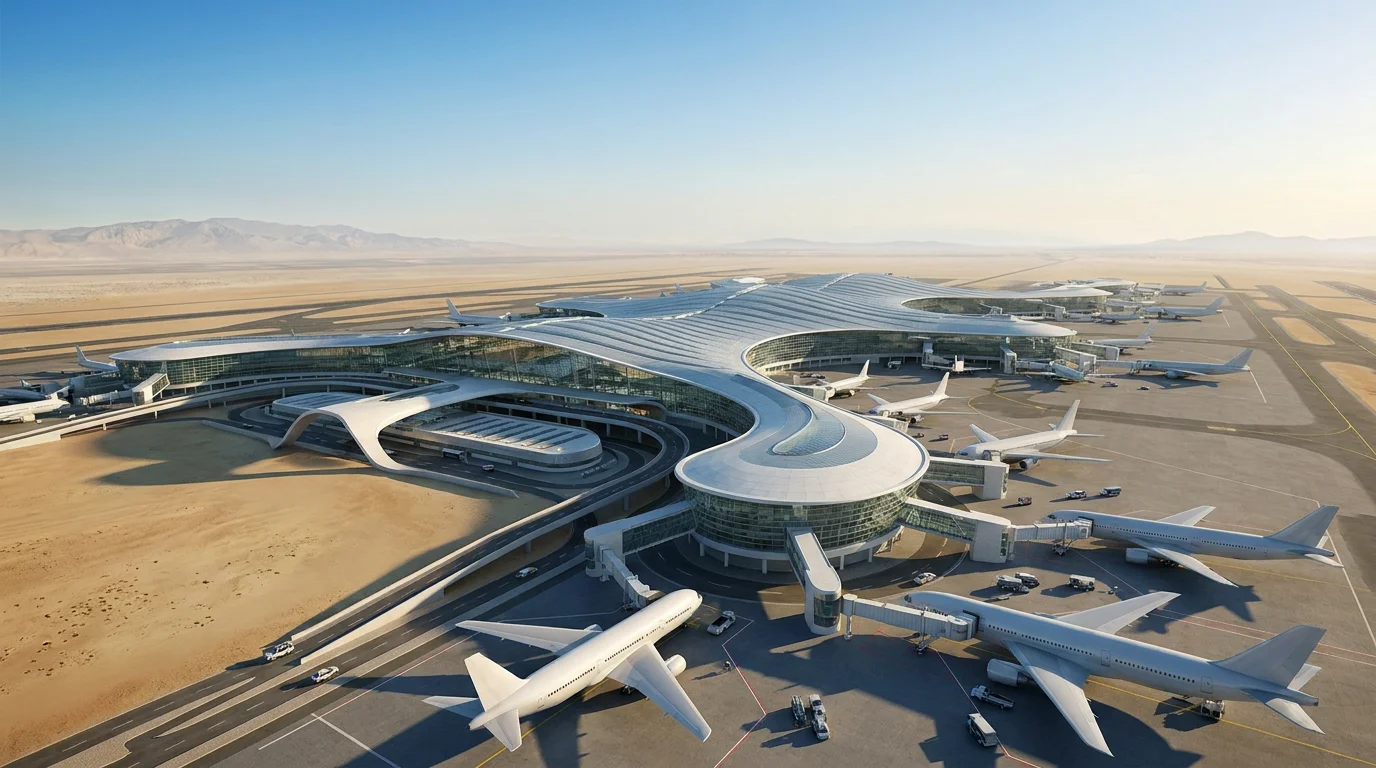
Al Maktoum International Airport (DWC) expansion
Dubai is building what is planned to be the world’s largest airport at Al Maktoum International in Dubai South. The Phase II expansion, approved in 2024, carries a price tag of roughly AED 128 billion (about USD 35 billion), and is designed to eventually handle up to 260 million passengers a year across five runways and more than 400 aircraft stands. The first major phase is targeted for a 2032 opening, and over time all operations from the current Dubai International Airport will move there. Infrastructure spending in successive budgets underpins the roads, utilities, and connectivity that make this mega-hub — and the surrounding Dubai South district — viable. For investors, it is reshaping the emirate’s next major real-estate growth corridor.
Transport, utilities, and a growing city
Beyond the airport, budget-funded infrastructure includes expansions to public transport, new roads and interchanges to ease congestion, drainage and sewage capacity, renewable energy, and green public spaces. The stated logic is to build ahead of demand: put the infrastructure in place before the population and economy need it, rather than playing catch-up.
The Population Story: Building Ahead of 4 Million Residents
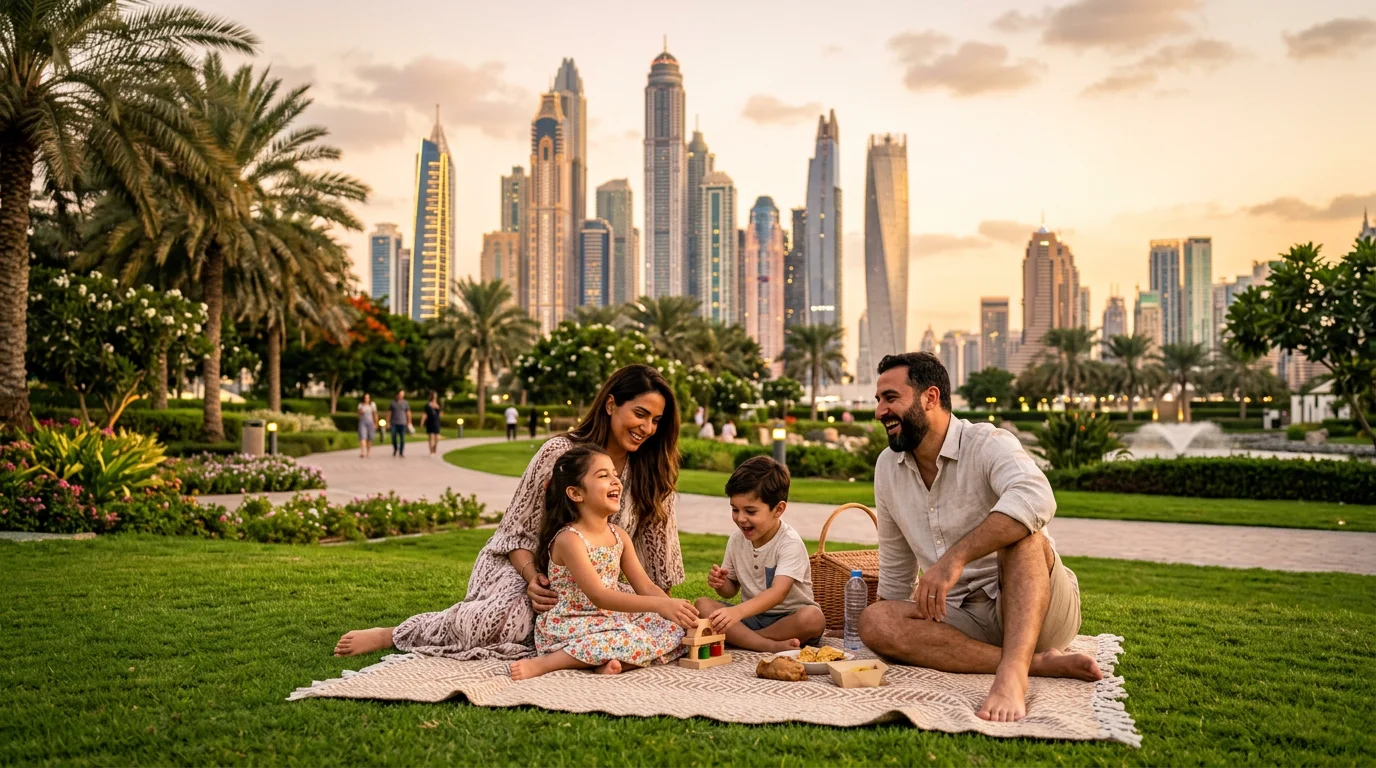
The infrastructure emphasis makes more sense against Dubai’s demographics. The emirate’s population crossed 4 million residents in June 2026, an all-time high, and roughly double the 2 million recorded in 2011. Growth has been driven by a steady influx of expatriates, professionals, and investors. If the pace holds, projections point toward 5 million by the early 2030s, tracking toward the 5.8 million envisioned in the Dubai 2040 Urban Master Plan.
More people means more demand for homes, schools, clinics, transport, and public services. Budgeting for that growth in advance is both a quality-of-life strategy for residents and a demand signal for anyone investing in property or consumer-facing businesses.
The Fiscal Discipline Behind the Ambition
What separates this budget from a simple spending headline is the financial framework around it. Several features stand out:
Al Maktoum International Airport (DWC) expansion
Dubai is building what is planned to be the world’s largest airport at Al Maktoum International in Dubai South. The Phase II expansion, approved in 2024, carries a price tag of roughly AED 128 billion (about USD 35 billion), and is designed to eventually handle up to 260 million passengers a year across five runways and more than 400 aircraft stands. The first major phase is targeted for a 2032 opening, and over time all operations from the current Dubai International Airport will move there. Infrastructure spending in successive budgets underpins the roads, utilities, and connectivity that make this mega-hub (and the surrounding Dubai South district) viable. For investors, it is reshaping the emirate’s next major real-estate growth corridor.
Transport, utilities, and a growing city
Beyond the airport, budget-funded infrastructure includes expansions to public transport, new roads and interchanges to ease congestion, drainage and sewage capacity, renewable energy, and green public spaces. The stated logic is to build ahead of demand: put the infrastructure in place before the population and economy need it, rather than playing catch-up.
The Population Story: Building Ahead of 4 Million Residents
The infrastructure emphasis makes more sense against Dubai’s demographics. The emirate’s population crossed 4 million residents in June 2026, an all-time high, and roughly double the 2 million recorded in 2011. Growth has been driven by a steady influx of expatriates, professionals, and investors. If the pace holds, projections point toward 5 million by the early 2030s, tracking toward the 5.8 million envisioned in the Dubai 2040 Urban Master Plan.
More people means more demand for homes, schools, clinics, transport, and public services. Budgeting for that growth in advance is both a quality-of-life strategy for residents and a demand signal for anyone investing in property or consumer-facing businesses.
The Fiscal Discipline Behind the Ambition
What separates this budget from a simple spending headline is the financial framework around it. Several features stand out:
A planned surplus. Revenue (AED 329.2bn) exceeds expenditure (AED 302.7bn), with an operating surplus targeted at up to 5% of GDP, equivalent to about 22% of total government revenues.
An annually funded reserve. The 2026 budget sets aside a AED 5 billion general reserve, part of a disciplined policy of building buffers against future shocks.
Medium-term planning. The three-year cycle aligns strategic planning with fiscal planning, improving spending efficiency and predictability for the private sector.
Global standards. Dubai is adopting International Public Sector Accounting Standards (IPSAS), among the first governments in the region to do so, and scores highly on the international Public Expenditure and Financial Accountability (PEFA) framework.
A cashless push. The Dubai Cashless Strategy and a new Financial Data Platform aim to make government finances more transparent, digital, and efficient.
Taken together, these are the ingredients of a stable, investment-grade fiscal position. As His Highness Sheikh Maktoum bin Mohammed bin Rashid Al Maktoum, First Deputy Ruler and Minister of Finance, framed it:
“Dubai has adopted a disciplined fiscal approach that supports the emirate’s robust financial position and strengthens investor and market confidence in its ability to continue undertaking long-term development projects without compromising its financial stability.” H.H. Sheikh Maktoum bin Mohammed bin Rashid Al Maktoum
What the Budget Means for Investors
For anyone deploying capital in Dubai (in property, a business, or a fund) the budget matters because government spending shapes the environment those investments operate in. Here is how to read it.
1. Infrastructure spending underpins property and logistics
With 48% of the 2026 budget going to roads, transport, and utilities — and mega-projects like the Al Maktoum Airport expansion in motion — connectivity keeps improving. Historically, districts that gain new metro links, road access, or airport proximity see stronger demand. Investors evaluating off-plan or emerging areas (Dubai South chief among them) should map opportunities against announced infrastructure corridors.
2. A pro-business, low-friction government
The government-development allocation funds digital services and the Unified Contact Centre — a single point of contact across departments. Faster permits, approvals, and online services lower the cost and time of doing business, which is material for company setup and day-to-day operations.
3. Population growth expands the customer base
With residents past 4 million and climbing, and infrastructure built ahead of that growth, consumer-facing businesses and residential landlords benefit from an expanding, high-income market. More people is a structural demand tailwind for rentals, retail, healthcare, education, and services.
4. Fiscal stability supports confidence
A record budget funded by a revenue surplus, an annual reserve, and global accounting standards is the kind of stability that supports credit ratings and long-term project delivery. It reduces the risk that major developments stall for fiscal reasons — a real consideration for multi-year investments.
5. Alignment with D33 priority sectors
The budget explicitly funds future-focused areas, artificial intelligence, digital economy, space research, and entrepreneurship. Investors positioned in the sectors Dubai is actively backing may find more supportive policy, funding, and infrastructure around them.
Practical takeaway for investors: align opportunities with the budget’s priorities, infrastructure-adjacent real estate, the Dubai South / airport growth corridor, and sectors named in the Dubai Economic Agenda D33 (AI, fintech, logistics, green tech). As always, this is general information, not investment advice, do your own due diligence.
What the Budget Means for Residents
For residents, the budget is less about macro figures and more about daily life. The 28% social allocation and 18% safety allocation translate into tangible, everyday services.
Healthcare: New funding flows into hospitals, clinics, and medical research, more capacity and more options for families as the population grows.
Education: Continued investment in schools and scientific research widens choices for children and supports a knowledge-based economy.
Safety: Dubai already ranks among the world’s safest cities; the budget funds faster police and emergency response to keep improving it.
Getting around: New roads, expanded public transport, and cleaner parks aim at smoother daily movement even as the city adds residents.
Government services: Permits, bills, and approvals are moving to faster online platforms, with one unified contact centre handling every department, one call, one answer.
Housing & welfare: The social sector explicitly includes housing for citizens and support for families, youth, seniors, retirees, and people of determination.
In short, the budget is designed so that a growing city keeps getting easier (not harder)to live in.
The Bigger Picture: D33 and Dubai Plan 2033
The budget is not a standalone document, it funds Dubai’s long-term strategy. The Dubai Economic Agenda (D33), launched in 2023, aims to double the size of the economy over ten years, reach roughly AED 32 trillion in cumulative GDP, attract more than AED 700 billion in foreign direct investment, grow foreign trade to AED 25.6 trillion, and place Dubai among the world’s top three cities for business, investment, and quality of life by 2033. It comprises 100 transformational projects across priority sectors.
The 2026–2028 budget is one of the main engines paying for that ambition. As Dubai Crown Prince His Highness Sheikh Hamdan bin Mohammed bin Rashid Al Maktoum put it, the cycle provides:
“a financial roadmap that accelerates Dubai’s ambitions to enhance the growth of its key sectors and solidify its position as a global economic centre.” H.H. Sheikh Hamdan bin Mohammed bin Rashid Al Maktoum, Crown Prince of Dubai
Read that way, the record budget is less a one-off headline and more an instalment in a decade-long plan, which is exactly why it matters to anyone making multi-year decisions about living or investing in the emirate.
FAQ
How big is Dubai’s 2026–2028 budget?
AED 302.7 billion in total expenditure and AED 329.2 billion in total revenue across the three years, the largest budget cycle in Dubai’s history. The 2026 single-year budget is AED 99.5 billion in spending and AED 107.7 billion in revenue.
Is the AED 300 billion figure a deficit?
No. Revenue (AED 329.2bn) exceeds expenditure (AED 302.7bn), and the plan targets an operating surplus of up to 5% of GDP, roughly 22% of total government revenues.
What gets the most funding in 2026?
Infrastructure and construction, at 48% of spending, followed by social development at 28%, security and justice at 18%, and government development at 6%.
When was the budget approved and under what law?
It was approved on 23 November 2025 by Sheikh Mohammed bin Rashid Al Maktoum under Law No. 15 of 2025.
Does the budget affect foreign investors?
Indirectly but significantly, infrastructure, a faster digital government, population growth past 4 million, and fiscal stability all shape the investment environment, and the budget funds the D33 agenda that targets AED 700 billion in FDI.
How does it connect to the Al Maktoum Airport expansion?
Infrastructure allocations across Dubai’s budgets support the roads, utilities, and connectivity around the AED 128 billion airport project in Dubai South, a key driver of the emirate’s next real-estate growth zone.
Key Takeaways
Dubai approved a record AED 302.7 billion budget for 2026–2028, with revenue of AED 329.2 billion and a planned surplus.
Nearly half of 2026 spending (48%) goes to infrastructure; 28% to social services, 18% to security, 6% to government development.
The budget backs flagship projects like the AED 128 billion Al Maktoum Airport expansion and builds ahead of a population that just passed 4 million.
Investors benefit from connectivity, a pro-business digital government, and D33-aligned sectors; residents gain in healthcare, education, safety, transport, and services.
Ultimately, the budget funds the Dubai Economic Agenda D33 goal of doubling the economy by 2033.
Thinking about Dubai's ultra-prime market?
Our advisory team helps investors identify genuinely scarce, income-resilient assets – and avoid over-priced launches. Get a private shortlist matched to your objectives.