
Two people earn the same $30,000 a month. One lives in Dubai, the other in New York. A year later, the Dubai earner is roughly $175,000 richer. Same job, same salary, same effort. The only difference is the city they chose.
That is the part most people get wrong about a high income. The number on your contract feels like the prize. It isn’t. What you keep after tax, rent and the cost of a decent life is the prize, and that figure swings enormously depending on where you live.
So if you earn well and your work travels with you, this guide answers the question that actually moves your net worth: what is the best city for high earners in 2026? We put six of the most talked-about cities head to head (Dubai, Sydney, Tokyo, Paris, London and New York) and follow the money all the way to what lands in your account each month.
Dubai wins on take-home pay, and it isn’t close. But money kept isn’t the whole story, so we’ll show you where the other five quietly earn their keep too.
First, what actually makes a city good for high earners?
Your gross salary is a vanity metric. Four things decide how much of it you ever see:
- How much tax you really pay. Forget the headline top rate. What matters is the effective bite once brackets, levies and social charges are done with you. For a high earner, this is almost always the biggest swing factor.
- What rent costs in a good area. Live somewhere central and the gap between cities can be thousands of dollars a month. That eats into a big salary faster than people expect.
- The price of normal life. Groceries, fuel, insurance, a few nice dinners. Individually small, collectively significant over years.
- What you get back for the tax. High-tax cities often hand you healthcare, pensions and great infrastructure in return. A fair fight counts that, not just the deduction.
To compare like with like, we put everything in monthly US dollars using June 2026 figures, then worked out what each city leaves behind.
How we ran the numbers
We took one high earner on $30,000 a month (about $360,000 a year), renting a one-bedroom flat in a central neighbourhood. For each city we estimated the real income tax on that salary, then subtracted typical rent, groceries and private health cover to land on a believable take-home figure. Fuel is listed per litre as a cost-of-living signal, not a monthly line item.
Quick honesty note: these are 2026 estimates, converted to dollars and rounded so the cities line up cleanly. They are not personalised quotes. Your real result shifts with your passport, your visa, whether you have a family and how you like to live. Every source is listed at the end.
The take-home pay ranking for 2026
Here are the six cities sorted by the one number that counts, the cash left in your pocket each month on an identical $30,000 salary.
| Monthly (USD) | Dubai | Sydney | Tokyo | Paris | London | New York |
|---|---|---|---|---|---|---|
| Gross monthly salary | $30,000 | $30,000 | $30,000 | $30,000 | $30,000 | $30,000 |
| Income tax (est. effective) | $0 | $12,000 | $13,200 | $13,800 | $12,900 | $11,100 |
| Rent, 1-bed city centre | $2,050 | $1,950 | $1,300 | $1,520 | $2,750 | $5,000 |
| Groceries | $500 | $650 | $450 | $550 | $600 | $700 |
| Private health insurance | $250 | $300 | $250 | $200 | $200 | $600 |
| Fuel (per litre) | $1.04 | $1.15 | $1.06 | $2.24 | $2.03 | $1.11 |
| Take-home left each month | $27,200 | $15,100 | $14,800 | $13,930 | $13,550 | $12,600 |
Estimates for a single high earner renting centrally, June 2026, in USD. See methodology and sources.
Look at the spread. First place to last is more than $14,000 every single month, which is about $175,000 a year, on the exact same paycheck. And notice what’s driving it. It isn’t rent. It’s tax.
Tax is the whole game
People love to say Dubai is expensive, so surely the cheaper cities win? They don’t, and the reason is simple. At this income level, rent might differ by two or three thousand dollars a month between cities. Tax differs by eleven to fourteen thousand. One of those numbers is small. The other decides the contest.
That is why Dubai’s 0% personal income tax is such a heavyweight. The UAE takes nothing from your salary, your freelance income, your rental income or your capital gains. No national tax, no state tax, no city tax. When every rival is handing over 37% to 46% of a big salary, no clever rent saving or lifestyle trade anywhere else can catch up. That single policy is why Dubai sits at the top of almost every 2026 list of the best cities for high earners to keep their money.
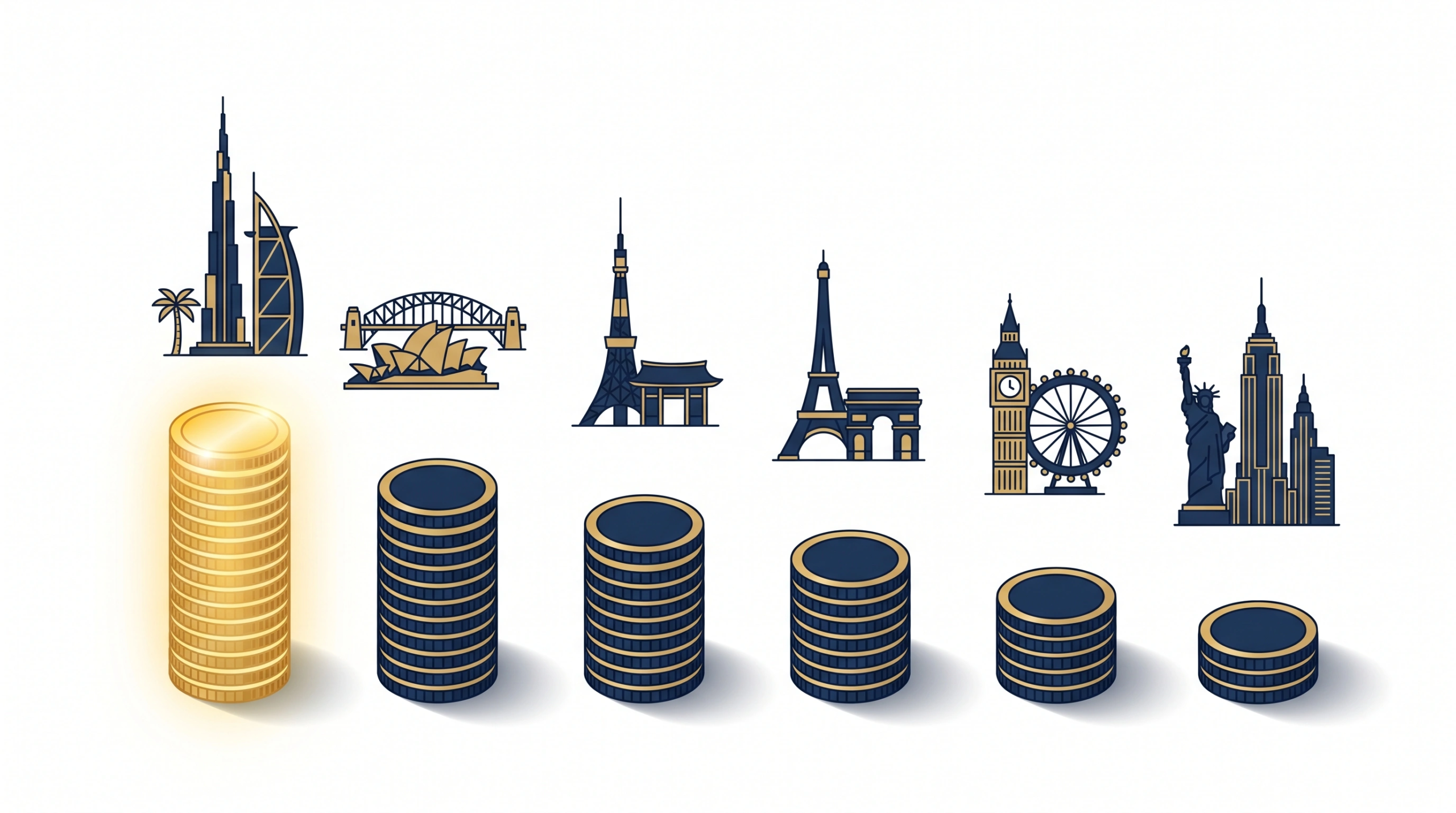
The six cities, up close
1. Dubai, UAE: the one to beat
The tax: zero. Nothing on your salary. On $30,000 a month you start with the full amount before you’ve paid for a single thing.
Living costs: a central one-bed runs around AED 7,500 (about $2,050). Groceries are middle of the road, fuel is genuinely cheap at roughly $1.04 a litre, and VAT is a slim 5%.
The catch: you buy your own health insurance and fund your own retirement, because there’s no tax paying for them on your behalf. Summers are brutally hot, and you need a qualifying visa to stay.
What’s left: about $27,200 a month. The highest here by a mile, and the reason Dubai keeps winning this argument in 2026.
2. Sydney, Australia: the best of the taxed world
The tax: between the top brackets and the 2% Medicare levy, the real bite on a high salary lands near 40%, so roughly $12,000 a month is gone before rent.
Living costs: rent is the pleasant surprise. An inner-city one-bed sits around A$3,000 (about $1,950). Groceries are steep and petrol is about $1.15 a litre.
The upside: a lifestyle people genuinely move continents for, plus public healthcare through Medicare. Plenty of high earners decide that’s worth the tax.
What’s left: about $15,100 a month. The strongest result among the taxed cities, even if it’s still $12,000 shy of Dubai.
3. Tokyo, Japan: cheap to live, costly to be taxed
The tax: national and local income taxes plus social premiums take around $13,200 a month from a high earner. One of the heavier loads in this group.
Living costs: the cheapest day-to-day life on the list. A central one-bed (about ¥195,000, or $1,300) and groceries are easy on the wallet, and fuel is moderate at $1.06 a litre.
The upside: safety, transport and service standards that are hard to find anywhere else. Low costs quietly claw back a lot of that tax.
What’s left: about $14,800 a month. Second only to Sydney, and it gets there on cheap rent rather than low tax.
4. Paris, France: you pay, but you get a lot back
The tax: income tax stacked on top of France’s social contributions makes for one of the heaviest effective burdens here, close to $13,800 a month.
Living costs: central rent is the soft spot, around €1,400 (about $1,520). Fuel, on the other hand, is the priciest on the list at roughly $2.24 a litre.
The upside: comprehensive healthcare, real social protection and a quality of life a lot of people rank at the very top in Europe.
What’s left: about $13,930 a month. Mid-table, with a big slice of your tax coming back as public services.
5. London, United Kingdom: brilliant for careers, brutal on the payslip
The tax: income tax and National Insurance together pull close to $12,900 a month out of this salary.
Living costs: among the most expensive here. A central one-bed averages about £2,150 (around $2,750), and petrol stings at roughly $2.03 a litre.
The upside: a global capital for finance and professional work, the NHS, deep hiring markets and connections to everywhere.
What’s left: about $13,550 a month. Huge earning potential, chewed down by high tax and high rent at the same time.
6. New York, USA: top salary, bottom of the take-home table
The tax: federal, New York State and New York City taxes stack up to roughly $11,100. Heavy, though not actually the worst here.
Living costs: housing is the story. A Manhattan one-bed now averages around $5,000 a month, the most expensive on this list, and US-style health insurance piles on top.
The upside: career ceilings, networks and raw earning power that few places can match. The gross offer that lands you here is often the biggest on the table.
What’s left: about $12,600 a month. The lowest of the six once that rent is paid, even with middling tax.
What the take-home number won’t tell you
Money kept is the cleanest way to rank cities, but it isn’t the only thing a smart move should weigh. Three points deserve a seat at the table:
- Your tax buys things. London, Paris, Sydney and Tokyo fund healthcare and pensions out of what they take. In Dubai you keep more, but you cover those yourself, so price in private insurance and your own retirement saving.
- Your passport sets the rules. US citizens are taxed on worldwide income, so an American in Dubai doesn’t fully escape the IRS. Always run your own nationality’s rules before you bank on the headline.
- Life isn’t a spreadsheet. Climate, culture, schools, safety and visa routes differ wildly. The richest city on paper is worthless if you’d hate living there.

So which one is right for you?
There’s no single winner, only the right fit for what you’re optimising for:
- You want to build wealth fast and you can move: Dubai. Nothing else is close on money kept, especially if you’re not a US citizen.
- You want take-home and lifestyle in one package: Sydney. Strong net pay, enviable way of life.
- You want low costs and excellent services: Tokyo. Cheap living quietly cushions a high tax bill.
- You value public services and culture above all: Paris or London. You pay a lot, but you get a lot.
- You’re at the top of your field chasing the highest ceiling: New York. The gross upside can justify the costs if your earnings keep climbing.
Turning the decision into an actual move
If a low-tax city like Dubai has made your shortlist, the path forward is short but worth walking carefully. Check how your home country taxes you once you leave. Model your real take-home for your exact salary and nationality, not a rounded estimate. Confirm the visa or residency route that matches your work. And budget for the things tax used to quietly cover for you, mainly health insurance and retirement. Get those four right and the move can be worth six figures a year, every year.
Frequently asked questions
What is the best city for high earners in 2026?
On take-home pay, it’s Dubai. Its 0% personal income tax lets a $30,000-a-month earner keep around $27,200, far more than anywhere else in this comparison. Sydney and Tokyo are the strongest runners-up once lifestyle and lower living costs are part of the picture.
Which big city has the lowest income tax for high earners?
Of the cities here, Dubai, at 0%. Sydney, Tokyo, Paris, London and New York all land somewhere between roughly 37% and 46% effective tax on a high salary once brackets, levies and social charges are counted.
Is Dubai actually tax-free?
For income, yes. The UAE charges no personal tax on salaries, freelance work, rent or capital gains. Two caveats: US citizens still owe US tax on worldwide income, and a 5% VAT applies to most spending. No income tax, but not literally cost-free.
Does a big New York salary beat a tax-free Dubai one?
On money kept, usually not. New York’s federal, state and city taxes plus the highest rent in this comparison leave a $30,000 earner with about $12,600 a month, roughly $14,600 behind Dubai. Where New York can win is gross earning power and career ceiling.
Do lower-tax cities mean worse public services?
Often, yes. Paris, London, Sydney and Tokyo fund strong public healthcare and pensions through higher taxes. In a low-tax hub like Dubai you keep more but pay privately for those, so a fair comparison should include the cost of doing it yourself.
The verdict
If the goal is keeping more of a high salary, 2026 has a clear answer. Dubai leaves you with almost twice the take-home of New York or London on the same money, purely because it doesn’t tax your income. Sydney and Tokyo are the smartest balanced picks. Paris and London ask you to pay heavily in exchange for genuinely excellent public services. And New York still owns the highest ceiling, even as it leaves the least at month’s end.
Pick the city that fits the life you want. But if the brief is simply to keep more of what you earn, the math points straight at the low-tax hubs. Run your own numbers first, and the gap between a good choice and a costly one could fund a very different future.