A record half-year, hiding in plain sight
A widely shared social post recently framed Dubai’s luxury boom around a single headline: the city sold hundreds of ultra-prime homes worth $10 million or more, out-pacing New York and London combined. The framing is eye-catching, but the underlying story is stronger — and more useful to investors — than a single viral statistic suggests. As of mid-2026, Dubai has not just sustained its luxury momentum; it has posted the strongest first half in its history at the very top of the market, even as the broader residential market cools.
According to Knight Frank, Dubai recorded 296 home sales above US$10 million in the first half of 2026, with a combined value of US$5.1 billion. That is a new record for any six-month period, and it caps a run that saw a full-year total of 500 such sales in 2025 — the figure that put Dubai ahead of New York and London on the world’s ultra-prime league table.
The headline numbers for 2026
Here is the up-to-date picture at the top of Dubai’s market, current to the H1 2026 reporting season:
| Metric | H1 2026 | Context |
|---|---|---|
| Homes sold above $10M | 296 | New record for a half-year |
| Value of $10M+ sales | $5.1 billion | +14% vs H1 2025 |
| $10M+ transactions YoY | +16% | +49% vs H1 2024 |
| Q1 2026 / Q2 2026 split | 165 / 131 | Front-loaded, still strong |
| Homes sold above $25M | 26 (Q2 alone) | Record super-prime quarter |
| Full-year 2025 $10M+ sales | 500 | Ahead of NY + London combined |
| 12-month resale rate | ~4% | vs ~25% in the 2008 boom |
The last row is the one seasoned investors should read twice. Only around 4% of luxury homes were resold within 12 months, against roughly 25% during the speculative 2008 cycle. This is the clearest signal that today’s top-end demand is driven by genuine occupiers and long-term wealth holders — not short-term flippers — which historically makes for a far more durable market.
From 74 sales to 500: a six-year re-rating
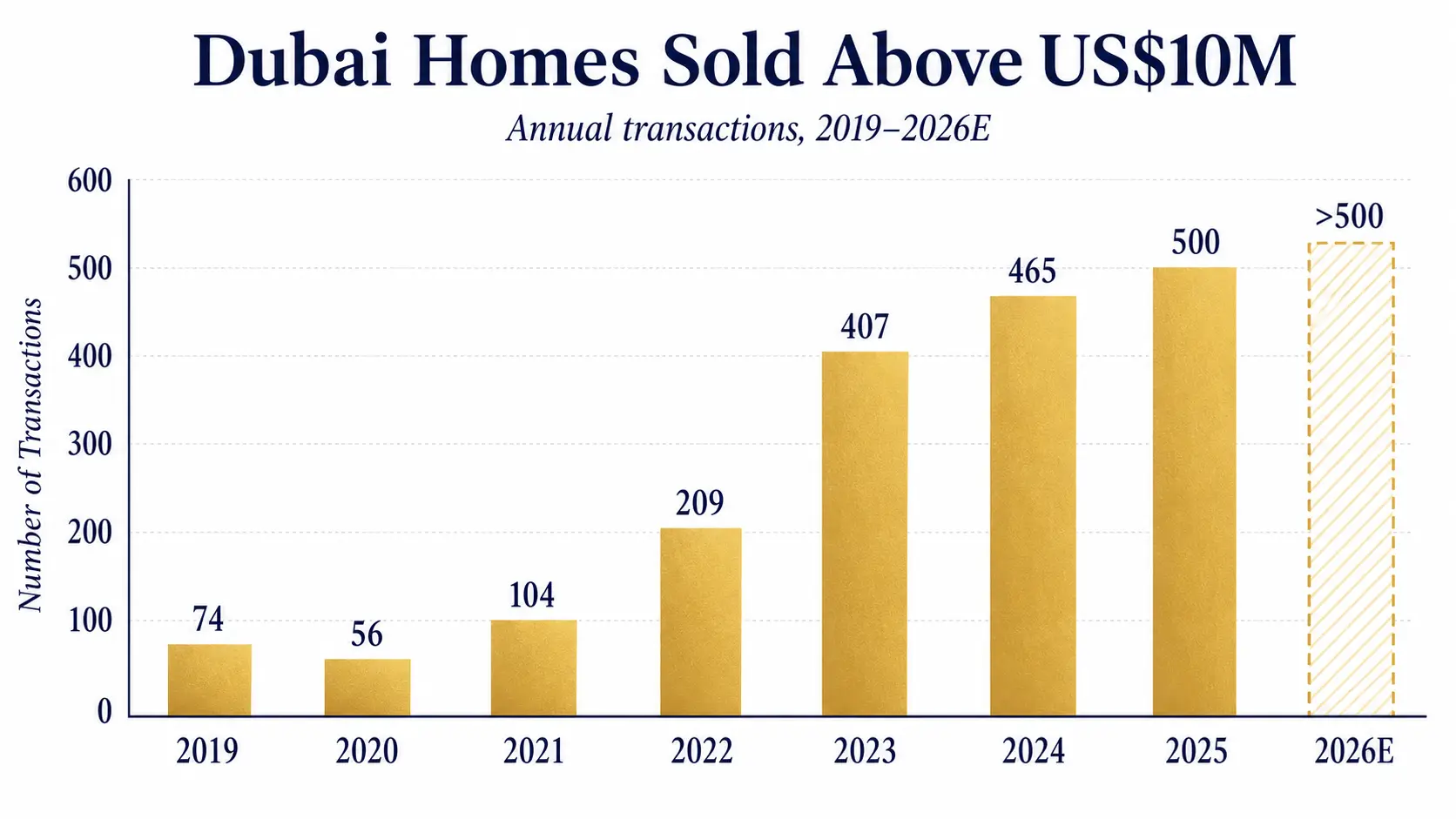
The 2026 numbers are not a spike — they are the top of a steep, multi-year staircase. Sales of homes above the ~AED 36M / $10M threshold climbed roughly eight-fold between 2019 and 2025, and the combined value of those deals expanded even faster.
| Year | $10M+ home sales | Trend |
|---|---|---|
| 2019 | 74 | Pre-boom base |
| 2020 | 56 | Pandemic dip |
| 2021 | 104 | Recovery begins |
| 2022 | 209 | Wealth migration wave |
| 2023 | 407 | Acceleration |
| 2024 | 465 | New normal |
| 2025 | 500 | Global #1 |
| 2026 (H1) | 296 | On pace to break 2025 |
Over the same window, the combined value of ultra-prime sales rose from roughly AED 6.29 billion in 2019 to AED 65.93 billion in 2025 — more than 10x growth in six years. Crucially, the momentum did not break in 2026 despite regional geopolitical tension, which speaks to how structurally embedded this demand has become.
Prices: still rising at the top, but the pace is normalising
Knight Frank’s Wealth Report ranked Dubai second in the world for annual prime price growth at 25.1%, with cumulative prime growth of roughly 194% over five years. That is an extraordinary run by any global standard. The important nuance for 2026 investors is that this pace is now expected to moderate.
Knight Frank projects prime values to grow around 3% in 2026, with mainstream growth closer to 1%. In other words, the market is shifting from explosive appreciation to a more sustainable, income-and-quality-led phase. For a buyer, that is arguably a healthier entry environment than the frenzied 20%+ years — the froth is coming out while the fundamentals stay intact.
It also remains comparatively affordable at the top. Dubai still offers around 62 square metres of prime space per US$1 million — dramatically more than Monaco, Hong Kong, London or New York — which is a core reason global capital keeps rotating in.
Where the money is going in 2026
Ultra-prime demand is concentrating in a small set of genuinely scarce addresses. The leading communities for $10M+ sales in H1 2026 were:
- Dubai Hills Estate — 51 sales above $10M, the top-performing community
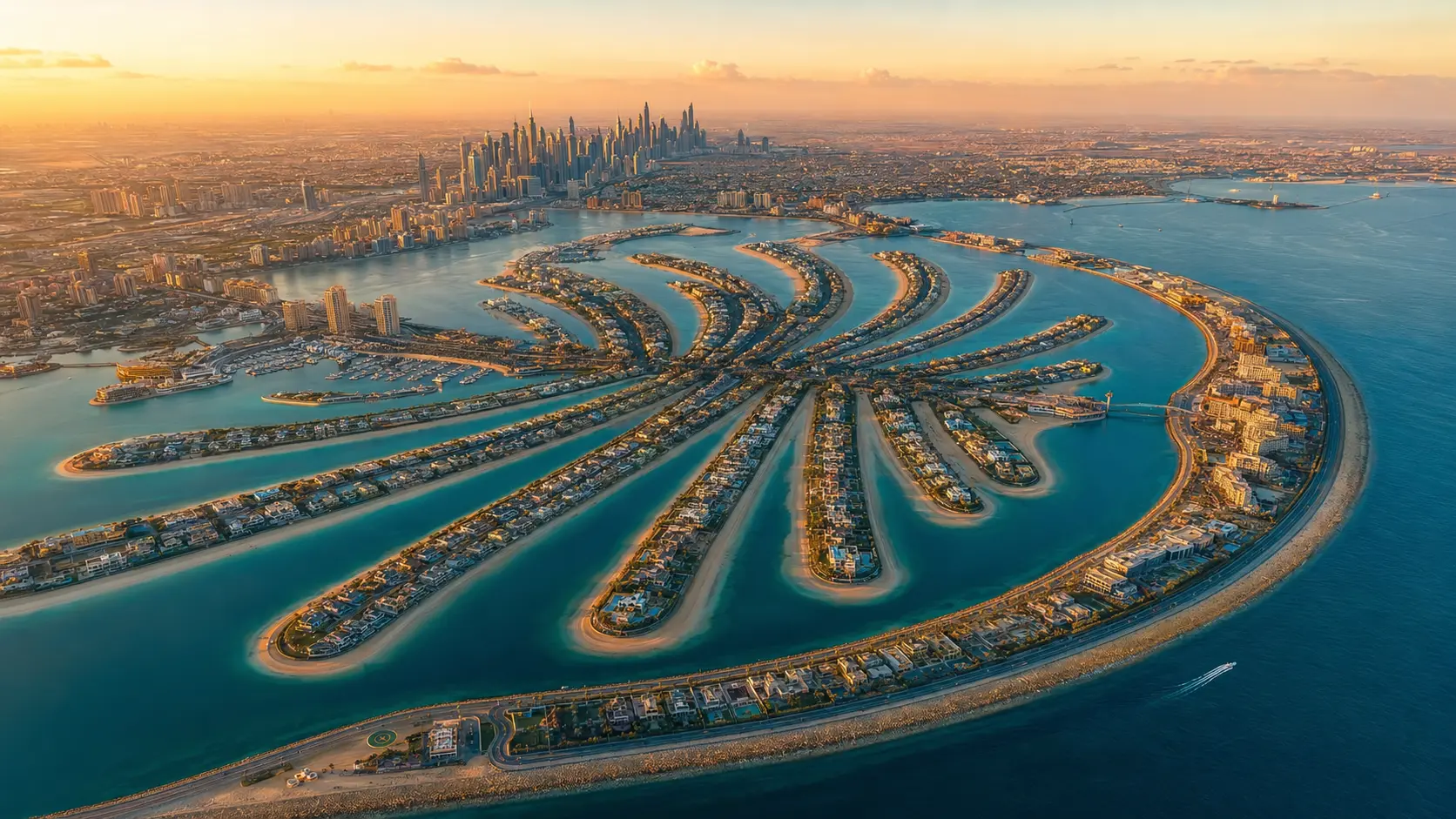
- Palm Jumeirah — 50 sales, the enduring blue-chip waterfront address
- Palm Jebel Ali — 40 sales, remarkable given completions are only expected from 2028 (buyers are securing scarcity early)
Individual trophy transactions illustrate how deep the top of the market now runs:
- A six-bedroom apartment at Aman Residences, Jumeirah Second — $114.9 million (AED 422M), the most expensive home of H1 2026
- A Bugatti Residences penthouse in Business Bay — $149.7 million (late-2025 / early-2026 cycle)
- A six-bedroom villa on Jumeirah Bay Island — $76.3 million
- An 80,000 sq ft plot on Naia Island — $152.5 million
Why global wealth is basing itself in Dubai — not just visiting
The most important shift the data reveals is qualitative. At this level, buyers are no longer paying only for size or finish. They are paying for privacy, scarcity, architecture, branded services and access to exceptional locations — and, increasingly, they are relocating their lives, families and businesses, with the home following the move rather than leading it.
Five structural advantages combine here in a way few rival cities can match:
- Zero personal income tax and no capital gains tax on property
- A 10-year Golden Visa tied to property ownership from AED 2 million
- A US dollar-pegged currency, removing FX risk for dollar-based wealth
- Mature private-banking and wealth infrastructure, now comparable to established hubs
- A proven price track record and world-leading super-prime liquidity
The wealth base is also expanding. Forecasts cited in the Wealth Report point to the UAE’s ultra-high-net-worth population rising from roughly 4,851 toward 6,588 individuals by 2031. More resident UHNWIs means a deeper, more self-sustaining pool of end-user demand for exactly the scarce assets that are outperforming.
The other half of the story: the wider market is cooling
A balanced investment view has to hold two facts at once. The ultra-prime segment is at record highs — but Dubai’s broader residential market is softening from its 2024–2025 peak, and that is healthy.
In H1 2026, Dubai recorded roughly 79,281 residential sales worth about AED 221 billion, down around 13.8% in volume and 15.7% in value versus H1 2025. Total real estate activity across the emirate still reached about AED 420 billion across ~112,850 transactions. The pattern is telling: fewer deals, but capital concentrating into larger, higher-value homes — buyers trading up in quality rather than exiting.
For income investors, yields remain a genuine draw. Dubai apartment yields have held in the 7.0%–7.5% band over the trailing four quarters — among the strongest in any leading global city — while villa yields have compressed as capital values ran ahead of rents. Branded residences continue to command a 25%–35% price premium (per Savills) and have historically held value better through corrections.
What this means for investors
Read together, the 2026 data supports a clear, non-hype thesis:
- The top of the market is broadening and deepening — more buyers, larger tickets, record super-prime activity, and low resale churn. This looks like a maturing market, not a bubble.
- Price growth is normalising, not reversing — a projected ~3% prime year is a more defensible entry point than the 20%+ years, especially for buy-and-hold capital.
- Scarcity is the differentiator — developer quality, location, privacy and genuine rarity still decide which assets hold attention. Luxury pricing alone does not create an ultra-prime asset.
- Income still stacks up — 7%+ apartment yields plus zero income tax is a rare combination among top-tier global cities.
The risks are real and worth naming: a cooling mainstream market, elevated off-plan supply in some segments, sensitivity to regional geopolitics, and the reality that not every “luxury” launch is a true store of value. This is why, at this level, asset selection matters more than market timing.
Frequently asked questions
Is Dubai luxury property a good investment in 2026?
Dubai’s ultra-prime segment posted a record H1 2026, with 296 sales above $10 million worth $5.1 billion, low 12-month resale churn (~4%) and apartment yields of 7.0%–7.5%. Price growth is normalising to around 3% for prime in 2026, which many investors view as a healthier, more sustainable entry point than the 20%+ years. As always, asset selection and a clear holding horizon matter more than headline momentum.
How many homes over $10 million has Dubai sold in 2026?
Dubai recorded 296 home sales above US$10 million in the first half of 2026 (165 in Q1 and 131 in Q2), following a full-year 2025 total of 500 — more than New York and London combined.
What was the most expensive home sold in Dubai in 2026?
The most expensive H1 2026 sale was a six-bedroom apartment at Aman Residences, Jumeirah Second, for about $114.9 million (AED 422 million). A Bugatti Residences penthouse in Business Bay traded around $149.7 million in the late-2025/early-2026 cycle.
Which areas lead Dubai’s ultra-prime market?
In H1 2026 the top communities for $10M+ sales were Dubai Hills Estate (51), Palm Jumeirah (50) and Palm Jebel Ali (40) — a mix of established blue-chip addresses and early positioning in future waterfront scarcity.
Can buying property in Dubai get me a Golden Visa?
Yes. Property ownership from AED 2 million can qualify you for a 10-year renewable Golden Visa. Combined with zero personal income tax and a US dollar-pegged currency, it is a core reason global wealth is relocating to — not just investing in — Dubai. Visa rules can change, so confirm current criteria before you transact.