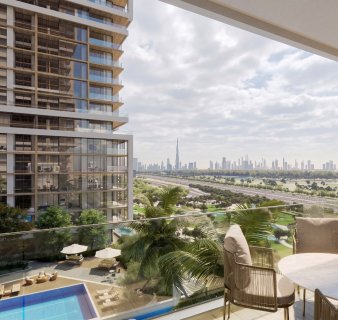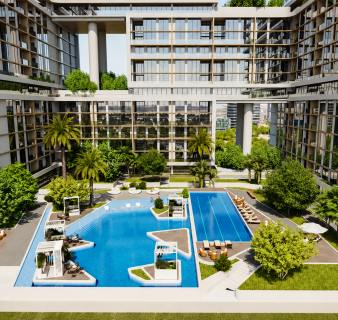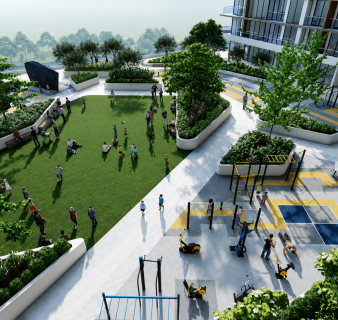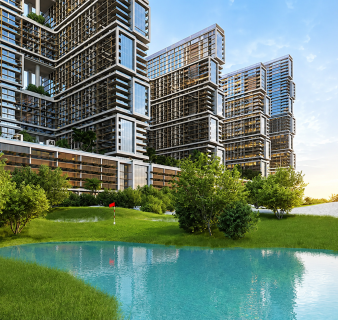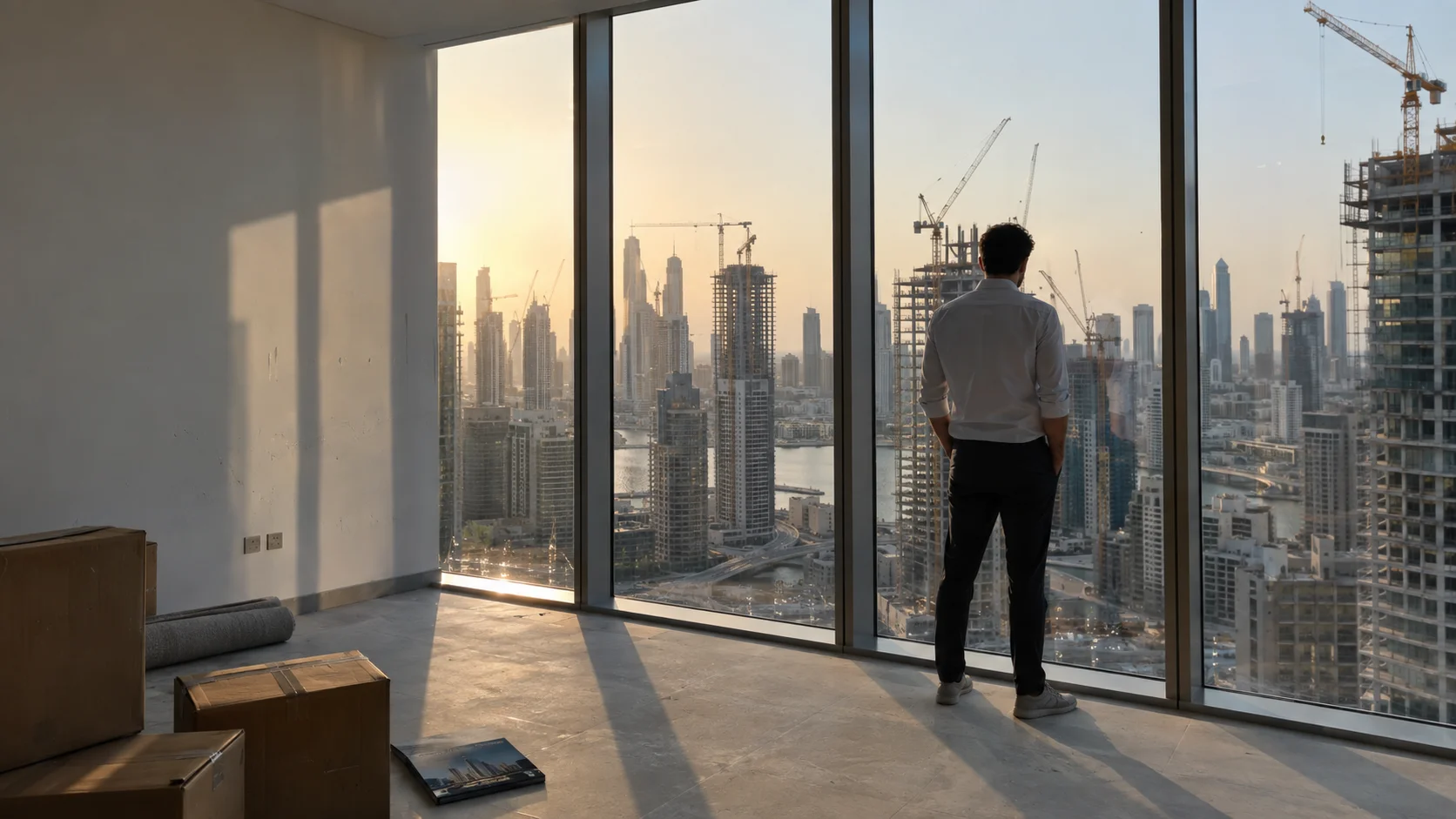
Every off-plan pitch in Dubai assumes a tenant.
Read the brochures and you will find the payment plan, the handover date, the amenities, the projected yield. What you will almost never find is the tenant. Who is this person? What do they earn? What else will they be able to rent on the same street in 2029, when the four towers behind this one also hand over?
That question has moved from niche to mainstream. In the last week it was the most engaged property discussion in Dubai’s online communities, and the framing was blunt: not how many units are coming, but who rents them, what can those tenants afford, and whether future rental income justifies today’s purchase price.
It is a fair question. Here is the arithmetic, with the assumptions on the table so you can change them.
1. The pipeline: what is actually coming
Start with the number that generates the anxiety.
More than 400,000 residential units are under construction or announced for delivery in Dubai between 2026 and 2030, according to Cushman & Wakefield Core. Three features of that pipeline matter far more than its size:
- 86% of it is apartments — against roughly 80% of the existing housing stock. The pipeline is more apartment-weighted than the city it is being built into.
- 66% of it is studios and one-bedroom units. Two thirds of everything coming is small.
- 45% of it sits in five districts: JVC/JVT, Dubai South, MBR City, Business Bay, and Dubailand Residence Complex.
“Approximately 66 per cent of the upcoming supply comprises studio and one-bedroom units, elevating oversupply risk for smaller units in high-delivery districts.” — Prathyusha Gurrapu, Head of Research, Cushman & Wakefield Core
Now apply the discount that every honest supply analysis needs: Dubai’s announced pipeline has never delivered in full or on time. Phasing, contractor capacity, funding and deliberate developer pacing routinely push handovers back by years, and a meaningful share of “announced” never breaks ground at all.
So work from delivery, not announcement:
| Year | Units delivered / expected | Source |
|---|---|---|
| H1 2026 | ~18,000 completed | CBRE |
| 2026 full year | ~55,600 — highest annual volume since 2008 | Cushman & Wakefield Core |
| 2027 | 60,000–75,000 expected | C&W Core / market consensus |
Take a working assumption of ~60,000 units delivered per year. Apply the pipeline’s composition and you get roughly 51,000 apartments a year, of which about 34,000 are studios and one-bedrooms.
That is the number the rest of this article is about. Not 400,000. Around 34,000 small apartments, every year, until 2030, concentrated in five districts.
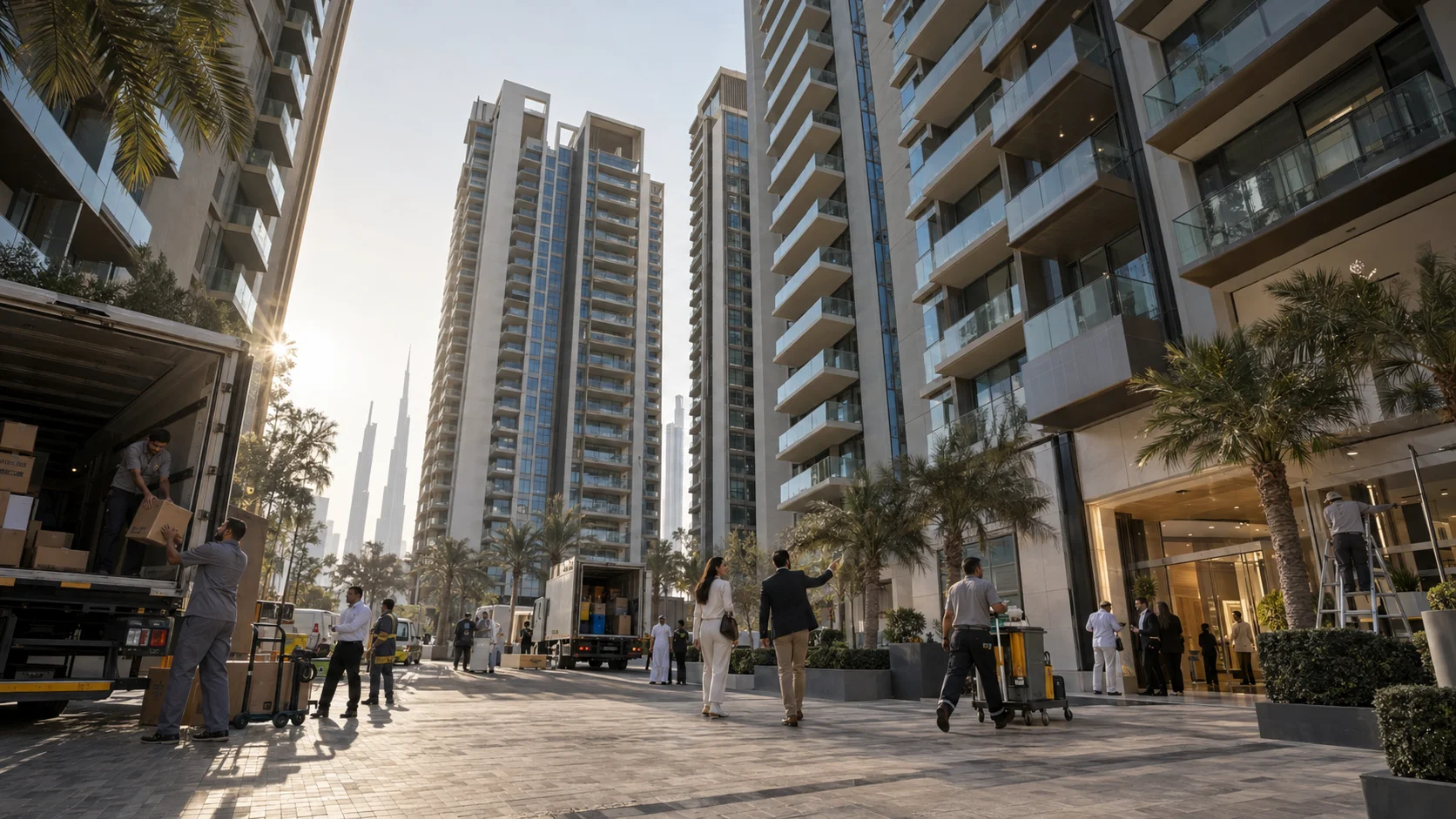
2. One number that cuts the other way
Before the pessimism, the counterweight, because it is substantial and most bearish takes ignore it.
New launches have collapsed. In the first half of 2026, apartment launches fell approximately 58% year-on-year and villa launches fell approximately 78%.
This matters enormously. The units handing over in 2026 and 2027 were sold in 2023 and 2024, at the top of the cycle. What is being launched now determines supply in 2029 and 2030, and developers have already pulled back hard. Emaar’s founder made the logic explicit at the AIM Congress:
“I’m ready for 2027. A lot of supply is coming into the market and as a result people will reach a proper balance. We have had extraordinary profits and margins for years, we can wait a little.” Mohamed Alabbar, Founder, Emaar Properties
Translation: the supply wave is real, it is largely already committed, and it is front-loaded into 2026–2028. The back half of the decade looks materially thinner than the 400,000 figure implies.
So the shape of the problem is a spike, not a plateau. That distinction changes what you should do about it.
3. The tenant, built from the bottom up
Now the part nobody publishes. Who rents a studio or a one-bedroom in Dubai, and how many of them arrive each year?
Step one: what the rent is
Dubai’s average apartment rent was AED 90,940 in April 2026, down 4.6% on the previous quarter. That average is dragged up by Marina, Downtown and Palm. In the five high-supply districts, studios and one-beds realistically sit in the AED 45,000–75,000 band.
Step two: what income that rent requires
Dubai’s working guideline ( used by banks and by most tenants ) is that rent should not exceed roughly 30% of gross income. Run it:
| Annual rent | Implied annual income | Implied monthly income |
|---|---|---|
| AED 45,000 (studio, outer district) | AED 150,000 | ~AED 12,500 |
| AED 55,000 (studio, better district) | AED 183,000 | ~AED 15,300 |
| AED 65,000 (1-bed) | AED 217,000 | ~AED 18,100 |
| AED 75,000 (1-bed, better district) | AED 250,000 | ~AED 20,800 |
| AED 90,940 (city average apartment) | AED 303,000 | ~AED 25,300 |
That is the tenant. Not “Dubai’s population,” not “expats.” A household earning roughly AED 12,500 to AED 21,000 a month, and for the average apartment, more than AED 25,000 a month.
Step three: how many such households Dubai adds
Dubai’s population reached 4.74 million on 30 July 2026, having added over 161,000 residents since the start of the year. Growth in 2025 ran at 7.5%, among the highest rates in the emirate’s history. Annualise 2026’s pace and you get roughly 275,000 new residents a year.
That looks like it comfortably swallows 34,000 small apartments. It does, but only after three deductions that most bullish analysis skips:
- Not every resident is a freehold-market tenant. A large share of Dubai’s population growth is housed in labour accommodation, company-provided staff housing and shared units. Those residents are real, they are counted, and they are not renting a JVC one-bedroom.
- Households, not heads. At roughly 2.2–2.5 people per renting household, 275,000 people is around 110,000–125,000 households — before deduction one.
- The income filter is the binding constraint. Only a portion of those households clear AED 12,500–21,000 a month.
The result
Assume ( and you should test this assumption yourself ) that 40–50% of net household formation lands in the freehold rental market at the required income level. That gives roughly 45,000–60,000 qualifying tenant households a year, against roughly 34,000 small apartments a year.
In aggregate, the math works. Dubai is not building more homes than it adds people to fill. Anyone telling you a crash is arithmetically guaranteed is not doing the arithmetic.
But the aggregate is not what you own. You own one unit, in one district, handing over in one quarter. And the aggregate only reaches your unit if three conditions hold.

4. Where the math actually breaks: the three conditions
Condition one — the income band holds
The pipeline is built for a household earning AED 12,500–21,000 a month. If Dubai’s growth skews below that band, those units compete on price until they reach it. Rents are the adjustment mechanism, and the adjustment has already begun.
Dubai rents fell 6.2% quarter-on-quarter in Q2 2026 and sat 2.6% below a year earlier (CBRE). This is not a forecast. It is the market clearing.
Condition two — the geography matches
Forty-five percent of supply sits in five districts. A tenant priced out of Marina does not automatically move to Dubailand Residence Complex, commute, schools, metro access and community maturity all intervene. Supply in the wrong place is not supply; it is vacancy.
Condition three — handovers stay spread
Absorption assumes a steady flow. Towers do not hand over steadily; they hand over in clusters. When 2,000 units in one district complete inside two quarters, they compete with each other for the same tenants at the same moment, and the first landlords to fill are the ones who cut first.
This is the single most under-modelled risk in Dubai off-plan. Your yield projection assumes a letting market that does not exist on handover day.
5. The evidence it is already happening
The split is visible in the data right now, and it is a clean split by segment, which is exactly what a concentrated supply shock looks like.
| Metric | Apartments | Villas |
|---|---|---|
| Average rent, April 2026 | AED 90,940 | AED 229,000 |
| Rent change, quarter | –4.6% | +3.3% |
| Rent change, year | +4.4% | +9.1% |
| Capital values, Aug 2026 (YoY) | –5.3% | –1.7% |
The August ValuStrat index read 218.8, down 3.1% year-on-year, with villas recording their first annual decline since 2021. That was the headline. But the composition tells the real story: roughly 60% of homes held their value and 73% of freehold villa communities were unchanged over the month.
A market where six in ten homes did not move, yet the average fell 3.1%, is not broadly repricing. It is repricing narrowly and deeply, and apartments are absorbing almost all of it.
The villa-to-apartment rent ratio has widened from 2.41x to 2.52x in twelve months. The two segments have stopped moving together, because they are no longer exposed to the same supply.
6. The trap in the yield table
Here is the finding most investors miss, and it follows directly from everything above.
| Community | Gross yield | Net yield after costs | On the five-district supply list? |
|---|---|---|---|
| JVC | 7–9% | 5.5–6.5% | Yes |
| Dubai South | 7–9% | ~5–6% | Yes |
| Business Bay | 7–9% | 3.8–5.3% | Yes |
| Dubai Marina | 6–6.8% | 5.5–6.5% | No |
| Downtown Dubai | 4–6% | 3.2–4.8% | No |
| Palm Jumeirah | 4–5.5% | 3–4.3% | No |
Indicative 2026 ranges. Verify per building, service charges vary from roughly AED 12/sq ft in mid-market stock to AED 35/sq ft in premium developments, and that single line can move net yield by more than a full percentage point.
Three things fall out of this table:
The highest gross yields sit in the highest-supply districts. That is not a coincidence or an opportunity the market has overlooked. It is the market pricing supply risk. You are being paid a yield premium to hold the units with the most competition arriving.
Business Bay shows what service charges do. A 7–9% gross yield becoming 3.8–5.3% net is not a rounding error, it is roughly half the return, consumed before a single vacant month. Any yield quoted to you without the service charge deducted is not a yield.
Net yield is calculated on today’s rent. With apartment rents down 4.6% in a quarter and the heaviest handovers still ahead, the honest exercise is to rerun every one of those numbers on a rent 10% lower and see whether the investment still works. If it only works at today’s rent, it is a bet on supply pausing.
7. What about smaller units and townhouses?
Two follow-up questions come up constantly. Both have clear answers.
“Are the units getting smaller?”
Yes, and it is a structural pattern rather than a recent one. Across 28,000 apartment transactions between 2015 and 2019, average sizes fell sharply while price per square foot rose:
| Unit type | 2015 | 2019 | Change |
|---|---|---|---|
| Studio | 480 sq ft | 406 sq ft | –15% |
| One-bedroom | 845 sq ft | 670 sq ft | –21% |
| Two-bedroom | 1,300 sq ft | 980 sq ft | –25% |
Check current launch sizes project by project, this is the established trend, not a 2026 measurement.
Why it matters for rent: a smaller unit at the same rent is a rent increase that never appears in any index. It works while tenants have no choice. In 2026, with rents falling 6.2% in a quarter, tenants have choice, and the compact unit is the first to be compared against something larger for the same money down the road.
“Does the pressure reach townhouses and villas?”
Not on current evidence, and the reason is supply, not sentiment. The pipeline is 86% apartments. Villa launches fell roughly 78% year-on-year in H1 2026. Villa rents rose 3.3% in the quarter that apartment rents fell 4.6%.
Villas and townhouses remain structurally undersupplied relative to demand. The risk in that segment is pricing and interest rates, not a wall of competing stock. That is precisely why villas fell only 1.7% while apartments fell 5.3%.
8. Five questions to ask before you buy off-plan
Take these to any unit, any developer, any agent. If the answers are vague, that is your answer.
1. How many units hand over within two kilometres of this one, in the same twelve months? Not “in the community.” Within walking distance, in the same window. These are your actual competitors for the same tenant on the same day. Any agent who cannot answer this has not done the work.
2. Who is the tenant, and what do they earn? Name the household. State the income. Check it against the table in Section 3. If the required income exceeds what that district’s tenant pool realistically earns, the rent assumption is wrong.
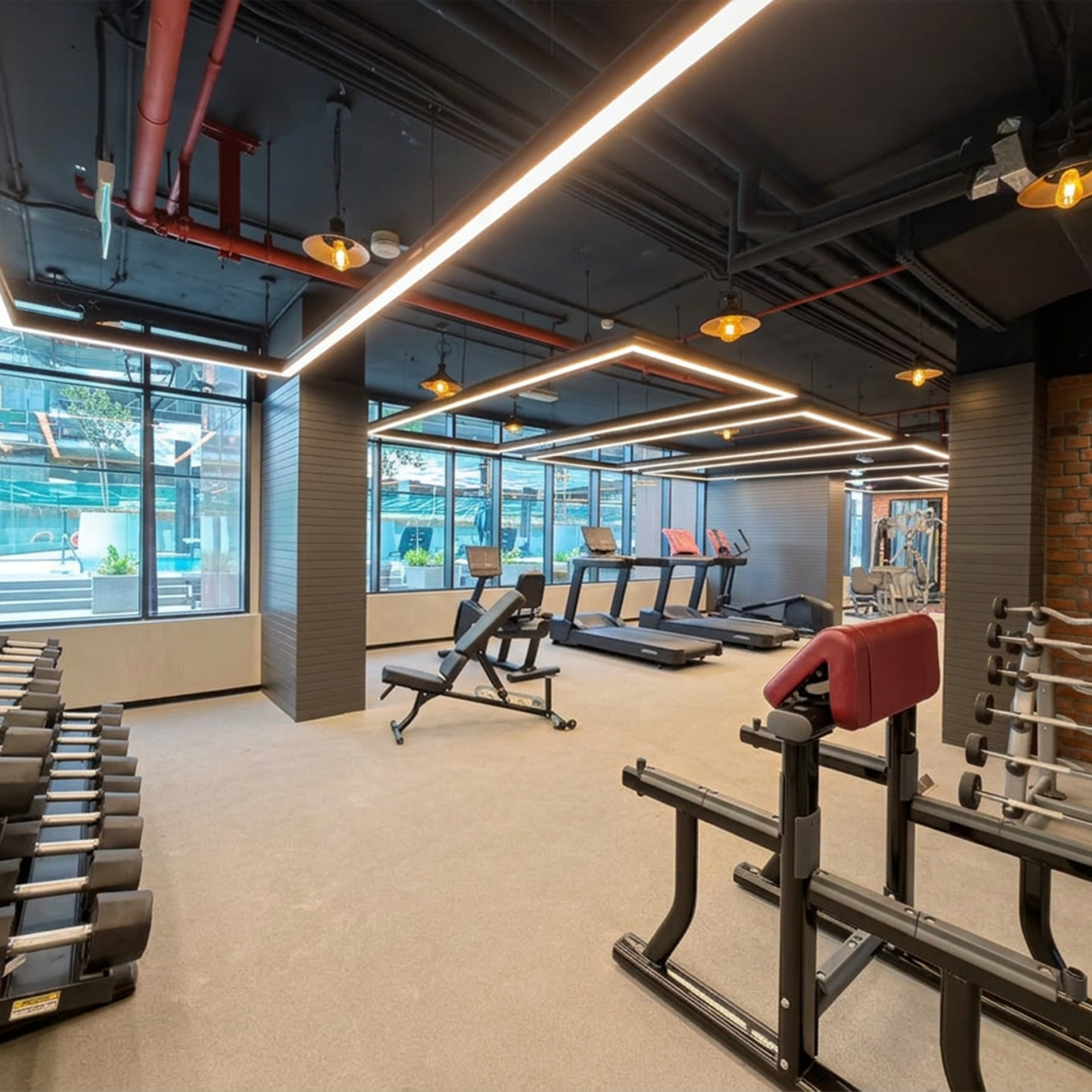
3. What does the same rent buy in the nearest established community today? Your unit is not only competing with new supply. It competes with a five-year-old building down the road, larger, with mature facilities, a working gym and a landlord who has already recovered their costs.
4. What is the service charge per square foot — and what is the five-year escalation history? Ask for the Mollak-registered figure, not an estimate. Then recalculate your yield. Then ask what happens when the reserve fund needs topping up.
5. If I need to exit before handover, who buys it and at what discount? Assignment rules, developer consent, transfer fees, and the resale depth for that unit type in that community. In a market where August saw 8,016 off-plan registrations against 3,038 ready-home sales, you are one of many potential sellers. Know that before you are one.

The bottom line
Dubai is not oversupplied in aggregate. Population growth of roughly 275,000 a year against roughly 34,000 small apartments a year is, on any reasonable set of assumptions, absorbable. The crash argument does not survive contact with the household-formation numbers.
But you do not own the aggregate. Sixty-six percent of the pipeline is studios and one-beds, 45% of it is in five districts, and the heaviest handovers fall in 2026–2028. Concentration is the risk, not volume — and the pressure is already showing exactly where the model says it should: apartments down 5.3% in value and 4.6% in quarterly rent, while villas held at –1.7% and +3.3%.
Which leaves a straightforward test. Underwrite rent, not appreciation. Deduct the service charge before you call anything a yield. Count the towers handing over beside yours in the same quarter. And check whether the investment still works at a rent 10% below today’s.
The units that pass that test will let easily and hold their value through the spike. The units that only work on a rising rent and an empty street were never an investment, they were a bet that the pipeline would stop.
It has not stopped. But it has slowed ( launches are down 58% on last year ) which means the far side of this wave looks considerably better than the near side. The question is whether the unit you are being offered today is on the right side of it.
How we can help
Before you commit to an off-plan unit, we will run the supply check for you: how many units hand over within two kilometres in the same window, what the realistic tenant income is, the Mollak service charge, the net yield after costs, and the resale depth in that community.
Speak to our Dubai-based team about a specific unit, community or portfolio. We reply during working hours (GST).
Send us the floor plan or listing link and we will come back with the supply picture on it. No obligation, no listing pitch.
FAQ
How many apartments are being built in Dubai between 2026 and 2030?
More than 400,000 residential units are under construction or announced for delivery in Dubai between 2026 and 2030, of which roughly 86% are apartments. Actual delivery is expected to run well below that figure, around 55,600 units completed in 2026 and 60,000–75,000 expected in 2027, because Dubai’s announced pipeline consistently delivers late or is re-phased.
Is Dubai oversupplied with apartments in 2026?
Not in aggregate. Dubai added over 161,000 residents in the first seven months of 2026 and its population reached 4.74 million, which is enough household formation to absorb the roughly 34,000 small apartments delivering each year. The risk is concentration rather than volume: 66% of the pipeline is studios and one-bedrooms and 45% of it sits in just five districts, JVC/JVT, Dubai South, MBR City, Business Bay and Dubailand Residence Complex.
Will Dubai apartment rents fall in 2027?
Rents are already falling. Dubai rents dropped 6.2% quarter-on-quarter in Q2 2026 and sat 2.6% below the previous year, with average apartment rents at AED 90,940 in April 2026, down 4.6% on the quarter. With the heaviest handovers scheduled for 2026–2028, further softening in apartment rents is likely, concentrated in high-supply districts and in studio and one-bedroom stock. Villa rents are moving in the opposite direction, up 3.3% over the same quarter.
What salary do you need to rent a one-bedroom apartment in Dubai?
Using the standard guideline that rent should not exceed about 30% of gross income, a one-bedroom at AED 65,000 a year requires a household income of roughly AED 18,100 a month, and one at AED 75,000 requires roughly AED 20,800 a month. A studio at AED 45,000–55,000 requires roughly AED 12,500–15,300 a month. The city-wide average apartment rent of AED 90,940 implies about AED 25,300 a month.
What is a realistic net rental yield in Dubai in 2026?
Net yields typically run 1.5–2 percentage points below gross. Indicative 2026 net yields are roughly 5.5–6.5% in JVC and Dubai Marina, 3.8–5.3% in Business Bay, 3.2–4.8% in Downtown Dubai and 3–4.3% on Palm Jumeirah. Service charges are the largest single variable, ranging from around AED 12 per square foot in mid-market buildings to AED 35 in premium developments.