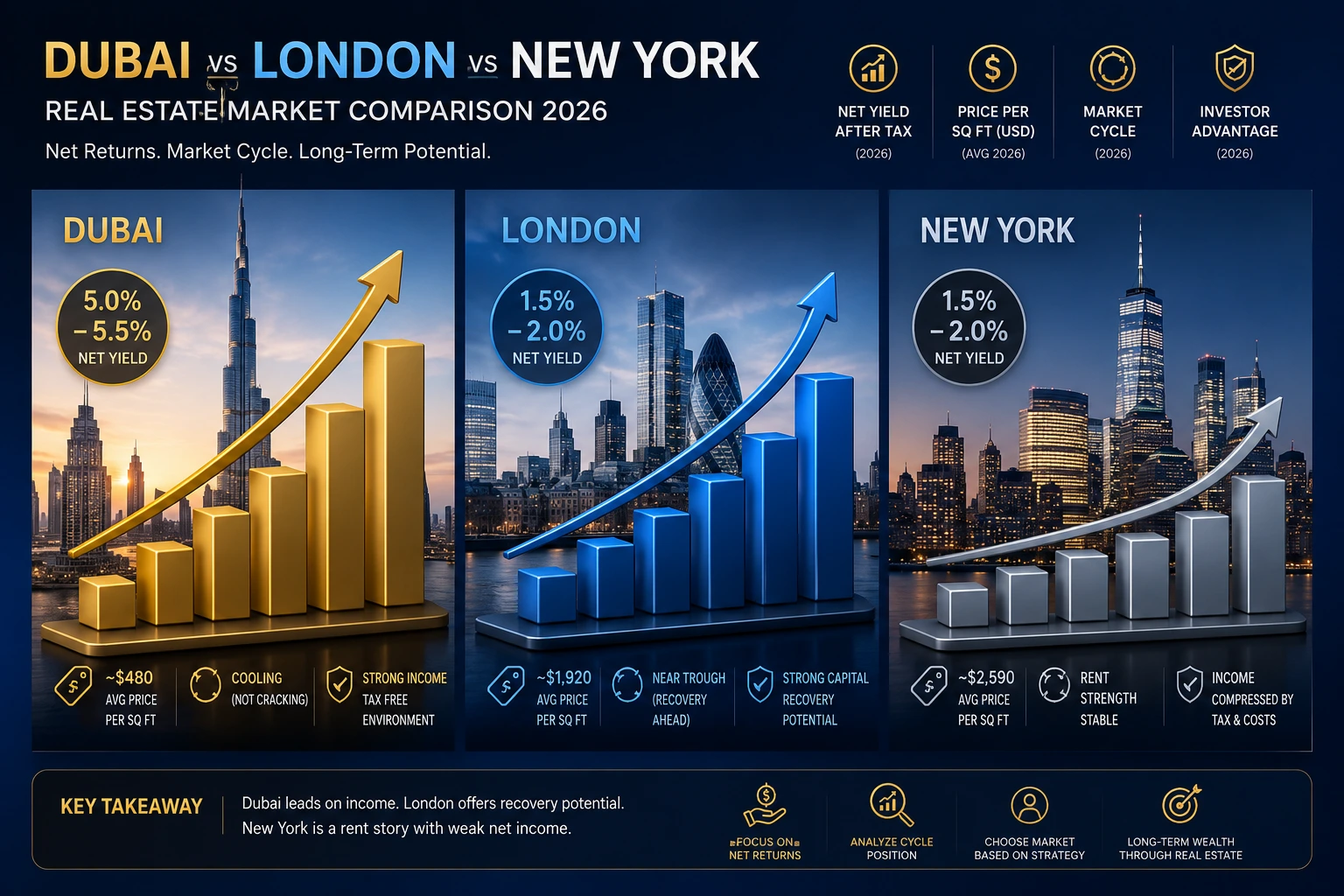
If you are weighing Dubai property investment vs London and New York in 2026, the honest answer isn’t found in a gross-yield chart. Every market advertises its best-case number. What matters to an investor is what actually lands in your account after income tax, service charges, agency fees and void periods — and where each market sits in its price cycle right now. This analysis rebuilds the comparison on that basis, using H1 2026 data.
1. The net-return waterfall: gross yield is not what you keep
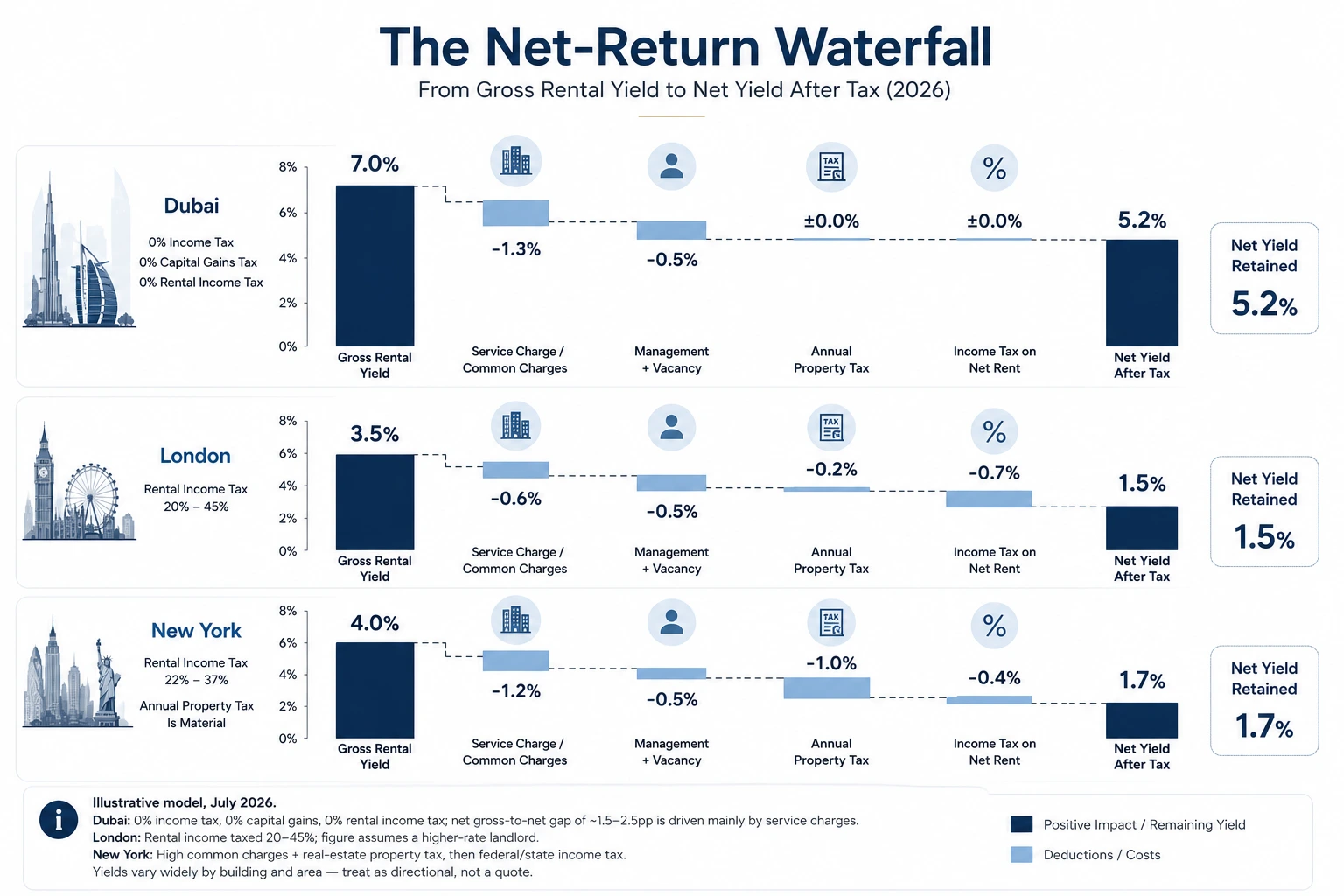
Start with the number everyone quotes, then subtract reality. Dubai apartments average a gross yield around 7.0–7.2% (6.68% citywide, 7.15% for apartments as of April 2026). London sits at roughly 2.4–4.0% and New York around 3–4%. But the deductions differ dramatically by city — most importantly, income tax and, in New York’s case, an annual property tax that Dubai simply does not levy.
| Illustrative waterfall | Dubai | London | New York |
|---|---|---|---|
| Gross rental yield | 7.0% | 3.5% | 4.0% |
| Less: service charge / common charges | -1.3% | -0.6% | -1.2% |
| Less: annual property tax | 0.0% | -0.2% | -1.0% |
| Less: management + vacancy | -0.5% | -0.5% | -0.5% |
| = Net operating yield | 5.2% | 2.2% | 1.3% |
| Less: income tax on net rent | 0.0% | -0.7% | +0.4% adj* |
| ≈ Net yield after tax | 5.2% | 1.5% | 1.7% |
Illustrative model, July 2026. Dubai: 0% income tax, 0% capital gains, 0% rental-income tax; net gross-to-net gap of ~1.5–2.5pp is driven mainly by service charges. London: rental income taxed 20–45%; figure assumes a higher-rate landlord. New York: high common charges + real-estate property tax, then federal/state income tax (*NY line reflects that much of the tax burden is already captured in property tax and common charges; net shown is indicative). Yields vary widely by building and area — treat as directional, not a quote.
The takeaway is structural, not cosmetic: Dubai’s advantage widens from gross to net. A ~7% gross that stays close to ~5% net compares with London and New York, where a 3.5–4% gross is nearly halved by charges and tax. On a leveraged basis, with New York investment mortgage rates near 6.1%, the traditional Manhattan condo currently produces negative cash flow after debt service — the return depends entirely on price appreciation, which has been broadly flat.
2. Entry price: what the same budget buys
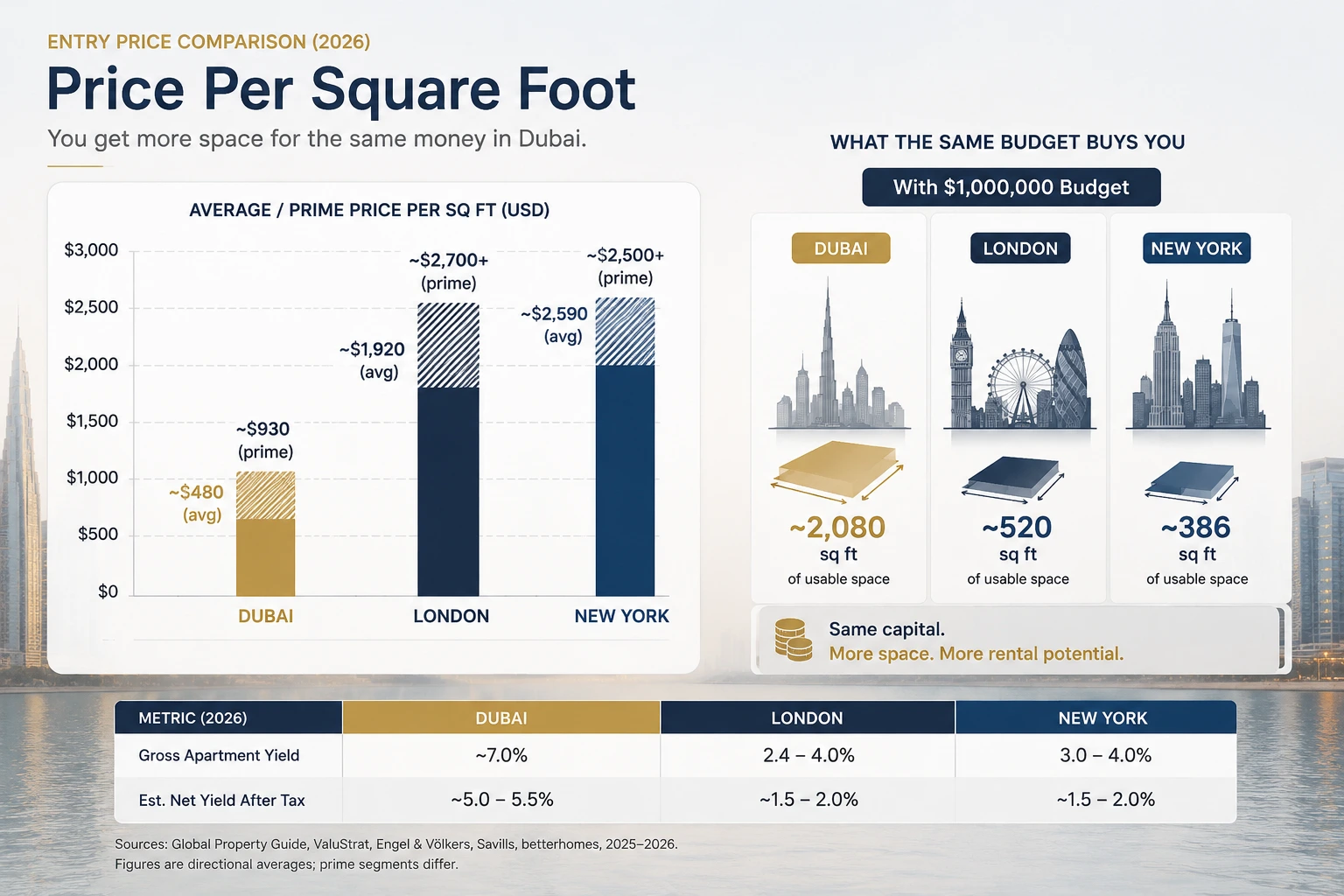
Net yield only tells half the story; the denominator — what you pay per square foot — is the other half. Dubai’s citywide average reached AED 1,770 per sq ft in H1 2026 (about USD 480), up 6.7% year on year from AED 1,600 in 2025. Prime Manhattan trades around USD 2,500+ and prime central London around USD 1,900–2,700+. The same capital simply buys more rentable area in Dubai.
| Metric (2026) | Dubai | London | New York |
|---|---|---|---|
| Avg / prime price per sq ft (USD) | ~$480 / $930 | ~$1,920 | ~$2,590 |
| Gross apartment yield | ~7.0% | 2.4–4.0% | 3.0–4.0% |
| Est. net yield after tax | ~5.0–5.5% | ~1.5–2.0% | ~1.5–2.0% |
| Annual property tax | None | Council tax (occupier) | Yes — material |
| Tax on rental income | 0% | 20–45% | 22–37% |
| Capital gains tax | 0% | Yes | Yes |
| Residency via purchase | 10-yr Golden Visa @ AED 2M | No | No |
Sources: Global Property Guide, ValuStrat, Engel & Völkers, Savills, betterhomes, 2025–2026. Figures are directional averages; prime segments differ.
3. Where each market sits in its cycle (H1 2026)
Dubai — cooling from a peak, not reversing
After three exceptional years, Dubai is normalising. Prices are still rising — average price per sq ft up ~6.7% YoY — but the pace and breadth have narrowed. H1 2026 recorded 79,281 residential sales worth AED 221.4bn, down ~14% in volume and ~16% in value versus H1 2025. Rental growth cooled sharply, from 6.2% in December 2025 to about 1.5% by April 2026. Forecasts for full-year 2026 range from Anarock’s conservative +4–7% to ValuStrat’s +10%. Read: the easy, everything-rises phase is over; selection by best areas for net yield, developer and building now drives returns.
London — near the trough, positioned for recovery
Prime central London has spent years resetting. Knight Frank’s Q2 2026 view still allows for a small dip (around -2%) this year, but Savills projects roughly +15–20% over five years as rate cuts, restored supply and returning confidence feed through. The yield is low and tax is heavy — but for an investor prioritising capital recovery over income, London is closer to a cycle bottom than a top.
New York — record rents, stalled prices, expensive debt
Manhattan’s rental market is red-hot: median rent hit a record near $5,295 in mid-2026, up ~8% year on year, with listings down 16%. But prices have been broadly flat and investment mortgage rates sit around 6.1%, so leveraged buyers face weak or negative cash flow. It is a landlord’s rental market that is a difficult buyer’s investment market — strong tenant demand, poor net entry economics.
4. The true cost of buying in Dubai (so the net number holds up)
An analytical piece has to account for transaction costs, because they dilute year-one returns. In Dubai, budget for total upfront costs of roughly 7–10% of price:
- DLD transfer fee: 4% of purchase price (the largest single cost).
- Agency commission: 2% + 5% VAT on secondary purchases.
- Registration & trustee fees: ~AED 4,200 plus fixed admin charges; mortgage registration 0.25% of the loan if financing.
- Ongoing service charges: ~AED 10–30 per sq ft/year for apartments (higher in Downtown/branded towers) — the main gap between gross and net yield.
Worked example: a AED 1,000,000 one-bed with AED 70,000 of transaction costs = AED 1,070,000 all-in. Annual rent of AED 70,000 minus ~AED 18,000 of running costs = AED 52,000 net, i.e. roughly 4.9% net yield in year one — rising as one-off purchase costs fall away and rent reviews apply. Crucially, none of that AED 52,000 is lost to income tax. If you are debating which route offers the best entry economics for your capital, read our data-led breakdown of off-plan vs ready buying behaviors in the current market.
5. Bottom line: matching the market to the mandate
Three markets, three distinct roles in a portfolio:
- Income and tax efficiency → Dubai. Best net yield of the three, zero tax on rent and gains, plus residency at AED 2M. Trade-off: a maturing cycle that now rewards careful selection over broad exposure.
- Contrarian capital growth → London. Low income and high tax, but arguably the best five-year recovery setup from a cycle low. A patient, appreciation-led bet.
- Rental demand, if you can absorb the entry cost → New York. Record rents and deep liquidity, but expensive debt and property tax make near-term net returns hard to justify for a yield-focused buyer.
For an investor whose objective is durable, tax-free income at a sensible entry price, the 2026 data continues to point to Dubai — provided the purchase is selective. Past performance and forecasts are not guarantees, and Dubai’s large supply pipeline is a genuine risk to monitor. But on net return, the gap is real.
Frequently asked questions
What is the real net rental yield on Dubai property in 2026?
Gross apartment yields average around 7% (6.68% citywide, 7.15% for apartments as of April 2026). After service charges, management and vacancy — typically 1.5–2.5 percentage points — realistic net yields land around 5.0–5.5%, with no income tax deducted. Financing costs reduce cash-on-cash further if you use a mortgage.
Is now a good time to buy property in Dubai?
The market is cooling from its 2023–2025 peak: prices are still rising modestly (about +6.7% per sq ft year on year in H1 2026) but volumes fell ~14% and rental growth slowed to ~1.5%. That favours selective buyers — strong areas, credible developers and well-run buildings — over broad, speculative exposure. It is a normalising market, not a falling one.
How does Dubai’s tax compare to London and New York for landlords?
Dubai charges 0% on rental income, 0% capital gains tax and no annual property tax — only a one-time 4% DLD transfer fee at purchase. London taxes rental income at 20–45% plus capital gains; New York adds a material annual property tax plus 22–37% income tax. This is the single biggest reason Dubai’s net returns pull ahead of its gross-yield lead.
Does buying property in Dubai give residency?
Yes. A residential investment of AED 2,000,000 (about USD 545,000) qualifies for the UAE’s 10-year Golden Visa. As of 2025 the previous down-payment minimum was removed, and off-plan and mortgaged properties can qualify if the Land Department valuation meets the threshold. The visa covers spouse, children and domestic staff.
Which city has the best five-year capital-growth outlook?
On current forecasts, London prime has the strongest medium-term recovery case (Savills: ~+15–20% over five years) because it is near a cycle low. Dubai is expected to keep growing but at a slower, more selective pace (+4–10% for 2026). New York prices are broadly flat with high financing costs. Growth potential and income potential point to different cities — which is why your objective should decide the market.